


Stargazing in Kazakhstan this winter starts with two meteor showers: the Leonids before dawn on 18 November 2026 and the Geminids on the evening of 14 December. The Geminids are the one to plan for, with a ZHR of 150 and almost no moonlight. All times on this page are Kazakhstan time, UTC+5, which the whole country has used since midnight on 1 March 2024. If an app or older table shows Almaty as UTC+6, subtract an hour.
The next two showers: Leonids on 17–18 November, Geminids on 14 December 2026
For the Leonids, go out on the night of 17–18 November and watch after midnight. The International Meteor Organization (IMO) gives two peak forecasts: 04:45 on 18 November Kazakhstan time, and an alternative model at 21:00 on 17 November. The radiant is highest at about 02:00 local time, so the early evening is weak either way. Expect a quiet shower, ZHR about 15, with the Moon out of the way.
The Geminids peak around 19:00 on 14 December. Past peaks have landed anywhere between 02:00 and 23:00 on that day, but the shower is broad: rates above 100 per hour last some 10–12 hours, with more bright meteors towards the end. In Almaty full darkness begins around 18:00 in mid-December and the Moon is a thin crescent, so the peak falls on a dark evening.
Meteor shower calendar for Kazakhstan, November 2026 to December 2027
The table uses the IMO calendars for 2026 and 2027. Kazakhstan time is UT plus five hours. The last column is our reading of the times: when a peak falls in daylight, you watch on the nights either side of it.
| Shower | Peak, UT | Kazakhstan time (UTC+5) | ZHR | Moon | Best time to watch in Kazakhstan |
|---|---|---|---|---|---|
| Leonids 2026 | 17 Nov, 23:45 (alt. 16:00) | 18 Nov, 04:45 (alt. 17 Nov, 21:00) | ~15 | no problem | night of 17–18 Nov, after midnight |
| Geminids 2026 | 14 Dec, 14:00 | 14 Dec, 19:00 | 150 | thin waxing crescent | evening of 14 Dec; backup night 13–14 |
| Ursids 2026 | 22 Dec, 22:00 | 23 Dec, 03:00 | 10 | 96% lit | night of 22–23 Dec, heavy moonlight |
| Quadrantids 2027 | 4 Jan, 03:25 | 4 Jan, 08:25 | 80 (60–200) | waning crescent | before dawn on 4 Jan |
| Lyrids 2027 | 23 Apr, 01:40 | 23 Apr, 06:40 | 18 (up to 90) | 3 days after full | before dawn on 23 Apr; poor |
| Eta Aquariids 2027 | 6 May, 09:00 | 6 May, 14:00 | 50 (40–80+) | new Moon | nights of 5–6 and 6–7 May |
| Daytime Arietids 2027 | 8 Jun, time not given | 8 Jun | 30 | irrelevant | not visible to the eye; radio only |
| Perseids 2027 | 13 Aug, 08:00–10:00 | 13 Aug, 13:00–15:00 | 110+ | waxing, full on 17 Aug | nights of 12–13 and 13–14 Aug after 22:00–23:00 |
| Draconids 2027 | 9 Oct, 07:00 | 9 Oct, 12:00 | 5 | just past first quarter | nights of 8–9 and 9–10 Oct; weak |
| Orionids 2027 | 22 Oct, time not given | 22 Oct | 20 | last quarter | nights of 21–22 and 22–23 Oct |
| Leonids 2027 | 18 Nov, 06:00; possible extra 17 Nov, 22:00 | 18 Nov, 11:00; extra 18 Nov, 03:00 | ~15; extra up to 40–50 | waning | night of 17–18 Nov, around 03:00 |
| Geminids 2027 | 14 Dec, about 20:00 | 15 Dec, about 01:00 | 150 | full Moon | night of 14–15 Dec; heavy moonlight |
| Ursids 2027 | 23 Dec, 04:00 | 23 Dec, 09:00 | 10 (up to 50) | past last quarter | before dawn on 23 Dec |
In short, the year has three strong showers without bright moonlight: the Geminids in 2026, then the Quadrantids and Eta Aquariids in 2027. Five of the 2027 peaks fall in daylight or at dawn in Kazakhstan, which is why the last column matters more than the peak time.
Perseids 2027: the peak comes in daylight
In 2027 the Perseid peak is due at 13:00–15:00 on 13 August Kazakhstan time, so the show for Kazakhstan is on the nights of 12–13 and 13–14 August. IMO notes that at mid-northern latitudes the radiant is high enough from 22:00–23:00 local time. A possible encounter with a dust filament from comet 109P (ZHR around 50) is forecast for 12:00 on 13 August, also in daylight.
The Moon will be waxing between first quarter on 9 August and full on 17 August, a worse setup than 2026, when the peak came at new Moon. Summer nights are short too: on 15 August 2026 full darkness in Almaty lasted from 20:45 to 03:08, about 6 hours 20 minutes. If you are planning a mountain trip for mid-August, our August guide lists places that pair well with a night under the Perseids.
Two more facts worth knowing. The Leonids are the fastest major shower at about 71 km/s, and their parent comet 55P/Tempel-Tuttle returns to perihelion on 20 May 2031. The strongest “daytime meteor shower” is the Daytime Arietids, peaking on 7–8 June with a ZHR of 30: the radiant is in the daytime sky, so they are recorded by radio, not by eye.
Where to go stargazing near Almaty
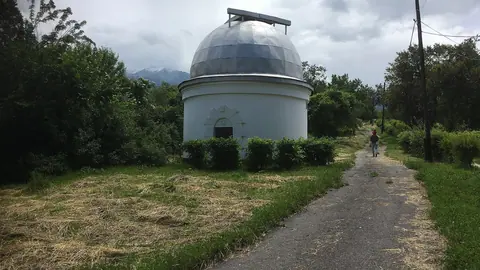
Only one of the Fesenkov Astrophysical Institute’s three observatories near Almaty is open to the public, and it has the brightest sky. The two mountain sites have the dark skies but no public tours that we could find.
| Observatory | Altitude | Location | Sky, per the institute | Public access |
|---|---|---|---|---|
| Kamenskoe Plateau | 1,450 m | inside Almaty | city glow was a problem already in the 1970s | talks and telescope viewing with tickets |
| Tien Shan (TShAO) | 2,735 m | 30 km south of Almaty, near Big Almaty Lake | up to 100 photometric nights a year, “negligible” light pollution | no tours found |
| Assy-Turgen | 2,750 m | 85 km east of Almaty | “ideal astroclimate”, no light pollution | no tours found |
What this means in practice: for a telescope, stay in town; for a dark sky, go up into the mountains and watch with your own eyes near, but not inside, an observatory.
Kamenskoe Plateau is the easy one without a car. The institute runs public talks and viewing with its historic telescopes, a guided tour of the night sky and a fragment of the Sikhote-Alin meteorite. Tickets are sold on the institute’s website for a group of up to five, with a charge for each extra guest; check current prices there. Our Kamenskoe Plateau page explains the city bus route.
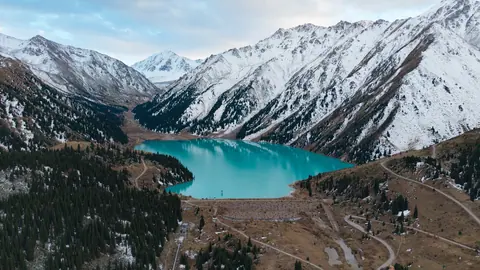
The Tien Shan Observatory stands above Big Almaty Lake. The road to the lake has been closed to private cars since 2020, and the walk up takes 4–6 hours, so a night under this sky is a hike, not an evening drive. We found no visiting rules for the observatory itself.
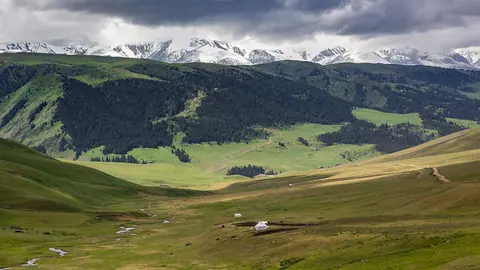
Assy-Turgen is on the Assy Plateau, reached through the Turgen gorge. It houses the AZT-20 with a 1,560 mm main mirror, which the institute calls the largest telescope in Kazakhstan. Sources disagree about the 1 m Zeiss: our plateau page, based on a 2017 Tengrinews report, describes it as working since 1981, while the institute’s site in 2026 says it is under reconstruction. The plateau is part of Ile-Alatau National Park (0.15 MCI per walker, registration at the park office in Turgen), and the dirt road calls for an SUV.
Dark skies in Kazakhstan: what we can and cannot say
There is no published list of dark-sky spots in Kazakhstan, so the honest tool is a map. The 2016 world atlas of artificial night sky brightness by Falchi and colleagues found that more than 80% of the world’s population and more than 99% of people in the US and Europe live under light-polluted skies. The Milky Way is hidden from more than a third of humanity.
The atlas also gives figures for Kazakhstan, but we could not match them reliably to the table’s columns, so we leave them out. Use lightpollutionmap.info instead: it has VIIRS satellite layers for 2012–2025, the atlas itself, sky-brightness readings and a nearest-dark-place tool. Then compare your spot with our map of places and the steppe guide, which covers where you are allowed in.
We found no reliable source on dark skies near Astana, Shymkent or other cities. We also could not confirm any Kazakhstan site on the DarkSky International list.
Checklist for a meteor night
- Take the Kazakhstan time from the table. If the peak is in daylight, pick the night before or after.
- Check the Moon phase for that date.
- Know your dark window: in Almaty, 20:45–03:08 on 15 August and 18:00–05:34 on 15 December.
- Check the cloud forecast the day before and on the day. IMO observers stop counting when cloud covers more than 20% of the sky. For conditions by altitude, see Almaty mountain weather.
- Pack warm layers and a mat: above 2,500 m it is cold even in summer.
- Find an open site with no trees or lights in view. The useful field of view is about 50° in radius and holds about 98% of meteors; face not too far from the radiant.
- Plan for at least an hour of continuous watching, as IMO advises, to catch both busy and quiet spells.
- Stay outside observatory grounds: these are working research sites.
- Camping overnight? Read the rules in our camping guide first.
What we could not confirm
Frequently asked questions
When is the next meteor shower in Kazakhstan?
What time zone should I use for meteor showers in Kazakhstan?
When can I see the Perseids from Kazakhstan in 2027?
Can I visit an observatory in Almaty?
Can tourists visit the Assy-Turgen Observatory?
Where is the darkest sky near Almaty?
Are there DarkSky-certified places in Kazakhstan?
How many meteors will I actually see?
Sources
- 2026 Meteor Shower Calendar — International Meteor Organization
- 2027 Meteor Shower Calendar — International Meteor Organization
- Visual observation — International Meteor Organization
- Major showers: observation — International Meteor Organization
- Kazakhstan has changed its clocks — Tengrinews, 29.02.2024 (in Russian)
- Falchi et al. The new world atlas of artificial night sky brightness — Science Advances, 2016
- Light pollution map
- Assy-Turgen Observatory — Fesenkov Astrophysical Institute
- Tien Shan Observatory — Fesenkov Astrophysical Institute
- Kamenskoe Plateau Observatory — Fesenkov Astrophysical Institute
- Excursions — Fesenkov Astrophysical Institute
- Twilight in Almaty, 15 August 2026 — sunrise-sunset.org API
- Twilight in Almaty, 15 December 2026 — sunrise-sunset.org API