
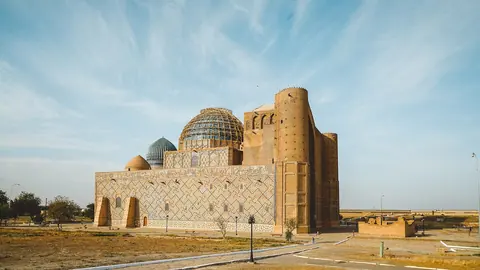
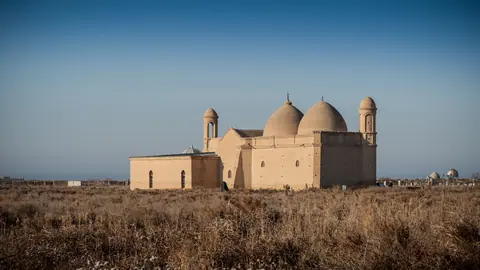
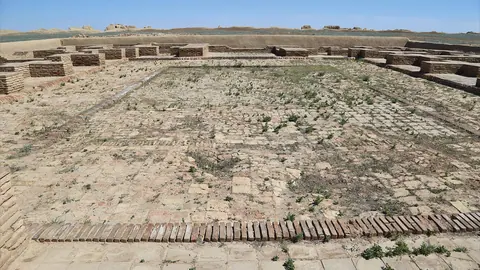
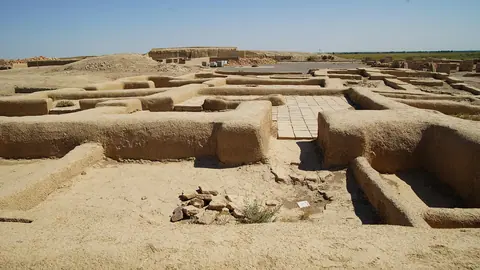


The Mausoleum of Khoja Ahmed Yasawi in Turkistan is the centrepiece of any heritage trip to Kazakhstan: a late-14th-century shrine that became the country’s first UNESCO World Heritage Site in 2003. Around it, within roughly 40–60 km, lie the Arystan Bab Mausoleum and the ruined cities of Otrar and Sauran. Further afield are smaller tombs near Taraz and Shymkent, and a handful of remote sites that need their own long trip.
Most of the mausoleums cluster in the south, around Turkistan
The densest group of sites sits along the Syr Darya plain in southern Kazakhstan, with Shymkent as the regional city and Turkistan as the base. Turkistan is about 160 km from Shymkent, and from there Sauran, Otrar and Arystan Bab are short side trips.
A second, smaller group lies around Shymkent and Taraz: Sairam on the edge of Shymkent, Domalak Ana about 60 km in a straight line from Shymkent, and Aisha Bibi about 15 km in a straight line from Taraz.
The rest are scattered across a very large country. Jochi Khan’s mausoleum is in the Ulytau Mountains of central Kazakhstan, Saraishyk is near Atyrau in the far west, and the Korkyt Ata memorial is about 200 km from Kyzylorda. These are not add-ons to a Turkistan visit. Each is its own long trip.
The Mausoleum of Khoja Ahmed Yasawi is the reason most people come
The Yasawi mausoleum dates from the late 14th century and was inscribed by UNESCO in 2003, the first site in Kazakhstan to be listed. Its main dome is 18.2 m across.
It is a working shrine as well as a monument, so expect pilgrims alongside tourists. Our Turkistan page covers the mausoleum and the two ruined cities nearby in one trip plan.
If you see only one site from this page, make it this one. By tradition, pilgrims visit Arystan Bab before it.
Arystan Bab Mausoleum is traditionally visited first
The Arystan Bab Mausoleum stands near ancient Otrar, about 50 km in a straight line from Turkistan, over the grave of the man legend calls Yasawi’s teacher. By tradition pilgrims stop here before going on to the Yasawi mausoleum.
The present brick building, roughly 35 × 12 m with a memorial mosque, was rebuilt in 1909 and has been protected since 1982. Because it sits next to Otrar, the two make a natural pair: a shrine and a ruined city in one outing.
Following the pilgrim order is not required for visitors, but if you want to see the sites the way local pilgrims do, plan Arystan Bab before Turkistan rather than after.
How the main sites compare
The table sets the sites side by side so you can see which ones fit a day from a city and which need several days.
| Site | What it is | Distance | Trip length | Peak months |
|---|---|---|---|---|
| Yasawi Mausoleum, Turkistan | Late-14th-c. shrine, UNESCO 2003 | ~160 km from Shymkent | Day | Apr–May, Oct |
| Arystan Bab | Mausoleum of Yasawi’s teacher | 50 km line from Turkistan | Day | Apr–May, Sep–Oct |
| Otrar | Excavated city mound, up to 18 m | 50 km line from Turkistan | Day | Apr, Oct |
| Sauran | Walled oval, 800 × 550 m | 46 km line from Turkistan | Half day | Apr–May, Sep–Oct |
| Sairam | Town with Yasawi family tombs | ~15 km line from Shymkent | Day | May, Sep |
| Aisha Bibi | Carved terracotta tomb, 11th–12th c. | 15 km line from Taraz | Day | May, Sep |
| Domalak Ana | 12 m domed shrine, grave 1456 | 60 km line from Shymkent | Day | Apr–May, Sep |
| Jochi Khan, Ulytau | Mausoleum in granite steppe hills | 106 km line from Zhezkazgan | Long | May, Sep |
| Saraishyk | Golden Horde city ruins | 47 km line from Atyrau | Long | May, Sep |
| Korkyt Ata | Kobyz-shaped memorial, 1980 | ~200 km from Kyzylorda | Long | No clear peak |
The practical split is simple. With a few days in the south you can cover the first seven rows. The last three each need a separate plan and transport arranged in advance.
Distances to Otrar differ between our pages: the Turkistan page gives 57 km, the Otrar page about 50 km in a straight line. Treat it as 50–60 km.
The ruined Silk Road cities: Otrar, Sauran, Sairam and Saraishyk
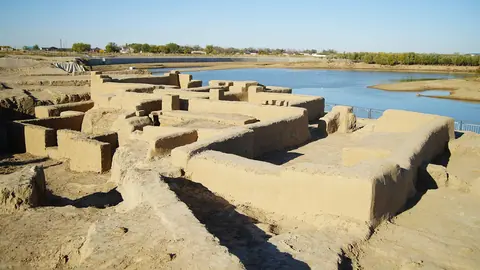
Otrar was one of the largest cities of medieval Central Asia until Genghis Khan’s army besieged it in 1219. Today it is a grassy mound up to 18 m high with excavated quarters, dug since 1969. Read our Otrar page if you want the history before you stand on the mound.
Sauran is the more legible ruin: an oval of eroded mud-brick walls 800 × 550 m with gates, tower stumps and the remains of a congregational mosque. It was a caravan town and a seat of the White Horde, and it fits into half a day from Turkistan.
Sairam is different again, a living mud-brick district of Shymkent that most researchers link to medieval Isfijab. It holds the graves of Yasawi’s parents and mausoleums dated from the 9th to the 18th centuries.
Saraishyk, in the far west near Atyrau, was one of the three largest cities of the Golden Horde (13th–16th centuries). It now has an open-air excavation, a Pantheon of Khans and a visitor centre opened in 2023.
Smaller shrines and remote memorials
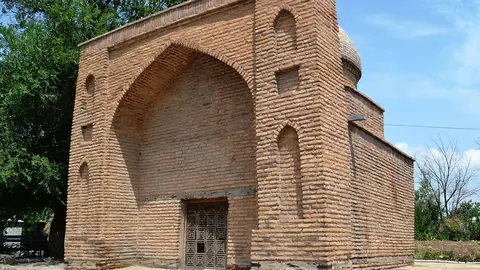
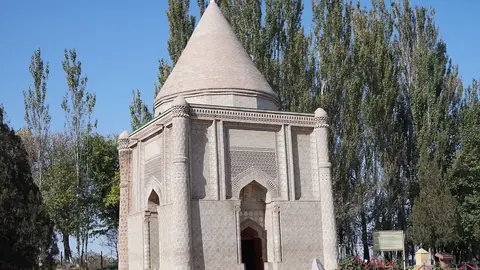
Aisha Bibi, outside Taraz, is a small square tomb of 7.6 × 7.6 m covered in carved terracotta, from the 11th–12th centuries. Newlyweds from Taraz still come here, and parts of it have been rebuilt, so ask what is original. Baidibek Ata Mausoleum, honouring the husband of Domalak Ana, is a building of 1996–1998.
Domalak Ana stands in the Balabogen valley on the southern slope of the Karatau. It is a 12 m domed mausoleum over a grave dated 1456, rebuilt many times, and visited as a pilgrimage site rather than a tourist attraction.
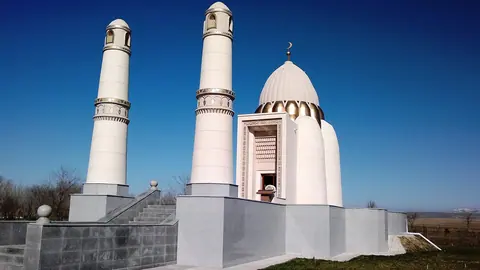
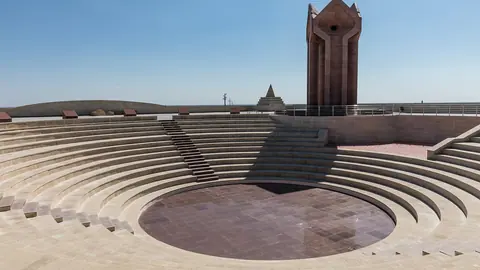
The Korkyt Ata memorial near Kyzylorda is a stela shaped like a kobyz, a stringed instrument, built in 1980 to sound in the wind near the reputed burial place of Korkyt Ata. Its page notes there is no public transit.
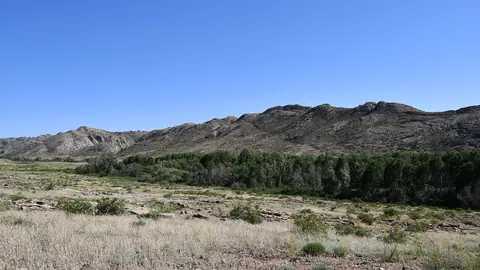
Jochi Khan’s mausoleum lies in the Ulytau range, a 200 km granite massif with hundreds of recorded monuments. Our season ratings mark Ulytau as off-season from November to March.
When to go: spring and autumn, not midsummer
For the southern cluster, April–May and September–October are the strong months, and July is the month to avoid. Our Turkistan page gives July daytime highs of about +36 °C, and most of these sites are open ground with mud-brick walls and little shade.
| Site | Mar | Apr | May | Jun | Jul–Aug | Sep | Oct | Nov |
|---|---|---|---|---|---|---|---|---|
| Turkistan | good | peak | peak | possible | possible | good | peak | good |
| Arystan Bab | good | peak | peak | possible | possible | peak | peak | good |
| Otrar | good | peak | good | possible | possible | good | peak | possible |
| Sauran | good | peak | peak | possible | possible | peak | peak | possible |
| Aisha Bibi | possible | good | peak | good | possible | peak | good | possible |
| Ulytau | off | possible | peak | good | good | peak | possible | off |
Winter visits to the southern shrines are rated possible, not closed. Ulytau and Botai-style steppe sites are a different matter: winter is off-season there, and Ulytau’s season peaks in May and September.
What is hard without a car or Russian
We could not confirm any public transport between Turkistan and Sauran, Otrar or Arystan Bab, and our Korkyt Ata page states there is no transit. Plan on a hired driver or a car for anything beyond the town where you sleep.
Several of these places are active shrines: Yasawi, Arystan Bab, Aisha Bibi, Domalak Ana and Korkyt Ata all draw pilgrims. Dress and behave as you would in any place of prayer, and be prepared for visitors who are there for reasons other than sightseeing.
Opening hours and entry rules are unconfirmed for most sites on this page. Saraishyk’s page says so directly. Check locally before you set out.
To see which mausoleums are on the national list, open the sacred map of Kazakhstan.
Nine sites are compared by what you can see today in the ancient cities of Kazakhstan.
- Opening hours and entry rules for the Yasawi and Arystan Bab mausoleums
- Any public bus or shared taxi between Turkistan and Sauran, Otrar or Arystan Bab
- Dress code expectations at the active shrines
- Road condition and access to Jochi Khan’s mausoleum in Ulytau
- Hours and fees at the Saraishyk visitor centre