
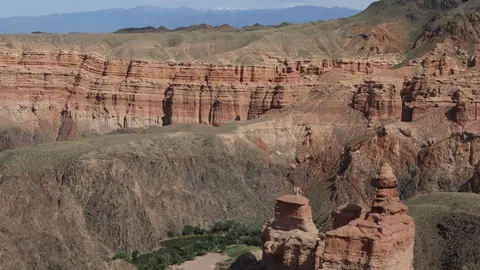
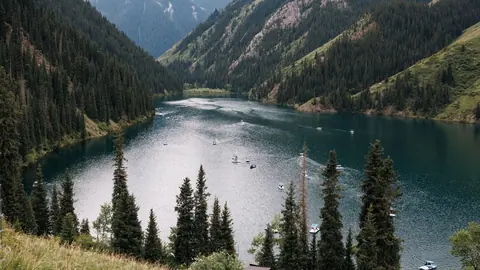
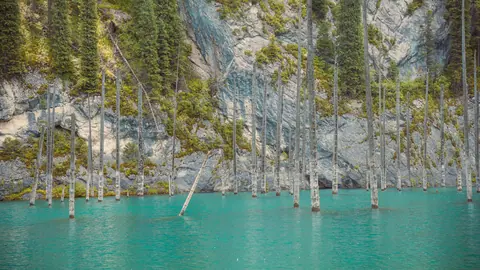
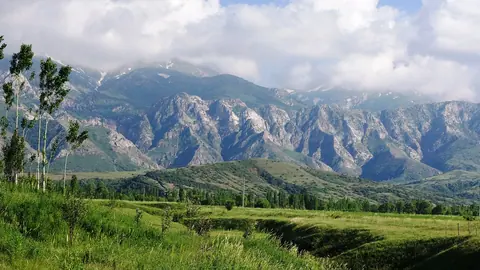


Glamping near Almaty is mostly a mountain affair, and the number that decides your trip is the night temperature at the site’s altitude. At Kolsai, 2,361 m up, the average July night is about 9 °C; at Charyn Canyon, 1,048 m, it is about 17 °C. Listings rarely state this, so this guide starts with the numbers, then covers the questions to send a host and the park rules that apply to every site, whatever it is called.
How cold the nights get, month by month
Without a stove or heater, mountain glamping near Almaty is realistic only in July and August, and even then you want a warm sleeping bag. The table shows the average daily minimum for 2011–2020 from the ERA5 reanalysis for each grid point. These are modelled values, not weather station readings.
| Month | Charyn, 1,048 m | Medeu, 1,702 m | Kaindy, 1,854 m | Kolsai, 2,361 m | Big Almaty Lake, 2,508 m | Burabay, 320 m |
|---|---|---|---|---|---|---|
| Jan | −13.0 | −10.7 | −12.9 | −12.6 | −15.0 | −17.0 |
| Feb | −10.0 | −8.9 | −10.9 | −11.1 | −13.0 | −14.8 |
| Mar | −2.1 | −3.4 | −5.2 | −5.7 | −7.7 | −7.8 |
| Apr | 4.6 | 1.0 | −0.8 | −1.1 | −2.8 | 0.8 |
| May | 9.7 | 4.9 | 3.6 | 2.4 | 1.0 | 6.6 |
| Jun | 14.5 | 9.2 | 7.8 | 6.3 | 5.1 | 12.6 |
| Jul | 17.3 | 11.9 | 10.3 | 9.0 | 7.9 | 14.6 |
| Aug | 15.7 | 10.9 | 9.3 | 8.3 | 7.0 | 13.5 |
| Sep | 10.4 | 6.7 | 5.1 | 4.1 | 2.8 | 7.7 |
| Oct | 3.0 | −0.4 | −2.3 | −2.5 | −4.5 | 0.6 |
| Nov | −5.1 | −6.9 | −9.0 | −8.2 | −10.9 | −8.0 |
| Dec | −10.3 | −9.4 | −12.1 | −11.2 | −13.7 | −13.7 |
All values are in °C and are averages, so single nights run colder. Charyn is the easy one: May to September averages 9.7–17.3 °C, while October falls to 3.0 °C. At Kaindy, Kolsai and Big Almaty Lake even July, the warmest month, stays at 7.9–10.3 °C, and from October nights are below zero. An “all-season” mountain site without heating cannot work. Burabay, in the north near Astana, is warmer than the mountains in summer but has the coldest January in the table.
Questions to send before you pay
Ask these in writing and keep the replies.
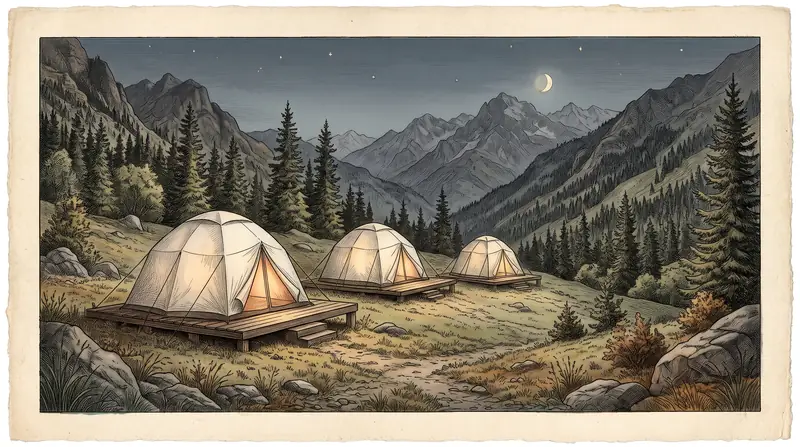
- How is the tent or cabin heated: electric heater, wood stove or gas? Does it run on your dates? Compare them with the table above.
- If there is a stove or gas inside, is there a carbon monoxide detector? We found no Kazakh rule requiring one, so ask directly.
- Where does the water come from, and is there hot water?
- Are the toilet and shower private or shared?
- Is the site inside a national park, and does the price include the park entry fee?
- Will they register you as a foreign guest, and through which channel?
- What is allowed during a fire ban: barbecue, fire pit, stove?
- How far is the nearest riverbed, and what does the site do during a mudflow warning?
- Is the ground treated against ticks?
What “glamping” means in Kazakhstan, legally
Nothing specific: the word does not appear in the Law on Tourist Activity, and neither does “yurt”. The law lists types of tourist accommodation (Article 1, point 8), including hotels, motels, campsites, tourist bases and guesthouses, without defining any of them.
Accommodation is subject to classification under Article 15-1, but we could not confirm whether the classification rules have a category for campsites or glamping. The government’s tourism development concept for 2023–2029 sets the goal of helping to build “a network of campsites, trailer parks and glamping sites” and of drafting standards for campsites. As of 2023 those standards were still a plan.
For you, this means the word in a listing guarantees nothing about heating, water or toilets. The state supports such sites in general terms: regional authorities refund part of the construction costs of tourist accommodation (Article 12). We found no programme aimed at glamping.
Glamping, yurt camp, campsite or guesthouse
Campsites and guesthouses exist in law; glamping and yurts do not, so their rules depend on how each business is registered.
| Glamping | Yurt | Campsite | Guesthouse | |
|---|---|---|---|---|
| In the tourism law | Not mentioned | Not mentioned | Listed as accommodation | Listed as accommodation |
| Where allowed in a national park | Tourism zone (temporary structures only) or limited economic use zone | Same zones; yurts are absent from the infrastructure list in park feasibility studies | Limited economic use zone names campsites | No specific rule |
| Park rate under order No. 232 | None found | Charyn and Kolsai 2.7 MCI per day; Ile-Alatau 0.6 MCI per adult | Campsites and parking are paid park services | Not applicable |
| Tourist fee for foreigners (Article 7-1) | Law is silent; ask | Law is silent; ask | Daily charge at accommodation | Guesthouses exempt |
MCI is Kazakhstan’s monthly calculation index, the unit used for fees and fines. For yurt rates and what to ask a yurt camp, see our page on staying in a yurt; guest yurts also stand in village house yards, for example in Saty. If you bring your own tent, the camping guide covers where you may pitch it: sleeping outside designated spots in a protected area brings a warning or a 5 MCI fine.
Staying inside a national park
A glamping site can legally stand in only two of a national park’s four zones. The Law on Protected Areas (Article 45) divides each park into a strict reserve zone, an ecological stabilisation zone, a tourism and recreation zone and a limited economic use zone. Recreation is banned in the first two, apart from regulated ecotourism, and the reserve zone covers 10–40% of a park.
Plots for tourism are leased for 1–5 years or 5–49 years, following the park’s infrastructure master plan (Article 46). Only temporary structures are allowed in the tourism zone; in the limited economic use zone the law names hotels and campsites. Only leaseholders with a long-term contract may build to an outline design (Article 46-1).
Park entry is a separate charge. Article 38 distinguishes fees paid by tourism businesses, fees paid by visitors and a vehicle entry fee. For Charyn Canyon, AIR Press reported in October 2026 that entry, the eco-taxi, parking and camping are all paid separately, and cards are not always accepted at the checkpoint, so carry cash. Pensioners, people with disabilities, veterans and minors are exempt from the visitor fee. Current rates per park are in our protected area fees table.
Fire bans, mudflows and ticks by season
A barbecue promised in a listing may be illegal on your dates. On 18 July 2026, Ile-Alatau National Park, under fire danger class V (the highest), banned lighting fires and cooking across the whole park, including plots held on short- and long-term leases. That covered rented accommodation too. Breaking fire rules in a protected area carries a fine of 100 MCI.
The Almaty emergency department advises against pitching tents near riverbeds, dams and moraine lakes, because water can leave known channels. Mudflow season usually runs from mid-June to the end of September, sometimes into October, peaking in July and August. In 2026 it was declared over on 1 October. Our mudflow safety page explains what to do.
The area around Almaty is endemic for tick-borne encephalitis. The 2026 season began in early March, and by 19 May two encephalitis cases had been recorded, both in unvaccinated people. See ticks, snakes and bears for prevention.
Wood stoves and carbon monoxide
We found no official Kazakh guidance on carbon monoxide in stove-heated yurts or tents, so we rely on general advice from the US Centers for Disease Control and Prevention (CDC). The CDC says not to use portable camping gas stoves or flameless chemical heaters indoors, and not to burn charcoal inside. Symptoms resemble flu: headache, dizziness, weakness, vomiting and confusion.
The worst part is that a sleeping person can die before any symptoms appear. Do not heat a tent with your own gas burner, and if the site has a stove, ask whether there is a detector. We also found no Kazakh fire safety requirements for yurts or tents at glamping sites.
Registration: who files it for you
Your host, the “receiving party” in the rules, must notify the authorities of your arrival within 3 working days. This is set by points 17–18 of the Rules of Entry and Stay (Resolution No. 148, as amended by Resolution No. 890 of 10 October 2026). Each move to a new place, for example from an Almaty hotel to a glamping site, starts a new 3-working-day period.
There is no special rule for hotels or glamping sites. Hosts file through vmp.gov.kz, egov.kz with a digital signature, a migration office, the post or the e-Qonaq system. Kazakhstan’s Foreign Ministry says e-visa holders do not need registration, and anyone staying longer than 30 days registers themselves by day 30. Details are on our registration page.
Gaps in the record
Frequently asked questions
Is there glamping near Almaty?
What is the best month for glamping near Almaty?
Can I go glamping in Kazakhstan in winter?
Is the national park entry fee included in the glamping price?
Can I have a barbecue at a glamping site in a national park?
Will the glamping site register me as a foreigner?
Is glamping in Kazakhstan regulated?
Are mudflows a risk at riverside glamping sites?
Sources
- Law of the Republic of Kazakhstan on Tourist Activity No. 211-II (Adilet, Russian)
- Tourism Industry Development Concept 2023–2029, Resolution No. 262 (Adilet, Russian)
- Law on Specially Protected Natural Areas No. 175-III (Adilet, Russian)
- Order No. 232 on fee rates in protected areas (Adilet, Russian)
- Rules of entry and stay of immigrants, Resolution No. 148 (Adilet, Russian)
- Code of Administrative Offences (Adilet, Russian)
- Charyn Canyon guide — AIR Press, 18.10.2026 (Russian)
- Ile-Alatau National Park bans open fires — Bes.media, 18.07.2026 (Russian)
- Hikers warned of mudflow threat in Almaty — Bes.media, 02.07.2026 (Russian)
- Tick-borne encephalitis cases in Almaty — Zakon.kz, 19.05.2026 (Russian)
- Carbon Monoxide Poisoning Basics — CDC
- Historical Weather API (ERA5) — Open-Meteo