Kazakhstan tiger and rewilding: a dated timeline, 2017–2026
Kazakhstan has six Amur tigers as of November 2026, and two of them now roam free in the Ile-Balkhash reserve. Kulans, Bukhara deer and Przewalski's horses are coming back too. Here are the dates, numbers and routes, taken from ministry releases, CMS and Prague Zoo.
Yes, Kazakhstan has tigers again. As of November 2026 there are six Amur tigers in the country, and two are free-ranging in the Ile-Balkhash reserve south of Lake Balkhash: the female Ümit, released on 31 July 2026, and the male Amur, released on 31 October 2026. They are the first wild tigers in Kazakhstan in more than 70 years, according to the Ministry of Ecology.
The tiger is the headline, but it is one of four species the country is bringing back. This page puts all four on one timeline, with a source for every date.
Key numbers
- 6 tigers, 2 in the wild. A breeding pair from the Netherlands (2024) plus four wild-caught tigers from Russia’s Far East (May 2026). Ümit and Amur are free; two cubs are still in enclosures.
- 9 years from agreement to release. The government and WWF signed up in 2017, the Ile-Balkhash reserve was created in 2018, and the first tiger walked out in 2026.
- 130 kulans had been moved from Altyn-Emel to Ile-Balkhash by October 2026, the latest 30 in September. Another 90 now live in Kostanay region.
- 5 → 15 → 61. Bukhara deer released at Ile-Balkhash in 2019, 2020 and 2021. Deer and kulans are the tigers’ future prey.
- 22 Przewalski’s horses have flown in over three years to the Altyn Dala steppe. The target is about 40, and the first foal was born on 22 August 2026.
The timeline: prey first, predator second
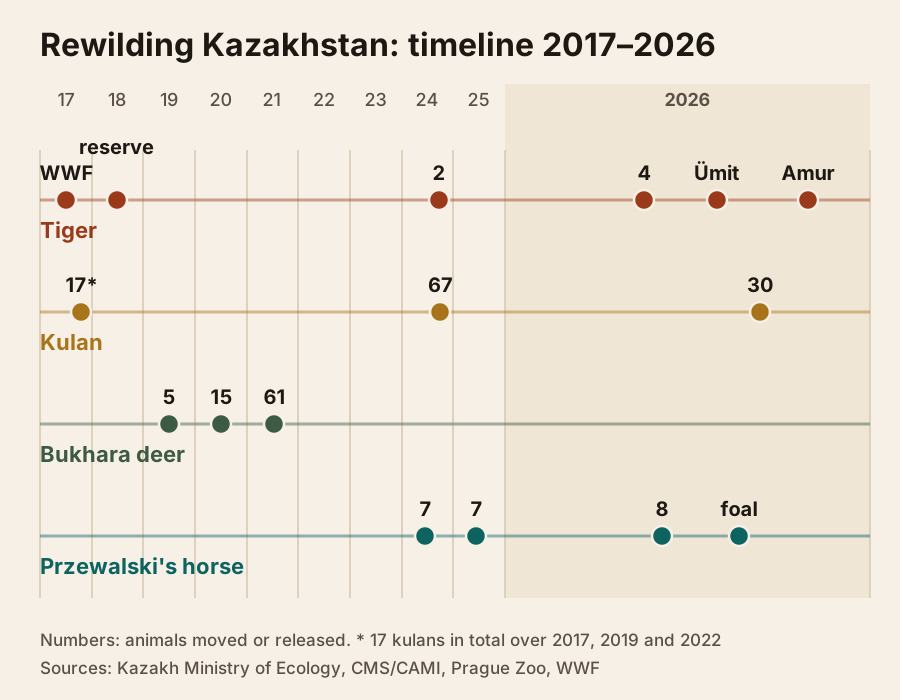
The order is deliberate. For five years Ile-Balkhash received hoofed animals: Bukhara deer from 2019, kulans from 2024. Tigers arrived only once there was something to eat, and the first release came almost two years after the first pair landed. The Przewalski’s horse project runs separately, a thousand kilometres north-west.
Tigers: from a 2017 agreement to two cats in the wild
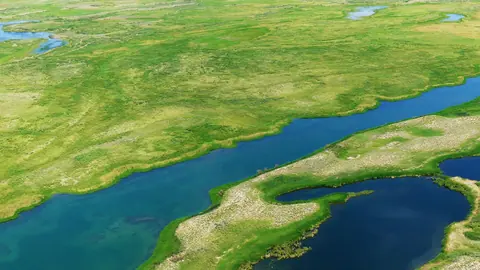
The Caspian tiger, called the Turan tiger in Kazakhstan, disappeared from the Ili delta in the mid-20th century. Its closest living relative is the Amur (Siberian) tiger, so that is the subspecies being reintroduced. The ministry’s stated goal is a self-sustaining tiger population in the Ili delta and the southern Balkhash region.
| Date | Event |
|---|---|
| 2017 | Government–WWF agreement on tiger return |
| 2018 | Ile-Balkhash reserve created |
| 21–22 Sep 2024 | Bogdana and Kuma arrive from the Netherlands |
| May 2026 | 4 wild tigers from Khabarovsk Krai: 2 adults, 2 cubs |
| 31 Jul 2026 | Female Ümit released |
| 31 Oct 2026 | Male Amur released |
The Dutch pair is not meant for release. Bogdana and Kuma came from the predator centre at Landgoed Hoenderdaell zoo, flew to Almaty by cargo plane and went on to the reserve by helicopter. Under the memorandum they are there to breed, and their cubs would be the ones released. Their compound covers about 10 hectares with six enclosures of 0.5–0.75 ha each. We found no reports of cubs from this pair as of November 2026.
The Russian tigers were caught in the wild. The two cubs were 6–7 months old when they arrived. Ümit was fitted with a GPS/GSM satellite collar before release, and Amur also went out collared after veterinary checks and behaviour tests. The cubs stay under observation until 18 months of age, and each will be tested separately before any release decision.
Kulans: one park supplies the rest of the country
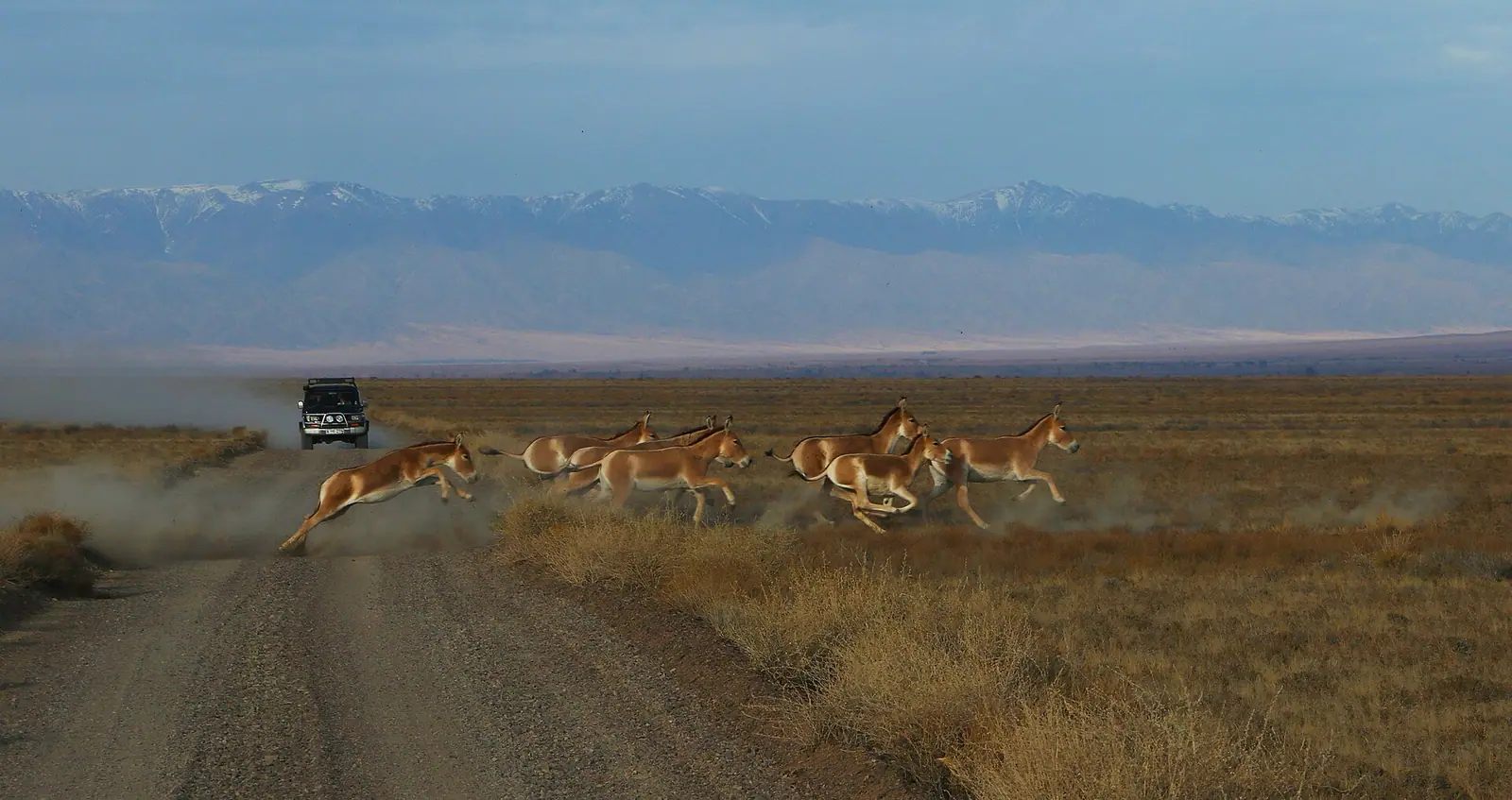
According to the ministry, wild kulans (Asiatic wild asses) died out in Kazakhstan in the 1930s, hunted and pushed off pastures by livestock. Between 1953 and 1961, 14 kulans were shipped from the Badkhyz reserve in Turkmenistan to Barsakelmes island in the Aral Sea. Once the island herd reached 200, animals were moved to the mainland, and in 1982 kulans arrived in what is now Altyn-Emel National Park.
| When | How many | From → to |
|---|---|---|
| 2017, 2019, 2022 | 17 in total | Altyn-Emel, Barsakelmes → Altyn Dala |
| 2024 | 43 and 24 | Altyn-Emel → Ile-Balkhash, Altyn Dala |
| Sep 2026 | 30 | Altyn-Emel → Ile-Balkhash |
| By 20 Oct 2026 | 130 | total moved to Ile-Balkhash |
Altyn-Emel holds the country’s largest herd, 3,965 kulans according to the ministry and CMS. The autumn 2024 transfer to Altyn Dala took 50 hours over 2,139 km of road, with females and yearlings travelling eight to a container. In October 2026 the park’s director said 90 kulans now live in Kostanay region, and that 30–35 a year will keep going to Ile-Balkhash.
If you want to see kulans yourself, Altyn-Emel is the realistic place; see our Altyn-Emel guide.
Bukhara deer: building a larder for tigers
Tigers in the Ili delta need large prey in the riverside tugai forest, and the ministry names Bukhara deer, roe deer and wild boar as that prey base.
| Year | Released at Ile-Balkhash |
|---|---|
| 2019 | 5 deer |
| 2020 | 14 adults and 1 fawn |
| 2021 | 61 planned, a one-year record |
By 2021 WWF estimated almost 100 deer in the wild, counting fawns born there. Nine satellite collars and camera traps tracked them. The release did not say where the deer came from, and we found no newer count for 2025–2026.
Przewalski’s horses: the Altyn Dala steppe
This project has nothing to do with tigers. Prague Zoo and partners fly horses from European zoos to the Alibi reintroduction centre in the Altyn Dala steppe of Kostanay region.
| When | How many | From |
|---|---|---|
| Jun 2024 | 7 | Prague (3), Berlin (4) |
| Jun 2025 | 7: 6 mares, 1 stallion | Prague, Debrecen |
| Jun 2026 | 8: 4 stallions, 4 mares | Czechia, Tierpark Berlin |
New arrivals spend about a year in acclimatisation pens, then the gates open and the horses leave when they choose. The 2024 group was released in June 2025. On 22 August 2026 the mare Tessa, from Berlin, and the Prague-bred stallion Zorro produced the project’s first foal. The plan is five transports in five years and about 40 horses.
Where the animals came from
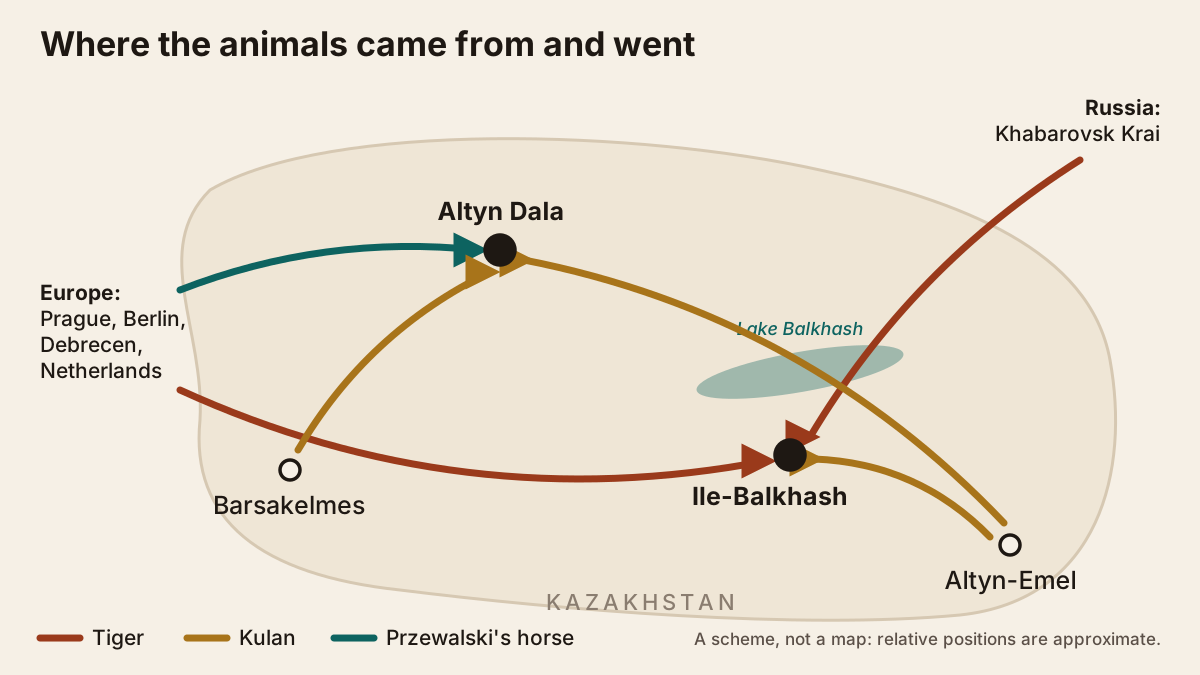
Two places receive the animals. Ile-Balkhash gets the tigers and their prey. Altyn Dala in Kostanay region gets kulans and wild horses. Altyn-Emel supplies kulans to both.
Can you see any of them?
- Tigers: no. Tracking is by collar and there are no tiger tours. What is known about visiting is on our Ile-Balkhash reserve page.
- Kulans: yes, at Altyn-Emel. It is the easiest wildlife trip of the four; compare options on where to see wildlife.
- Przewalski’s horses: not for now. We found no visitor access to Altyn Dala.
For the bigger picture see animals of Kazakhstan and the saiga page.
Method and gaps
Dates and numbers come from Ministry of Ecology releases on gov.kz, the CMS kulan review, Prague Zoo pages and Kazakh media quoting the ministry or reserve directors. The timeline with a source for every row is in a CSV file; the charts are generated from it.
Cite as: “charyn.kz, from Kazakh Ministry of Ecology, CMS and Prague Zoo data, November 2026”. Data under CC BY 4.0.
Frequently asked questions
Are there tigers in Kazakhstan?
Where did Kazakhstan's tigers come from?
Why Amur tigers and not Caspian tigers?
Can tourists see the tigers at Ile-Balkhash?
How many Przewalski's horses has Kazakhstan received?
Sources
- Kazakh Ministry of Ecology: first tiger released into its historical range in more than 70 years, 3 Aug 2026 (in Russian)
- Kazakh Ministry of Ecology: second tiger, Amur, released into the wild, 2 Nov 2026 (in Russian)
- Kazakh Ministry of Ecology: record number of Bukhara deer released into Ile-Balkhash, 12 Jul 2021 (in Russian)
- Zakon.kz: what is known about the tigers brought to Kazakhstan, 23 Sep 2024 (in Russian)
- CMS Central Asian Mammals Initiative: kulan reintroduction in Central Kazakhstan
- 24.kz: kulans from Altyn-Emel moved to other reserves, 20 Oct 2026 (in Russian)
- Kazakhstanskaya Pravda: kulans brought to the Ile-Balkhash and Altyn Dala reserves (in Russian)
- Prague Zoo: Return of the wild horses — Kazakhstan
- Prague Zoo: Four more Przewalski's horses settle into Kazakhstan, 6 Jun 2026
- Conserve Wild Cats: Kazakhstan tiger reintroduction, 25 Aug 2026