Largest lakes in Kazakhstan by area and depth
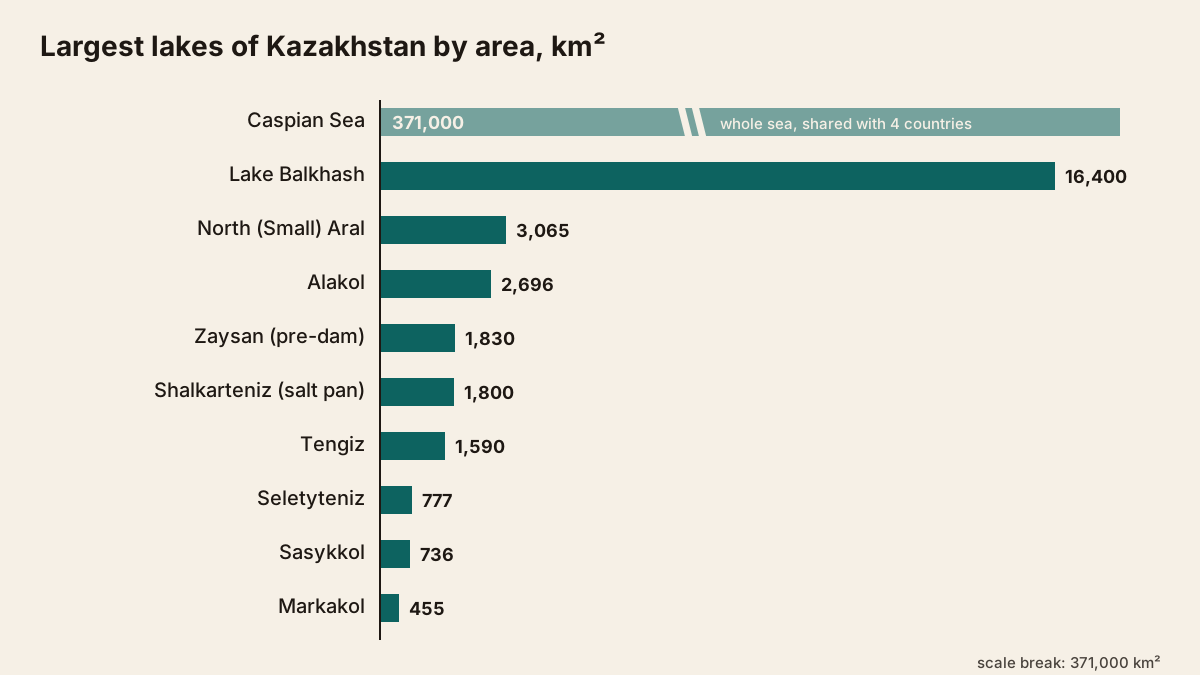
Lake Balkhash, about 16,400 km², is the largest lake entirely inside Kazakhstan. The Caspian Sea is 22 times bigger but shared by five countries, and the deepest lake within the country is Alakol at 54 m. Here are 15 lakes ranked by area, with depth, salinity and region.
The largest lake entirely inside Kazakhstan is Lake Balkhash, about 16,400 km² in 2000. At 22 times that size, the Caspian Sea is bigger still, yet five countries share it, so whether it “counts” depends on the question. Next come the North Aral and Alakol; Alakol, at 54 m, is also the deepest lake within the country. Many steppe lakes shrink or swell several-fold from year to year, which is why each figure below carries a year or a caveat.
In short
- Biggest by area: Balkhash (≈16,400 km²), North Aral (3,065 km²), Alakol (2,696 km²).
- Deepest: Alakol (54 m), Markakol (27 m), Balkhash (26.5 m). The Caspian, at 1,025 m, is in another league.
- Fresh water among the big ones: Markakol, Zaysan, Koshkarkol and western Balkhash.
- Most changeable: Ulken-Karoy drops from 305 to 4.6 km² in dry years; Shalkarteniz turns into a salt pan in summer.
- Total: 48,262 lakes, only 21 of them larger than 100 km².
Lakes of Kazakhstan ranked by area
Tap a column heading to sort. Without JavaScript the table stays ranked by area.
| Lake | Area, km² | Depth, m | Water | Region |
|---|---|---|---|---|
| Caspian Sea | 371,000 (whole) | 1,025 | 12.8–12.9 ‰ | Atyrau, Mangystau |
| Balkhash | ≈16,400 (2000) | 26.5 | west ≈0.74 g/l, east 3.5–6 g/l | Almaty, Zhambyl, Karaganda, Zhetysu |
| North Aral | 3,065 (2025) | 18 | 8–9 g/l | Kyzylorda |
| Alakol | 2,696 | 54 | saline | Abai, Zhetysu |
| Zaysan | 1,830 (pre-dam) | 15 | fresh | East Kazakhstan |
| Shalkarteniz | up to 1,800 | up to 3 | bitter-salty | Aktobe |
| Tengiz | 1,590 | 7.75 | saline | Akmola |
| Seletyteniz | 750–777 | 3.2 | bitter-salty | North Kazakhstan |
| Sasykkol | 736 | 4.7 | flow-through | Abai, Zhetysu |
| Markakol | 455 | 27 | ultra-fresh | East Kazakhstan |
| Ulken-Karoy | 305.5 | shallow | saline | North Kazakhstan |
| Teke | 265 | 1 | bitter-salty | North Kazakhstan |
| Aralsor | 200 | no data | no data | West Kazakhstan |
| Karasor | 154 | no data | no data | Karaganda |
| Koshkarkol | 120 | 5.8 | fresh, 0.85–1.16 g/l | Zhetysu |
Areas and depths come from the Russian Wikipedia article on each lake; Aralsor and Karasor appear only in English Wikipedia’s list, without depth or salinity. All rows and caveats are in kazakhstan-lakes.csv.
Balkhash or the Caspian: which is the biggest?
Counting only lakes within Kazakhstan, Balkhash wins. Technically the Caspian is a lake too, the largest enclosed body of water on Earth, but Kazakhstan owns only part of its shore. Even its size is debated: 371,000 km² in English Wikipedia’s lake list, about 390,000 km² in the Russian article.
Balkhash itself changes with its water level: 15,730 km² in 1946, and 18,000–19,000 km² in the early 20th century and in 1958–1969. It is about 600 km long, up to 74 km wide in the west and only 9–19 km in the east. Sites quoting different areas are often each right for their own year.
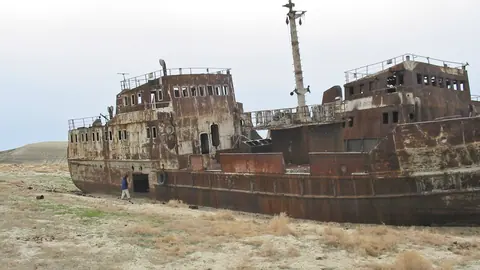
The Aral Sea was once bigger than Balkhash, about 68,000 km² in the 1950s. Kazakhstan’s part, the North Aral, covered 3,065 km² in January 2025, its level held by the Kokaral Dam completed in 2005. The story of the shrinking sea is on the Aral Sea page.
The deepest lakes
Alakol is the deepest lake inside Kazakhstan, 54 m at most and 22 m on average. Steppe lakes, even the big ones, are shallow: Tengiz reaches 7.75 m, Seletyteniz 3.2 m and Teke about a metre.
Russian Wikipedia articles on each lake; North Aral figure from 2004.
For a visitor this means shorelines move: when the level of a shallow lake drops, the water can retreat a long way from last year’s beach. Mountain lakes such as Kolsai and Kaindy are too small in area to make this list; their elevations are in the altitude tool.
Fresh, brackish or salty?
Balkhash is a rare lake that is nearly fresh at one end and brackish at the other. The Ili River feeds the western half and brings 73–80% of all the water flowing in; the eastern half connects through the narrow Uzynaral strait and is saltier.
| Water | Lakes |
|---|---|
| Fresh | Markakol (ultra-fresh), Zaysan (up to 100 mg/l), Koshkarkol, western Balkhash |
| Brackish | eastern Balkhash, North Aral (8–9 g/l) |
| Salty or bitter-salty | Alakol, Tengiz, Seletyteniz, Teke, Ulken-Karoy, Shalkarteniz |
Tengiz shows how unreliable single numbers are: one article gives under 18 ‰, another 50–200 g/l. Closed-basin lakes get saltier as they shrink, so salinity varies with the season and the year. For pink and salt lakes worth a visit, see lakes of Kazakhstan.
Border lakes
Kazakhstan has two large border waters: the Caspian and the Aral. The Caspian is shared with Russia, Azerbaijan, Iran and Turkmenistan. The border with Uzbekistan crosses the Large Aral, while the North Aral lies wholly in Kazakhstan.
Reservoirs: bigger than most lakes
Man-made reservoirs are not in the lake ranking, though the largest outsize nearly every lake on it.
| Reservoir | Area, km² | River |
|---|---|---|
| Bukhtarma | about 5,490 | Irtysh; swallowed Lake Zaysan |
| Kapchagay | 1,847 | Ili |
| Shardara | 783–900 | Syr Darya |
Areas follow the pages for each place, where their sources are listed. Behind the Bukhtarma dam, Zaysan rose by 7 m and became part of a reservoir with about 5,500 km² of water surface.
How we built the list
We took every lake over 100 km² from English Wikipedia’s list and checked area, depth and salinity against the Russian Wikipedia article for each lake, which cites reference works. Where figures disagree, the table shows the one in the article text and the CSV gives the alternative. Kamyslybas (176 km²) is in the list but without a region, so it is left out for now.
Frequently asked questions
What is the largest lake in Kazakhstan?
Which lakes are on Kazakhstan's borders?
What is the deepest lake in Kazakhstan?
Is Lake Balkhash salt or fresh water?
Can you swim in Kazakhstan's big lakes?
Sources
- Wikipedia: List of lakes of Kazakhstan
- Wikipedia (Russian): Balkhash
- Wikipedia (Russian): Caspian Sea
- Wikipedia (Russian): Aral Sea
- Wikipedia (Russian): North (Small) Aral Sea
- Wikipedia (Russian): Alakol
- Wikipedia (Russian): Lake Zaysan
- Wikipedia (Russian): Tengiz
- Wikipedia (Russian): Markakol
- Wikipedia (Russian): Shalkarteniz
- Wikipedia (Russian): Seletyteniz
- Wikipedia (Russian): Sasykkol
- Wikipedia (Russian): Ulken-Karoy
- Wikipedia (Russian): Teke
- Wikipedia (Russian): Koshkarkol
- Wikipedia (Russian): Geography of Kazakhstan (lake counts)
Read also
 Lakes of Kazakhstan: 15 places to visit
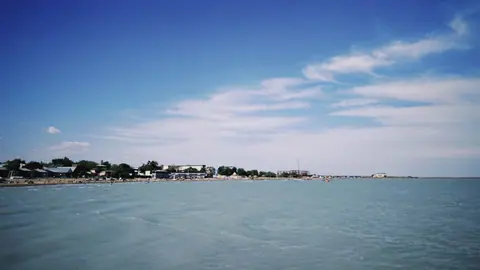 Lake Balkhash in Kazakhstan: a 600 km lake that is fresh at one end and salty at the other
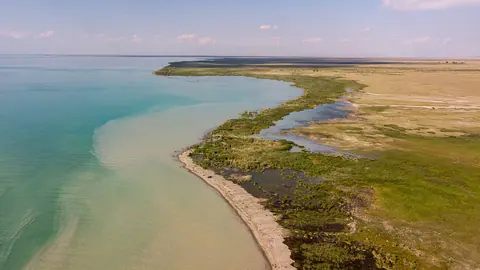 Alakol
 The Aral Sea in Kazakhstan: where it lies, what is left and how to reach it
 Lake Alakol: where it is, water and weather by month, getting there
- How big is Kazakhstan? Area, borders and extreme points on the map