Hotel occupancy in Kazakhstan by region and resort area, 2025–2026
Kazakhstan's hotels were a third full in 2025: 33.4% of rooms on average. Almaty and Lake Alakol top the table, but at Alakol a bed sells for fewer than three weeks a year. Here is what the official numbers say about when and where rooms are easy to find.
Verified: 2026-11
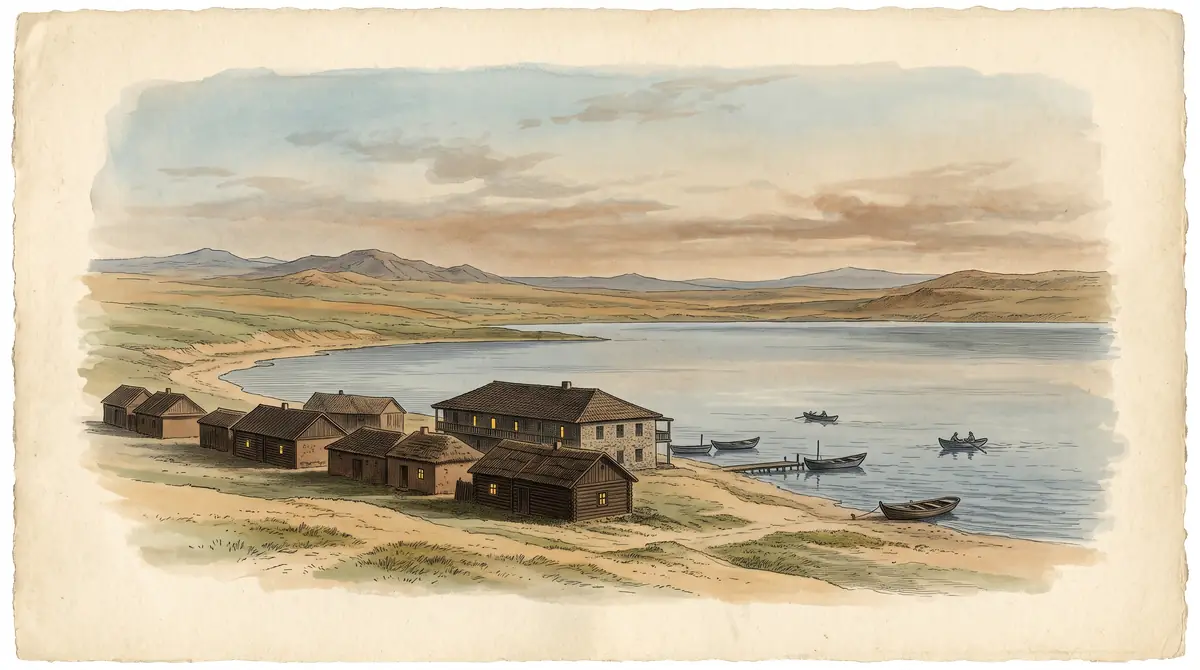
Kazakhstan’s hotel rooms were 33.4% occupied on average in 2025, and hotel beds 26.4%. Almaty city (46.8%) and Shymkent (43.1%) were the busiest regions; Atyrau (15.5%) and Kyzylorda (17.5%) the quietest. Among 20 resort areas the Abai side of Lake Alakol led at 53.7%, while Zerenda and Katon-Karagay were less than a fifth full. We recalculated the Bureau of National Statistics (BNS) annual report and two 2026 updates, and added a measure the reports do not show: how many nights a year each bed is actually sold.
Key numbers
- 33.4% of rooms occupied nationwide; 4,482 accommodation providers hosted 10.09 million guests in 2025.
- Almaty 46.8%, Astana 35.9%. A bed-night in Almaty costs 1.77 times the national average.
- Resort areas: 39.7% of rooms, with bed-nights 1.33 times the national average price.
- Alakol (Abai region): 53.7% hotel occupancy, but only 18.8 nights sold per bed per year across all accommodation.
- The Almaty mountain cluster hosted 2.98 million guests, 61% of all resort-area guests; a quarter were non-residents.
- Burabay is busy in winter too: 116,747 guests in January–March 2026 and 135,310 in April–June.
Occupancy by region
BNS, Accommodation activity, January–December 2025, tables 5 and 26
The three big cities and Kostanay region sit above the national average. If you are booking Almaty or Shymkent, rooms are nearly half full on an average day, so holidays and big events fill them quickly. In most regions a third of rooms or fewer are taken. Turkistan (0.62), Aktobe (0.63) and Kostanay (0.67) have the cheapest bed-nights relative to the national average.
Resort areas: crowded and empty
BNS, Accommodation activity, January–December 2025, tables 5 and 26
BNS reports 20 resort areas separately. Together they hosted 4.88 million guests in 2025.
| Resort area | Rooms | Guests 2025 | Non-residents | Room occupancy | Nights per bed | Price index |
|---|---|---|---|---|---|---|
| Almaty mountain cluster | 15,847 | 2,976,997 | 25.7% | 46.0% | 115.7 | 1.55 |
| Shchuchinsk–Burabay | 3,883 | 463,140 | 3.7% | 31.2% | 92.7 | 1.29 |
| Mangystau | 3,063 | 370,119 | 11.5% | 38.0% | 72.9 | 1.22 |
| Balkhash | 2,263 | 182,901 | 1.1% | 25.5% | 33.0 | 0.69 |
| Alakol (Zhetisu region) | 5,829 | 149,180 | 0.1% | 32.6% | 21.1 | 1.47 |
| Turkistan | 1,479 | 148,525 | 11.4% | 20.1% | 66.5 | 0.66 |
| Altai | 567 | 108,220 | 1.2% | 29.9% | 45.3 | 1.82 |
| Alakol (Abai region) | 5,090 | 100,926 | 0.4% | 53.7% | 18.8 | no data |
| Kapchagay | 1,807 | 100,443 | 0.1% | 26.4% | 20.6 | 1.36 |
| Bayanaul | 1,865 | 72,876 | 0.1% | 27.0% | 27.7 | 1.00 |
| Zerenda | 526 | 40,334 | 0.0% | 9.6% | 47.0 | 0.98 |
| Katon-Karagay | 146 | 7,977 | no data | 17.2% | 16.5 | 0.69 |
Why 53.7% at Alakol does not mean it is crowded
charyn.kz calculation: bed-nights provided ÷ bed capacity, BNS table 26, 2025
BNS states in its methodological notes that room and bed occupancy are published for hotels only. Bed-nights and bed capacity in the same table cover all accommodation, including lakeside camps and guesthouses. Dividing one by the other gives the nights each bed is sold in a year: 62.3 nationwide, 115.7 in the Almaty mountain cluster, 92.7 in Burabay, and just 18.8 and 21.1 on the two sides of Lake Alakol.
So a high occupancy figure at a seasonal lake describes its hotels in season, not the whole resort. Outside its short summer, Alakol has plenty of free beds. When Kazakhstan searches for lakes, month by month, is shown in our study of the summer lake peak.
What a night costs, relative to the national average
charyn.kz calculation from BNS tables 5 and 26, 2025; no price is given for Alakol (Abai region)
We show an index rather than prices: 1.0 is the national average cost of a bed-night. The Altai area is the priciest (1.82), followed by the Almaty mountain cluster (1.55) and Alakol on the Zhetisu side (1.47). Bukhtarma (0.46), Karkaraly (0.61) and Turkistan (0.66) are the cheapest. We left out the Kostanay resort area: with four providers, its index of 2.04 reflects a handful of hotels.
Seasons by quarter, 2026
| Resort area | Room occupancy, Q1 2026 | Room occupancy, H1 2026 | Guests, Q1 | Guests, Q2 |
|---|---|---|---|---|
| Almaty mountain cluster | 36.0% | 39.7% | 509,280 | 713,798 |
| Shchuchinsk–Burabay | 25.7% | 30.8% | 116,747 | 135,310 |
| Mangystau | 23.9% | 30.4% | 53,295 | 106,336 |
| Balkhash | 11.2% | 21.5% | 8,711 | 66,217 |
| Altai | 46.1% | 33.1% | 30,318 | 15,048 |
| Alakol (Zhetisu region) | 9.6% | 19.5% | 1,391 | 14,321 |
| All resort areas | 29.0% | 34.6% | 802,029 | 1,258,554 |
Three patterns appear. The Altai area peaks in winter. Balkhash and Alakol are almost empty in winter and start filling in spring, with the main summer peak still to be published. Burabay and the mountains above Almaty work year-round.
What it means for your trip
Burabay’s hotels were below the national average over the year and each bed sold 92.7 nights, so pressure comes from weekends and holidays rather than the whole summer. See our Burabay National Park guide. Alakol is the opposite: a short, intense summer and near-empty camps the rest of the year; details on the Lake Alakol page. Mountain and city stays around Almaty are covered in Almaty mountains.
Methodology
- We downloaded three BNS “accommodation activity” reports: January–December 2025, January–March 2026 and January–June 2026.
- Table 5 gives regions and cities, table 26 resort areas, table 27 resident and non-resident guests.
- The price index is the average cost of a bed-night divided by the national average (table 5).
- Nights per bed is “bed-nights provided” divided by “bed capacity”. This is our measure; BNS does not publish it.
- Q2 2026 guests are the half-year minus Q1. Occupancy cannot be derived that way, so the table shows Q1 and H1 values.
Our approach to sources is described in the methodology.
What we don’t know
How to cite
Suggested credit: “charyn.kz calculation based on Bureau of National Statistics of Kazakhstan, accommodation activity reports, 2025–2026”. Example: “In 2025 a bed in the Abai part of the Alakol resort area was sold for 18.8 nights on average, compared with 115.7 in the Almaty mountain cluster (charyn.kz, based on BNS data).”
Regional and resort-area data for 2025 and the first two quarters of 2026 are in a CSV file under CC BY 4.0. What foreign visitors spend on lodging is covered in visitor spending in Kazakhstan; more datasets are on the open data page.
Frequently asked questions
What is the average hotel occupancy rate in Kazakhstan?
How busy are Almaty hotels?
Is it hard to find a hotel in Burabay?
When is Lake Alakol quiet?
Which resort areas in Kazakhstan are the most expensive?
How many foreign guests stay in Kazakhstan's resorts?
Sources
- Bureau of National Statistics: accommodation activity, January–December 2025, published 1 Apr 2026 (xlsx, Russian)
- Bureau of National Statistics: accommodation activity, January–March 2026 (xlsx, Russian)
- Bureau of National Statistics: accommodation activity, January–June 2026 (xlsx, Russian)
- Bureau of National Statistics: tourism statistics section
Read also
 Almaty in winter by numbers: smog, snow and cold days
 Direct flights to Kazakhstan: where they come from and how long they take
 Earthquakes in Almaty: 50 years of seismic data around the city
 How foreign visitors spend money in Kazakhstan: survey data by country
 Kazakhstan vs Uzbekistan vs Kyrgyzstan: a data comparison for travellers
 Mangystau month by month: heat, wind and when people go