What language do they speak in Kazakhstan? Census data and useful phrases
In the 2021 census, 73.7% said they speak Kazakh fluently, 71.6% Russian and 27.6% English. Without Russian, your phone screen will do more for you than your voice.
Verified: 2026-11
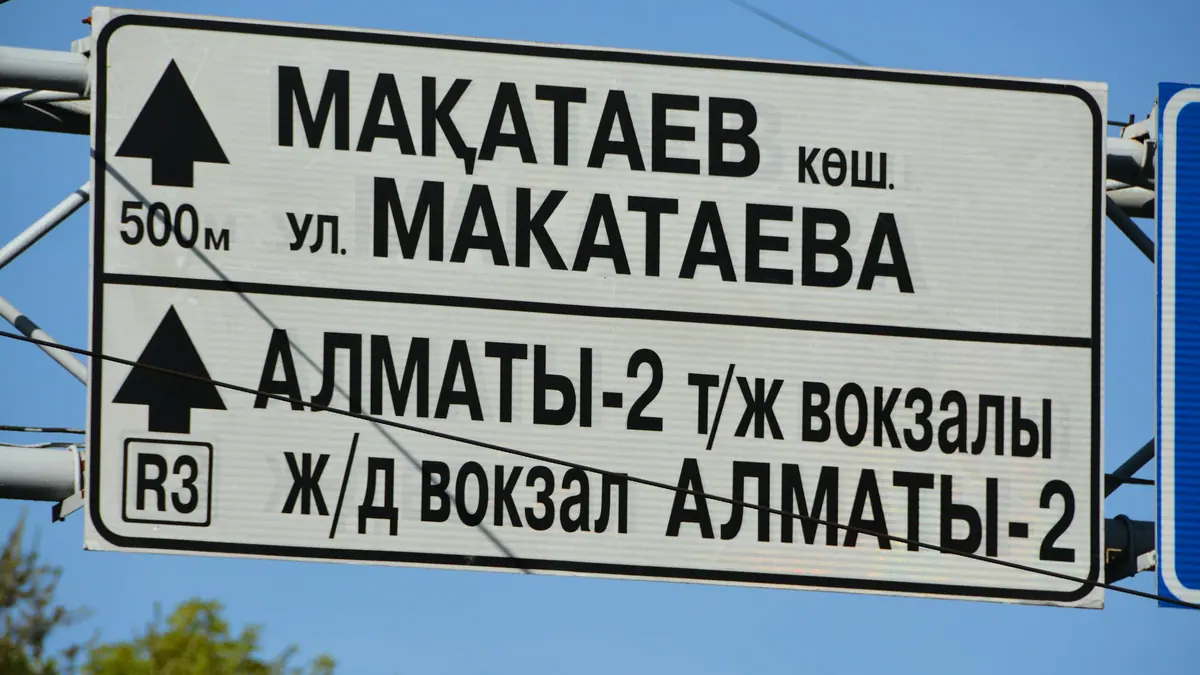
You will mostly hear Kazakh and Russian. In the 2021 census, 73.7% of people aged 5 and over said they speak Kazakh fluently and 71.6% said the same of Russian; only 27.6% said so of English. If you have no Russian, plan on showing written text instead of relying on conversation. Both the census and the EF test point that way.
How to manage without Russian
Prepare written text in advance and treat spoken English as a welcome exception.
- Save addresses in Cyrillic. Your hotel, your stops, station names. By law, signs carry Kazakh and often Russian, and road signs the state language, so do not count on Latin letters.
- Install a translation app with offline languages and show the screen. 83.5% read Russian fluently and 80.0% read Kazakh, so a Cyrillic sentence on your phone beats your spoken English.
- Learn a greeting, thank you and the numbers 1 to 10. Numbers cover prices and bus routes.
- Prepare an emergency note. The 103 ambulance operator may not speak English, and hospital staff often do not either. Write your diagnosis, allergies and medicines in Russian, and read our health and insurance page.
- Plan a go-between for mountains and long trips. The UK advises trekking with a reliable agency, as our safety guide explains. If you hire a driver or guide, agree on a shared language first. Before you go lists other things to check, and getting around covers transport options.

Kazakh and Russian phrases to have ready
Either language suits a short exchange, so continue in whichever one you get back. The Latin spelling of Kazakh below is approximate, and the Russian pronunciation comes from the Wikivoyage phrasebook. Who greets whom first, and how hosts welcome you, is covered in Kazakh culture and customs.
| Meaning | Kazakh | Latin spelling | Russian | Say it like |
|---|---|---|---|---|
| Hello | Сәлеметсіз бе | sälemetsız be | Здравствуйте | ZDRAHST-vooy-tyeh |
| Thank you | Рақмет | raqmet | Спасибо | spuh-SEE-buh |
| How much is this? | Мынау қанша? | mynau qanşa | Сколько стоит? | SKOHL’-kuh STOH-eet |
| Where? | Қайда? | qaida | Где? | gdyeh |
| Water (asking for some) | Су | su | Воды | vah-DYH |
| Help! | Көмектесіңіз! | kömektesıñız | Помогите! | puh-mah-GEE-tyeh |
| Number | Kazakh | Latin spelling | Russian | Say it like |
|---|---|---|---|---|
| 1 | бір | bır | один | ah-DEEN |
| 2 | екі | ekı | два | dvah |
| 3 | үш | üş | три | tree |
| 4 | төрт | tört | четыре | chee-TYH-ree |
| 5 | бес | bes | пять | pyaht' |
| 6 | алты | alty | шесть | shehst' |
| 7 | жеті | jetı | семь | syeem' |
| 8 | сегіз | segız | восемь | VOH-seem' |
| 9 | тоғыз | toğyz | девять | DYEH-veet' |
| 10 | он | on | десять | DYEH-suht' |
What the census says: Kazakh and Russian almost level
By self-assessment, the two main languages are nearly tied. Kazakh leads slightly on speaking, and Russian on understanding, reading and writing.
Bureau of National Statistics, 2023 compendium, section 8. Self-assessed.
The table counts 17,194,712 people aged 5 and over, and the percentages are worked out from section 8 of the Bureau of National Statistics compendium.
| Language | Understand speech | Read fluently | Speak fluently | Write fluently |
|---|---|---|---|---|
| Kazakh | 13,768,406 (80.1%) | 13,750,439 (80.0%) | 12,670,407 (73.7%) | 7,380,900 (42.9%) |
| Russian | 14,391,085 (83.7%) | 14,356,787 (83.5%) | 12,310,685 (71.6%) | 8,631,152 (50.2%) |
| English | 6,042,162 (35.1%) | 5,670,216 (33.0%) | 4,751,516 (27.6%) | 3,113,036 (18.1%) |
More people understand than speak fluently (for Russian, 83.7% against 71.6%). A short question will work more often than a long conversation.
Daily use is lower. 8,472,661 people use Kazakh in everyday life, which is 49.3% of the census base. 3,426,306 do not know it: 2,474,697 in cities and 951,609 in villages, so most live in cities, and a Kazakh phrase in a city may get a reply in another language. Multilingualism is common: 44.9% named two languages, 28.6% three, 1.7% four and 0.2% five.
Do people speak English in Kazakhstan?
Some do, and fewer than the headline figure suggests. The 35.1% counts understanding of speech, while fluent speakers come to 27.6%. EF’s 2025 English index measures something else and ranks the country 107th with 417 points against a world average of 488, down 10 on the year before. Wikipedia’s table puts anything below 450 in the Very low band. The census is self-assessment and EF is a test, so the numbers cannot be compared directly.
Two details are useful on the road. Astana (460) and Almaty (457) score clearly above the national result, so your chances are better in those two cities. Reading is the strongest skill in EF’s data (429) and speaking the weakest (392), with listening at 397 and writing at 395. If someone cannot follow you by ear, show them the words.
What signs and road signs will look like
Article 21 of Law No. 151 sets the rules, and English gets no line of its own.
| Item | Language |
|---|---|
| State organisations’ signs | Kazakh and Russian |
| Non-state organisations’ signs | Kazakh, plus Russian and others where needed |
| Layout | Kazakh on the left or top, Russian on the right or bottom, same letter size |
| Road signs | State language, unless international treaties provide otherwise |
So a road sign may be in Kazakh only. Compare the Cyrillic spelling of your destination when you look at a map or a bus board.
Legally, Kazakh is the state language (Art. 4). Article 5, in the 12 July 2026 version, says Russian is used in state bodies and local government on an equal footing with it. Press summaries of the new Constitution, in force since 1 July 2026, say Russian is used alongside Kazakh. We did not open the text of its Article 9 and do not interpret the difference in wording.
Cyrillic for now: no date for the Latin alphabet
Kazakh is written in Cyrillic, which is why the phrase table uses it. Decree No. 569 (26 October 2017) set a phased change of alphabet by 2025; Decree No. 637 (19 February 2018) approved a new version of the alphabet. A 28 January 2021 presentation showed 31 letters and a 2023 to 2031 transition, also not final.
A report from 8 September 2026 says there is no date now, the draft alphabet and spelling rules are being revised, and the language policy committee considers using different variants before the acts are approved to be unjustified. With no newly approved alphabet, the Latin spellings above are approximate.
Phrase spellings were checked against Wiktionary and Wikivoyage. We could not open an academic dictionary, and a native speaker has not yet proofread the table. The table has no line for a hospital: the dictionary did not confirm the spelling and we did not verify the Russian pronunciation.
We could not confirm whether English announcements on Almaty transport work today (three-language navigation and the Visit Almaty centre were a 2018 plan, and we do not know if it was carried out), whether 2GIS has an English interface (its Kazakh test mode was reported in 2023), or whether 112 operators speak English.
Frequently asked questions
Can I travel in Kazakhstan with English only?
Should I learn Kazakh or Russian for a trip?
Do people in Kazakhstan speak Russian?
Is Kazakh written in Latin or Cyrillic?
Sources
- Bureau of National Statistics: National composition, religion and language proficiency, 2023, sections 8 and 9
- Bureau of National Statistics: compendium news item, 2 November 2023
- Law No. 151 on languages, version of 12 July 2026
- 24.kg: new Constitution in force, 1 July 2026
- EF EPI 2025: Kazakhstan
- EF EPI 2025: Kazakhstan fact sheet
- Wikipedia: EF English Proficiency Index
- Decrees No. 569 and No. 637 on the alphabet
- The Astana Times: Latin alphabet transition plan, 1 February 2021
- Economist.kg: Latin alphabet timeline, 8 September 2026
- Wikivoyage: Kazakh phrasebook
- Wikivoyage: Russian phrasebook
- Wiktionary: сәлеметсіз бе
- Wiktionary: рақмет
- Wiktionary: қанша
- Wiktionary: қайда
- Wiktionary: су
- Wiktionary: көмек
- FCDO: Kazakhstan, health
Read also
 Almaty to Issyk-Kul: routes via Korday or Kegen, distance and border
 Kazakh culture and customs: what visitors should know
 Kazakhstan border crossings: which ones foreigners can use
 Kazakhstan time zone: one zone, UTC+5, since 1 March 2024
 What to buy in Kazakhstan: souvenirs and export rules
 Accessible nature in Kazakhstan: wheelchairs, strollers and older travellers