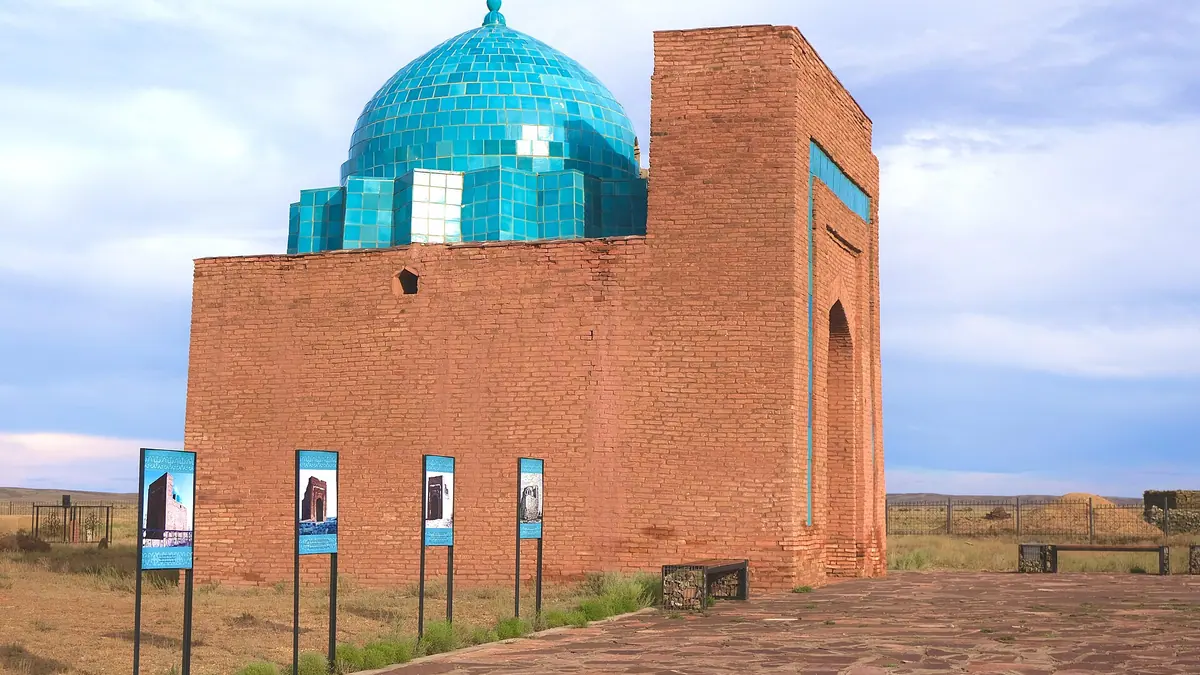
Jochi Khan Mausoleum: when to go, month by month
- January: off season
- February: off season
- March: possible
- April: good
- May: best time
- June: good
- July: possible
- August: good
- September: best time
- October: possible
- November: off season
- December: off season
May and September bring daytime highs around 20–22 °C, July peaks near 30 °C, and winter highs stay below freezing.
Jochi Khan Mausoleum: why go
The Jochi Khan Mausoleum portal
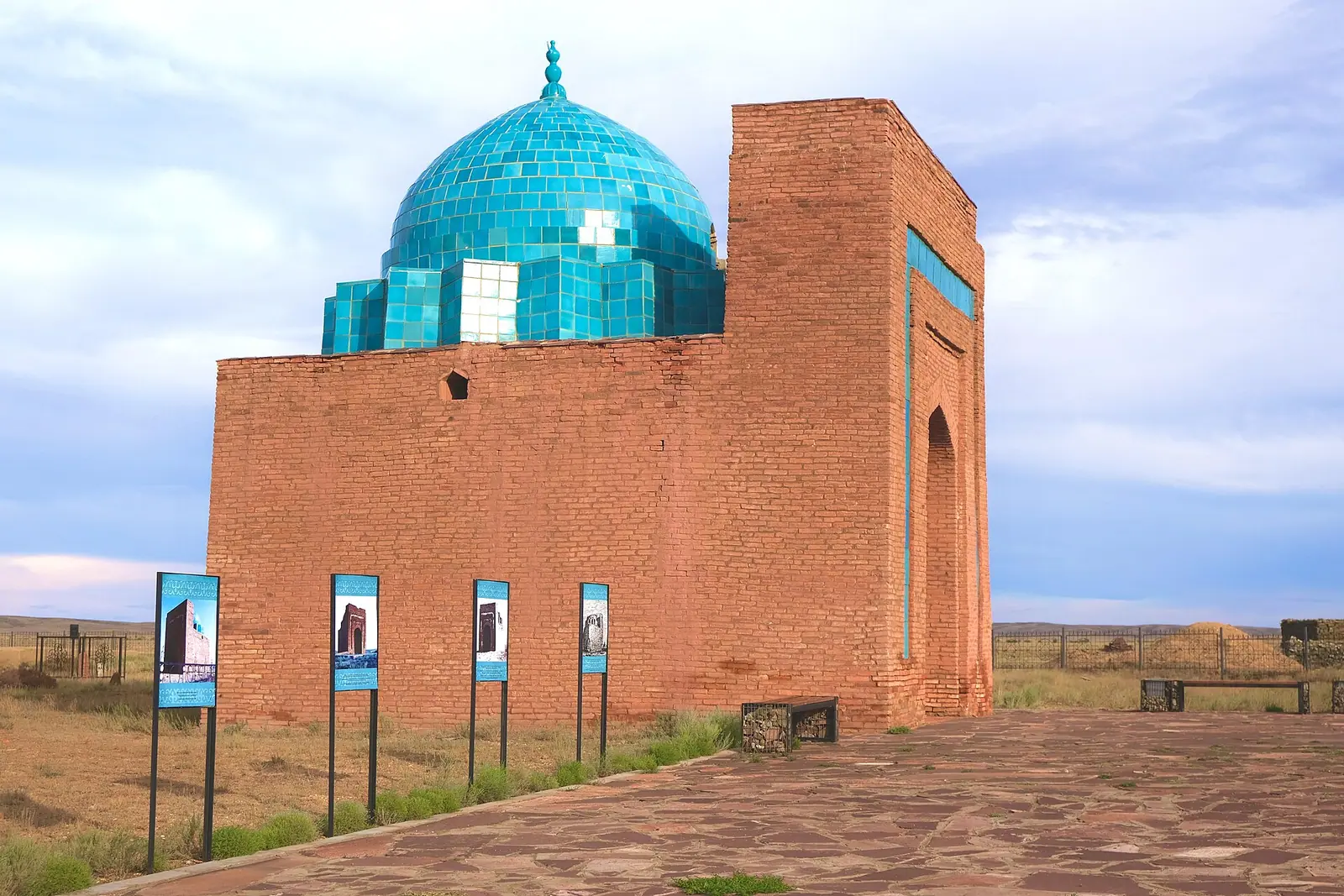
A pointed-arch portal, 7.85 m high as it survives, faces south-west. Its niche is about 4.5 m tall, and the frame around it once held glazed tiles 45 × 45 cm.
A disputed royal grave
A coffin in the first burial dates to 1245 ± 25 years, later than Jochi's death in 1227, so research doubts he lies here at all.
Steppe drive from Zhezkazgan
About 50 km north-east of Zhezkazgan by Wikipedia, near Malshybai village, on a low hill above the Karakengir river that is visible from far away.
Mild windows in May and September
ERA5 normals give highs near 22 °C in May and 20.5 °C in September, against about 29.5 °C in July and -9 °C in January.
Tiles stripped in 1911
Kazakh Wikipedia says an Atbasar district official removed the inscribed portal tiles in 1911 and sent them to a museum; only fragments survive.
Jochi Khan Mausoleum in photos
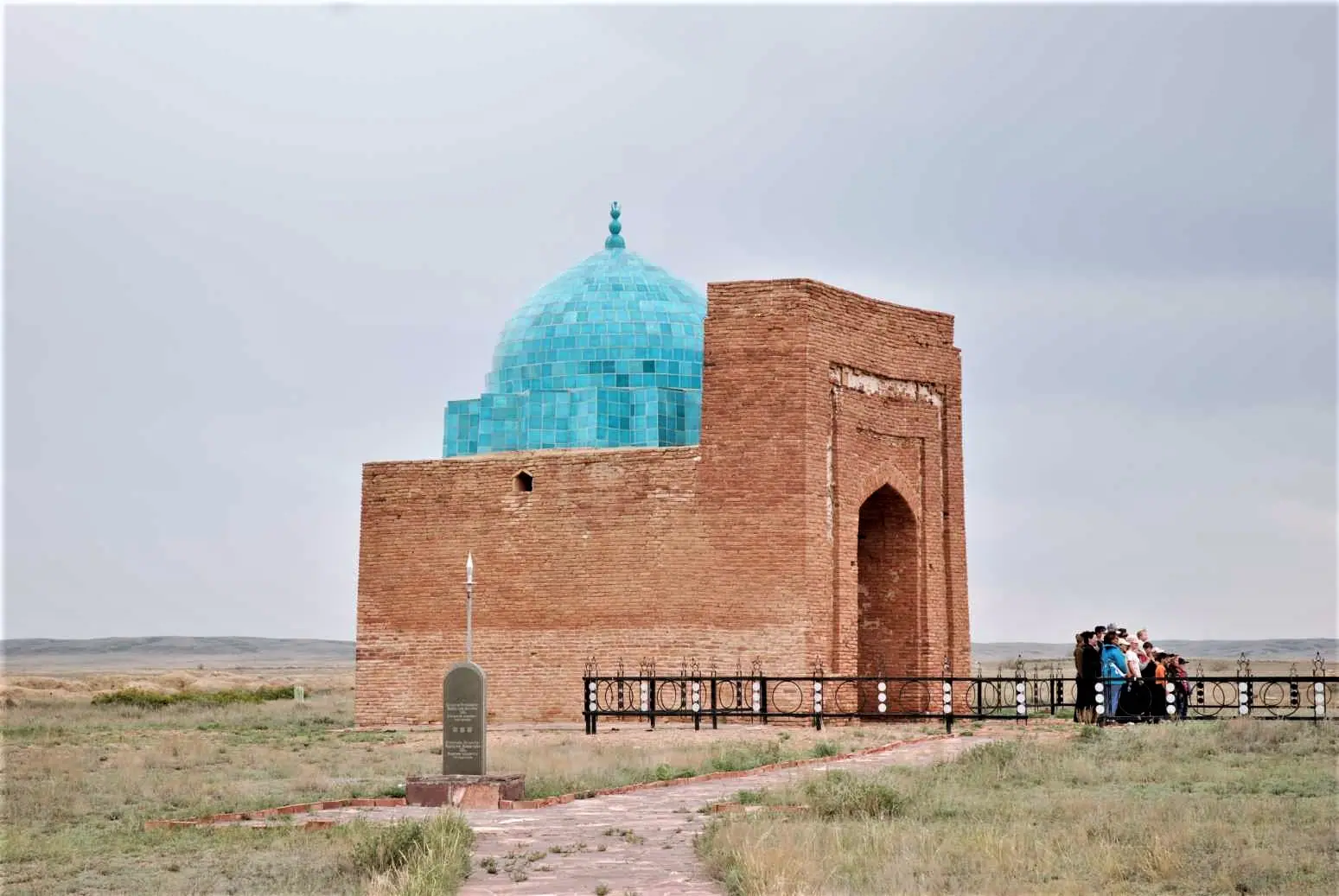
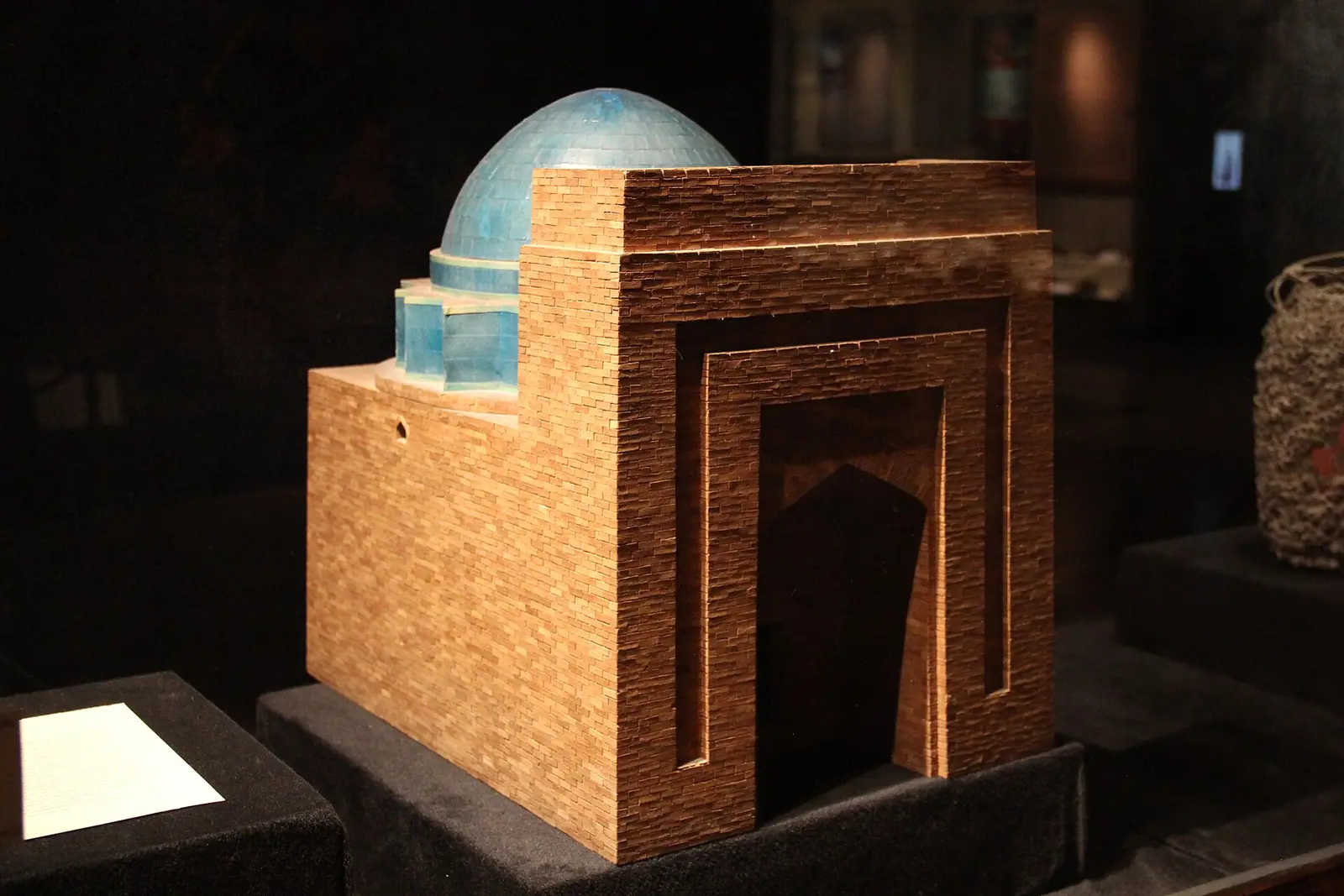
Real photos by travellers (Pexels, Unsplash, Wikimedia Commons); author and licence are given in each caption.
The Jochi Khan Mausoleum is a domed brick tomb in the Ulytau region of central Kazakhstan, about 50 km north-east of the city of Zhezkazgan, near the village of Malshybai. Tradition holds that Jochi, eldest son of Genghis Khan, lies here, but research summarised by Russian Wikipedia dates the building to the 14th century and casts doubt on that. It is a small, single-building site, so it suits travellers who are already in the Zhezkazgan or Ulytau area rather than anyone planning a trip around it alone.
Where it is and what kind of trip it takes
The mausoleum sits in the middle of the Kazakh steppe, far from the country’s two main cities. Zhezkazgan is the nearest city, about 42 km away in a straight line; Wikipedia gives 50 km, which is closer to a road figure. Astana is about 425 km away and Karaganda about 427 km, both in a straight line, so this is a long overland or multi-day trip from either.
We could not confirm any public transport to the site, a road description, or the distance from Almaty. For a visitor without a car or Russian, the realistic plan is to reach Zhezkazgan first and arrange a ride from there. The granite hills of Ulytau, about 79 km in a straight line, are the natural pairing for the same trip.
What you see: one portal, a double dome, plain walls
The building is small and is best read up close. It stands on a low hill on the bank of the Karakengir and is visible from a long way off. The main facade faces south-west and is a tall portal with a pointed arch over a deep entrance niche about 4.5 m high.
| Feature | Figure |
|---|---|
| Footprint | 7.25 × 9.52 m (Russian Wikipedia); 9.55 × 7.25 m (Kazakh Wikipedia) |
| Surviving portal height | 7.85 m |
| Dome height | 7.1 m (Russian Wikipedia); inner 7 m, outer 8 m (Kazakh Wikipedia) |
| Drum under outer dome | 17-sided (Russian Wikipedia); 16-sided (Kazakh Wikipedia) |
| Brick size | 26 × 29 × 5 cm, red fired brick |
| Window openings | two, 35 × 55 cm, at about 3.28 m |
The two Wikipedia editions differ on some details, as the table shows; neither changes what you will see. The dome has a double shell. The original outer dome did not survive; it once sat on a rare star-shaped drum faced with turquoise-glazed tiles. The frame around the portal niche held glazed tiles 45 × 45 cm. Kazakh Wikipedia says an official of Atbasar district stripped these tiles in 1911 and sent them to a museum, and only fragments now remain. Inside, the walls are clay-plastered and undecorated apart from tamgas (clan marks), and a gravestone stands at the back of the brick-floored chamber.
Is Jochi really buried here
Probably not, according to the research cited by Russian Wikipedia, though Kazakh Wikipedia tells the traditional version. The difference matters if you come for the history: the building is medieval Golden Horde architecture, while the link to Jochi rests on legend and on one disputed burial.
| Question | Traditional view (Kazakh Wikipedia) | Research view (Russian Wikipedia) |
|---|---|---|
| When built | 1228, a year after Jochi’s death in 1227 | 14th century, in two stages; the outer dome likely Timurid-era |
| Burial No. 1 | Jochi; the skeleton lacked its right arm | Coffin radiocarbon-dated to 1245 ± 25 years: older than the building, younger than Jochi’s death |
| Burial No. 2 | Jochi’s senior wife Bektumysh | A later burial |
| Conclusion | Built by tribes subject to Jochi, judging by the tamgas | Jochi’s own grave is most likely absent; Burial No. 1 may be a Muslim of his line |
Russian Wikipedia notes that members of Jochi’s Borjigin clan were buried in secret by pre-Islamic rites. The burial rite found here combined Muslim and pre-Islamic elements. The Kazakh article mentions remains of fine clothing, red leather boots, silk, animal bones, a camel skull and iron weapon fragments in the first grave.
The legend and the written record
The story told locally is that Jochi died while hunting. A lame kulan (wild ass), wounded by an arrow, turned on him, pulled him from his horse and tore off his right arm. Kazakh Wikipedia ties this to the missing right arm in the first grave.
The earliest written mention dates from the 16th century. Hafiz-i Tanysh Bukhari referred to the mausoleum when describing the 1582 campaign of the Bukhara ruler Abdullah Khan II to Ulytau. In 1946 the Central Kazakhstan archaeological expedition led by Alkey Margulan surveyed the site and attributed the burials to Jochi and his wife. In 1982 the mausoleum was listed as a historical and cultural monument of national significance and placed under state protection. It remains a grave, so plain, respectful behaviour inside is expected.
When to go
Late spring and early autumn are the comfortable windows; winter is harsh. The figures below are computed normals for 2011–2020 from the ERA5 reanalysis at a grid point at 428 m, not readings from a weather station.
Day high, °C / Night low, °C · Rain/snow, mm
A computed reanalysis normal for these coordinates, not weather station records.
Monthly figures
| Month | Day high, °C | Night low, °C | Rain/snow, mm |
|---|---|---|---|
| Jan | -9.6 | -17.1 | 13.2 |
| Feb | -8.4 | -17.3 | 15.6 |
| Mar | 2.2 | -7.8 | 21.8 |
| Apr | 15.7 | 2.8 | 24.1 |
| May | 23 | 8.6 | 17.9 |
| Jun | 28.2 | 14.2 | 17.6 |
| Jul | 30.1 | 16.3 | 18.1 |
| Aug | 28.3 | 14.6 | 14.5 |
| Sep | 21.2 | 7.6 | 11 |
| Oct | 11.8 | 0.2 | 14.8 |
| Nov | -0.1 | -7.9 | 20.3 |
| Dec | -7.6 | -14.6 | 21.7 |
May and September have daytime highs around 18–23 °C and cool nights, good for standing on an exposed hill. July averages about 30.1 °C at its peak, with little shade at a single small building. From November to March, daytime highs sit below or near freezing and January nights average about -17 °C. Precipitation is low all year, roughly 12–25 mm a month, so rain is rarely the problem; heat, cold and steppe wind are.
- Road condition and route from Zhezkazgan to the mausoleum
- Any public transport or shared taxis to Malshybai
- Opening hours, entry rules or fees at the site
- Facilities on site such as water, toilets or shade
- Transport links to Zhezkazgan from Almaty or Astana
Jochi Khan Mausoleum: tips before you go
- Plan from Zhezkazgan: the site is about 42 km away in a straight line, while Astana and Karaganda are over 420 km.
- Pair it with Ulytau, about 79 km in a straight line, to justify the long trip to central Kazakhstan.
- Avoid November to March: ERA5 normals show daytime highs at or below freezing and January nights near -17 °C.
- In July carry water and sun cover: highs average about 29.5 °C and the hilltop site is a single small building.
More to see nearby

Frequently asked questions
Who is buried in the Jochi Khan Mausoleum?
How old is the Jochi Khan Mausoleum?
How far is the mausoleum from Zhezkazgan?
Can I combine it with Ulytau?
Is the mausoleum protected?
Sources
Read also
 Almaty Zoo in Kazakhstan: opening hours and how to visit
 Ayusai Gorge, Almaty: visitor centre and waterfall trail
 Gorelnik Gorge above Medeu: waterfalls, trail and season
 Kamenskoe Plateau above Almaty: observatory and trails
 Pervomaiskie Ponds near Almaty: location, swimming, season
 Saty village: base for the Kolsai and Kaindy lakes