Zharkent-Arasan: radon hot springs in the Zhetysu mountains
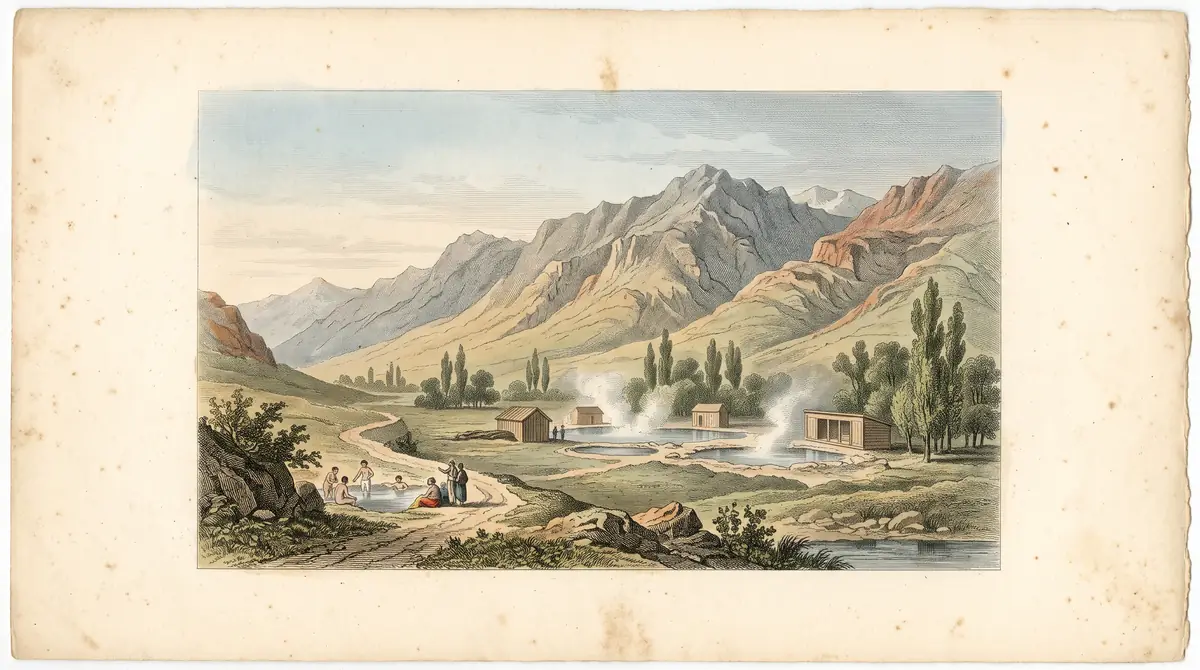
Zharkent-Arasan is a village and a sanatorium running on radon thermal water in a gorge on the Zhetysu (Dzungarian) Alatau foothills, at about 1,100 m and roughly 40 km from Zharkent. The water was first brought to the surface in 1952, and a clinic opened in 1967.
Verified: 2026-10
Zharkent-Arasan: when to go, month by month
- January: good
- February: good
- March: good
- April: best time
- May: best time
- June: good
- July: good
- August: good
- September: best time
- October: best time
- November: good
- December: good
The sanatorium is open all year; spring and autumn are easiest for the drive, and winter tyres are a must in winter.
Zharkent-Arasan: why go
Zharkent-Arasan radon springs
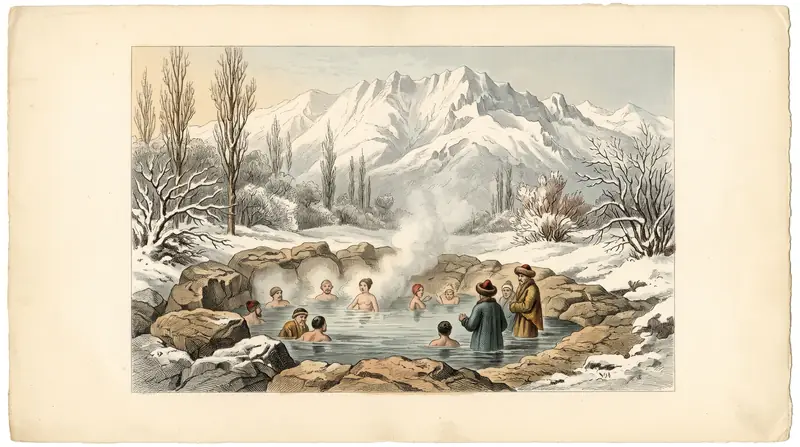
Chloride-sulphate sodium water with radon leaves the wells at 37–53 °C and is used in baths at 35–37 °C.
Borokhudzir gorge at 1,100 m
The sanatorium sits in a mountain gorge on the Dzungarian Alatau foothills, about 460 m above Zharkent and 40 km from town.
Zharkent-Arasan since 1952
Radon water was first brought up in 1952, an all-Union clinic opened in 1967, and the current complex has run since 2004.
28 treatments at Zharkent-Arasan
Per the sanatorium's website, the rate covers a room, three meals and 28 types of treatment, radon baths and mud therapy included.
Zharkent Mosque nearby
40 km away stands a wooden mosque of 1892–1895 by master Hon Pike, with Tian Shan spruce columns; it has housed a museum since 1978.
Zharkent-Arasan is a radon hot spring sanatorium and a small village in Panfilov District of Zhetysu Region, in Kazakhstan. It sits in the Borokhudzir river gorge on the foothills of the Zhetysu (Dzungarian) Alatau, at about 1,100 m and roughly 40 km from the town of Zharkent. The water leaves the wells at 37–53 °C and is used in the baths at 35–37 °C. This is a year-round medical complex with treatments, rooms and meals, not a wild roadside pool.
Zharkent-Arasan is a village and a working radon sanatorium
The name covers both the village and the sanatorium beside it. According to Wikipedia, the village belongs to Ulkenagash rural district of Panfilov District, and 67 people lived there in 2009. The sanatorium stands next to it in the Borokhudzir valley and draws on its own well of radon thermal water.
Do not confuse it with other springs named Arasan. Zharkent-Arasan is not Alma-Arasan near Almaty, and it is not the Arasan-Kapal resort on the northern slopes of the same range.
| Parameter | Value |
|---|---|
| Where | Panfilov District, Zhetysu Region, Borokhudzir river gorge |
| Range | foothills of the Zhetysu (Lesser Dzungarian) Alatau |
| Sanatorium altitude | about 1,100 m |
| From Zharkent | about 40 km, to the north-west |
| Water | chloride-sulphate sodium, radon |
| Temperature in the wells | 37–53 °C |
| Treatment / drinking water | 35–37 °C / 25–28 °C |
| Resort | water brought up in 1952, clinic opened in 1967 |
| Season | all year |
The hot springs: what is in the water
The water is chloride-sulphate sodium with radon, as described by Wikipedia, the sanatorium’s website and the welcome.kz guide (2025). Welcome.kz says it comes from wells of the Ku-Arasan deposit at 37–53 °C; WeProject (2026) gives “up to 53 °C”. Informburo (2023), in a review of the country’s radon resorts, lists Zharkent-Arasan among the sanatoriums with radon water.
The sanatorium’s website gives radon levels of 1–10 nCi/l for low-radon baths and 120–200 nCi/l for high-radon baths. It also states a mineralisation of 12 g/dm³, yet its home page calls the water lightly mineralised. The two claims do not match, so ask the sanatorium doctor if the figure matters for your treatment.
Silt mud is the second resource. According to welcome.kz, it is brought from two lakes in the Ili floodplain, about 70 km from the resort.
Treatments, indications and who should not take radon baths
A stay here is built around a medical programme. The “Treatment” page of the sanatorium’s website lists radon baths, drinking radon water, mud therapy, paraffin wraps, magnetotherapy, electrophoresis, inhalations and exercise therapy. Mud is recommended there for chronic joint and spine conditions, the after-effects of injuries, peripheral nervous system disorders and chronic inflammation of the reproductive system.
The website lists indications for the radon baths: the musculoskeletal system, the cardiovascular system, pelvic organs and metabolic disorders. It also lists contraindications, and they are serious.
| Contraindication (sanatorium website) | What it means for you |
|---|---|
| Heart rhythm disorders | see a cardiologist before booking |
| Pregnancy and breastfeeding | radon baths are excluded |
| Cancer, tuberculosis, radiation sickness | radon baths are excluded |
| Alcohol intoxication | no baths after drinking |
| Children | baths from age 5, only when indicated |
Radon baths are a strong procedure. Treatment decisions belong to a doctor, both at home before you travel and at the sanatorium itself.
A Soviet-era resort that still runs on its own well
According to the sanatorium’s website, radon water was first brought to the surface here in 1952, and an all-Union clinic opened in 1967; Wikipedia gives the same opening year. The current complex has operated since 2004 on the site of the Soviet balneological sanatorium.
It still uses its own well. The website says a stay includes 28 types of treatment, massage excluded, and three meals a day.
Getting there: Almaty to Zharkent, then 40 km into the gorge
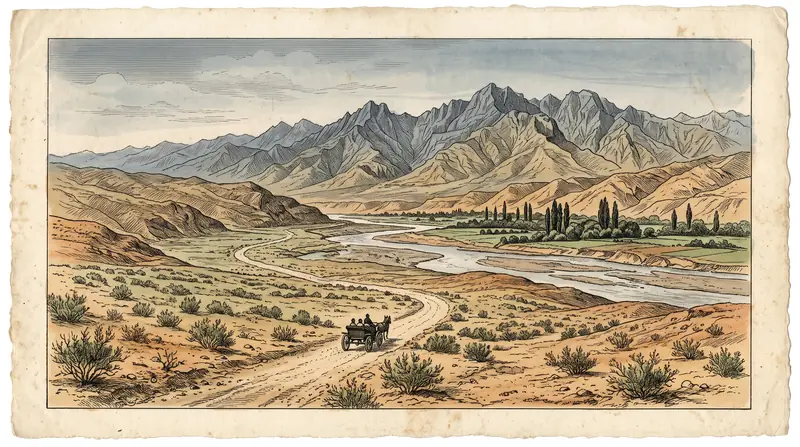
The route has two stages: reach Zharkent, then drive about 40 km on the tarmac road that, according to the sanatorium’s website, links it with the town and the district’s villages. Total distances differ between sources, and even between pages of the same website, so plan with a navigator.
| Leg | Distance | Note |
|---|---|---|
| Almaty — Zharkent | about 265 km to the east | Kazinform |
| Almaty — sanatorium | 280 km or 320 km | two figures on different pages of the sanatorium website |
| Taldykorgan — sanatorium | 280 km or 320 km | same two figures as for Almaty |
| Zharkent — sanatorium | about 40 km | sanatorium website, welcome.kz, WeProject agree |
| Zharkent — Chinese border | about 29 km | Wikipedia |
| Almaty — Derevyannoye Lake (on the way) | about 220 km | Informburo 2023 |
By car. Welcome.kz (2025) suggests leaving Almaty eastwards on the Kulja road and keeping left after Shelek onto the new concrete road; Derevyannoye Lake and the 700-year-old Aulie-Agash tree are landmarks on the way. The alternative is the Khorgos highway via the Baiserke interchange, the route Informburo used in 2023 to reach Derevyannoye Lake.
Without a car. Buses run to Zharkent from Almaty’s Sayakhat bus station, and taxis are also available (Inbusiness, 2020). The railway through Zharkent continues to Khorgos, but the same 2020 source says no passenger trains ran on it. For the last 40 km you need a taxi or a transfer.
Phone signal. According to its website, only Beeline works on the sanatorium grounds. If your SIM is on another network, tell people at home and download an offline map beforehand.
Zharkent, the last town before the springs
Zharkent is the centre of Panfilov District and the last town on the road. It lies at about 640 m, 29 km from the Chinese border, and the 2021 census counted 52,361 residents (Wikipedia). According to Kazinform, Uyghur and Dungan refugees from Kulja founded it in 1881; in Soviet times it was called Panfilov. The Khorgos border crossing is nearby (Inbusiness, 2020).
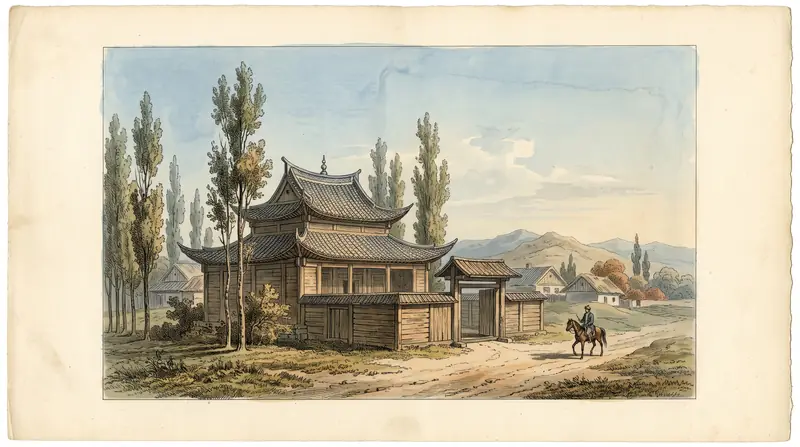
The town’s main sight is the Zharkent Mosque. Wikipedia says the idea of building it came up in 1887; the main mosque and portal went up in 1892–1895, and the small mosque, madrasa and wall in 1903–1905. It was built by the Chinese master Hon Pike with money from the merchant Vali Akhun Yuldashev, with columns of Tian Shan spruce and no nails used to join the wooden parts.
The mosque has housed a museum since 1978 and has been protected as a monument of history and culture of national significance since 1982 (Wikipedia). Kazinform (2022) writes that it is described as the only mosque in the country built in the form of a Buddhist temple, and that it receives 30–40 visitors a day on average.
When to go: open all year, easiest in spring and autumn
The sanatorium works in every season: according to Wikipedia, mild winters and warm summers allow it to operate all year. For the drive and for walks in the gorge, April–May and September–October are the most comfortable months. Summer days in Zharkent average +30 to +32 °C, but the sanatorium is about 460 m higher than the town and cooler.
Winter is the season that needs preparation. Zharkent nights average −8 to −12 °C, and the sanatorium’s website gives an absolute minimum of −42 °C, so fit winter tyres for the mountain section.
Day high, °C / Night low, °C · Rain/snow, mm
The sanatorium sits at about 1,100 m — roughly 460 m above central Zharkent (640 m) — so it is cooler there than at the station.
Monthly figures
| Month | Day high, °C | Night low, °C | Rain/snow, mm |
|---|---|---|---|
| Jan | -0.8 | -11.7 | 12.4 |
| Feb | 2.7 | -7.9 | 14.1 |
| Mar | 12 | 0.1 | 13.1 |
| Apr | 21 | 7 | 21.3 |
| May | 26.2 | 11.9 | 19.1 |
| Jun | 30.2 | 16.2 | 23.8 |
| Jul | 32.1 | 17.8 | 23.3 |
| Aug | 31.3 | 16 | 15.7 |
| Sep | 26.6 | 10.9 | 11.5 |
| Oct | 18.9 | 4.7 | 15.6 |
| Nov | 9.1 | -1.9 | 19.8 |
| Dec | 1.5 | -8.4 | 12.4 |
Source: Zharkent — Wikipedia, climate data (Pogoda.ru.net, NOAA)
The sanatorium’s own figures give a mean annual air temperature of 8.5 °C and a July mean of 24.2 °C; the coldest month averages about −11 °C, and the summer maximum has reached 42 °C. Zharkent gets about 200 mm of precipitation a year, so rain or snow rarely disrupts treatments or walks.
Border area: carry your passport
Zharkent lies 29 km from the Chinese border, and documents may be checked in border districts. Carry your documents with you.
What a stay includes and what costs extra
Rates are quoted per day. According to the sanatorium’s website, the daily rate covers the room, three meals and 28 types of treatment. Massage and extras such as halotherapy in a salt cave, oxygen cocktails and acupuncture are paid separately. We do not quote amounts.
Combining Zharkent-Arasan with nearby places
Places to combine with the sanatorium:
- Zharkent Mosque, about 40 km away in Zharkent: the wooden mosque of 1892–1895 described above.
- Derevyannoye Lake and the Aulie-Agash tree, on the way from Almaty (welcome.kz, WeProject). According to Informburo, the last kilometres to the lake are dirt and sand, so a 4×4 is the safer choice.
- Altyn-Emel National Park: the Singing Dune and the Aktau mountains in the Ili valley, a good pairing on a trip of several days.
- Zhongar-Alatau National Park: higher ground in the same Dzungarian Alatau, with wild Sievers apple forests, glaciers and high lakes.
For other thermal water, see Chundzha in Uygur District and Saryagash in southern Kazakhstan. A packing checklist is in before you go.
Zharkent-Arasan: tips before you go
- Check the route in a navigator: the sanatorium's own site gives 280 km from Almaty in one place and 320 km in another.
- Only Beeline has signal at the sanatorium, so download offline maps before you go.
- Radon baths have contraindications, so talk to your doctor before the trip.
- Winter nights in Zharkent average down to −12 °C, so fit winter tyres for the mountain road.
More to see nearby


Frequently asked questions
Where is Zharkent-Arasan?
How do I get to Zharkent-Arasan from Almaty?
How far is Zharkent-Arasan from Taldykorgan?
How hot is the water at Zharkent-Arasan?
Are the Zharkent-Arasan springs radon springs?
Is Zharkent-Arasan open in winter?
What is there to see near Zharkent-Arasan?
Sources
- Жаркент-Арасан — Википедия
- Жаркент — Википедия
- Жаркентская мечеть — Википедия
- Zharkent-Arasan sanatorium — website, home page
- Zharkent-Arasan sanatorium — About us
- Zharkent-Arasan sanatorium — Treatment
- Hot springs of Kazakhstan: where they are, what they are good for and how to get there — welcome.kz, 27.07.2025
- Термальные источники Казахстана: 10 мест для отдыха и восстановления — WeProject, 24.08.2026
- Какие курорты в Казахстане радоновые и относится ли к ним Чунджа — Informburo, 02.05.2023
- Отдохнуть с пользой для здоровья: санатории Казахстана — Tengrinews, 21.08.2018
- В чём уникальность 130-летней Жаркентской мечети — Казинформ, 30.10.2022
- Жаркент: юго-восточные ворота Казахстана — Inbusiness.kz, 13.10.2020
- Деревянное озеро и тайны Жаркента: интересный маршрут на выходные — Informburo, 18.05.2023
- Zharkent: climate data 1991–2020 — Wikipedia (Pogoda.ru.net, NOAA)
Read also
 Rakhmanov Springs: radon hot springs in the Altai
 Barlyk-Arasan hot springs near Lake Alakol: water, radon and what to ask
 Arasan Spa Almaty: prices, steam rooms and rules at the Arasan Baths
 Saryagash: a mineral water spa town in southern Kazakhstan
- Hot springs in Kazakhstan: how to choose between six thermal spas
-
Chundzha (Shonzhy): hot springs of the Uygur district