Ukash Ata well and mausoleum: when to go, month by month
- January: possible
- February: possible
- March: good
- April: best time
- May: best time
- June: good
- July: possible
- August: possible
- September: best time
- October: best time
- November: possible
- December: possible
April–May and September–October bring mild highs of 17–26 °C, while summer climbs to about 34 °C and winter stays near freezing with the most rain.
Ukash Ata well and mausoleum: why go
The Ukash Ata well
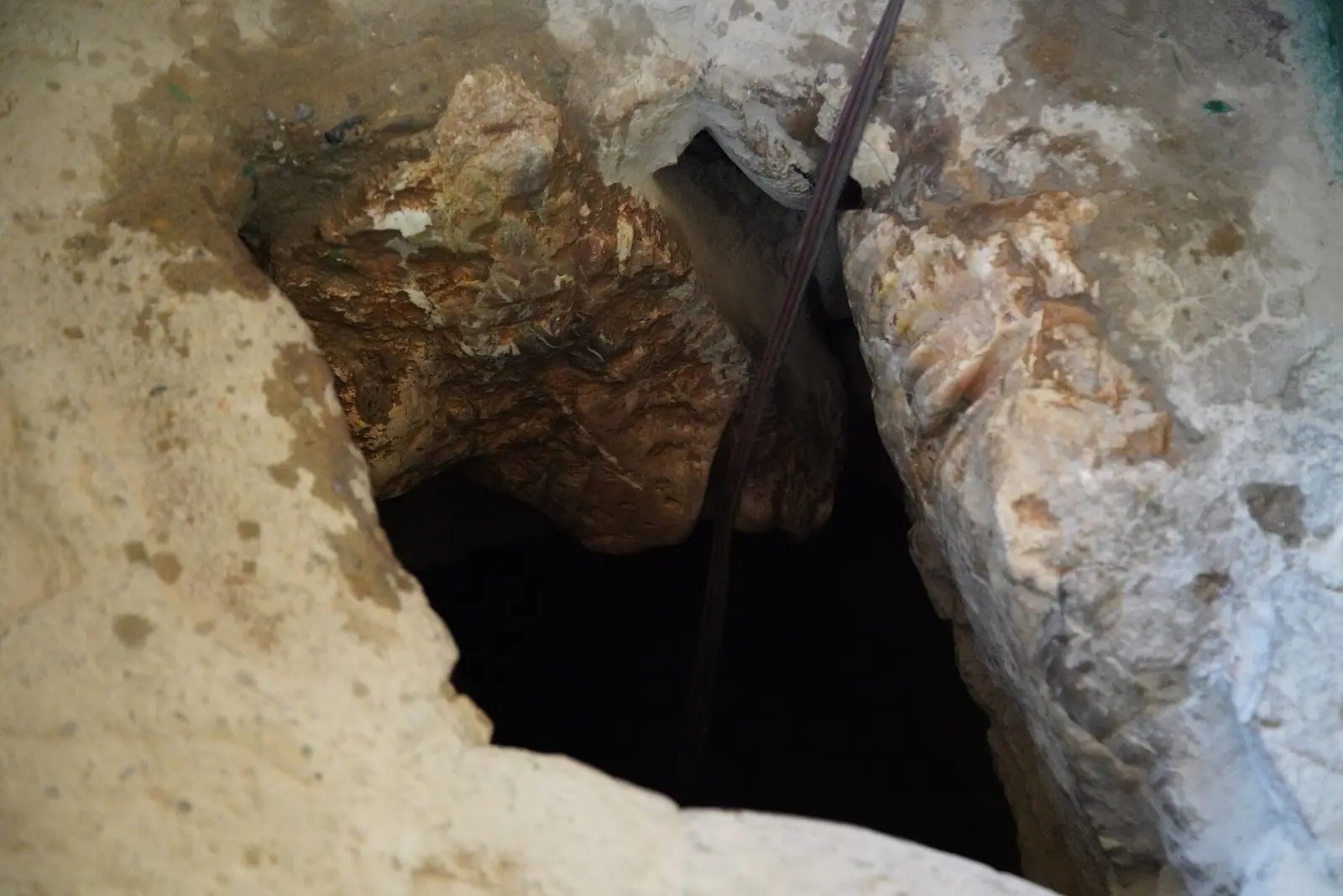
A well about 22–25 m deep over a rock crevice, under a yurt-shaped roof. Pilgrims lower a bucket; the water level varies and many raise it empty.
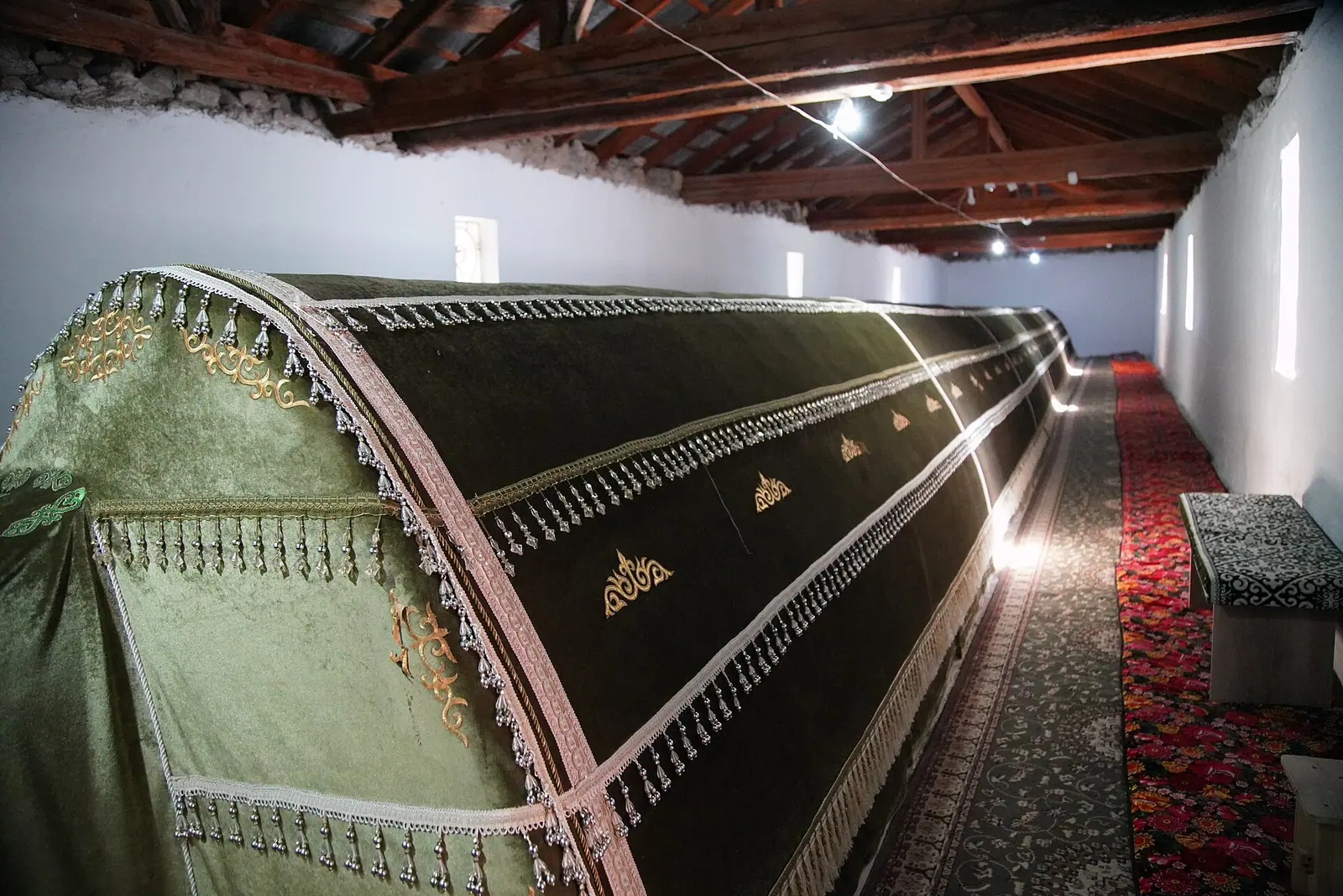
A 21 m tombstone inside
The main chamber holds a tombstone 21 m long by Russian Wikipedia, about 12 m by Kazakh Wikipedia. Outside lies the 12 m grave of Er-Koyan batyr.
A side trip from Turkistan
The shrine lies about 35 km in a straight line north of Turkistan on the Karatau foothills. We could not confirm public transport, so plan a car.
Ukash Ata in spring and autumn
April–May and September–October bring highs of 17–26 °C. July averages near 34 °C with almost no rain; winter nights drop to about −6 °C.
Ancient or rebuilt in 1989–1990
Historians date the complex to the 9th–10th centuries, yet the Margulan Institute calls it a 1989–1990 construction by local residents.
Ukash Ata well and mausoleum in photos
Real photos by travellers (Pexels, Unsplash, Wikimedia Commons); author and licence are given in each caption.
Ukash Ata is a memorial complex in Turkistan Region, in southern Kazakhstan, made up of a mausoleum with a very long tombstone and a well about 22–25 m deep. Pilgrims lower a bucket into the well. Legend says only a sinless person brings it up with water. It lies about 35 km in a straight line north of the city of Turkistan, so it fits into a day based there.
Where Ukash Ata is and what kind of trip it demands
Ukash Ata stands on the southern slope of the Karatau range, on high ground near the Ogiz-tau gorge, in the Babaykurgan rural district of Sauran District. Russian Wikipedia puts it 35 km north of Turkistan. Kazakh Wikipedia gives 55 km; we could not confirm which distance is right or how it was measured. The straight-line distance from the city is about 35 km.
In practice this is a half-day or day trip from Turkistan, the nearest city. We could not confirm any bus or shared-taxi service to the site. A traveller without a car or Russian should plan to arrange transport in Turkistan before setting off. The complex belongs to the Azret Sultan National Historical and Cultural Museum-Reserve, and since 30 May 2019 it has been listed as a monument of history and culture of republican significance.
The well is the reason most pilgrims come
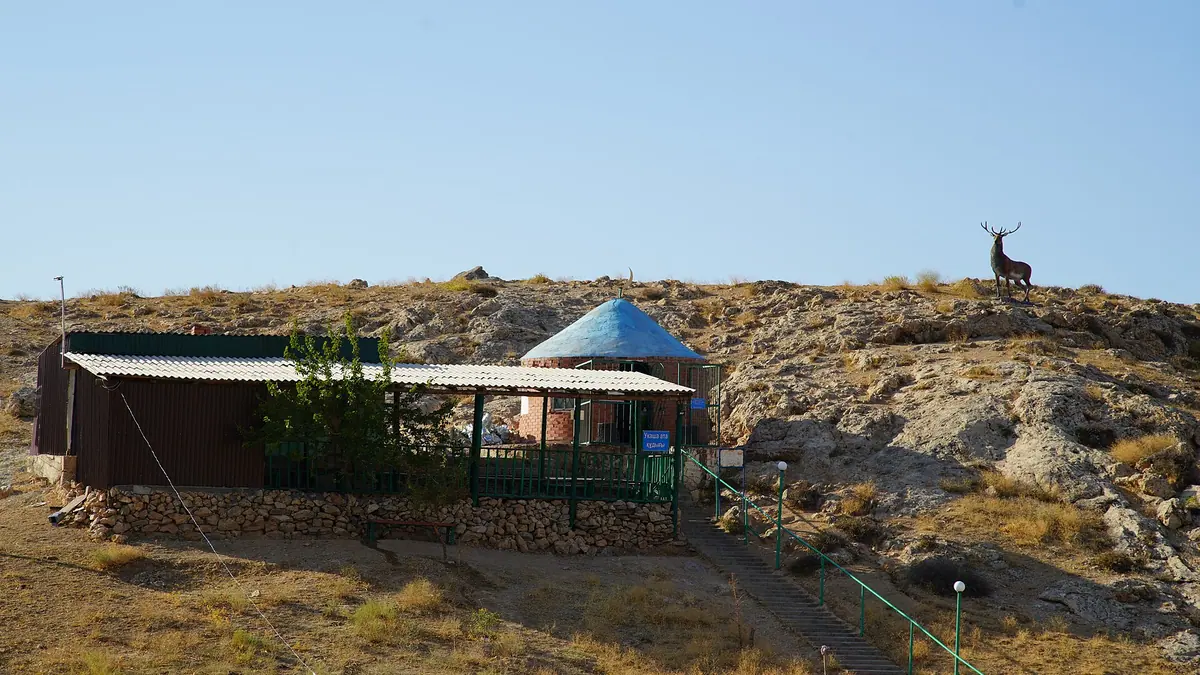
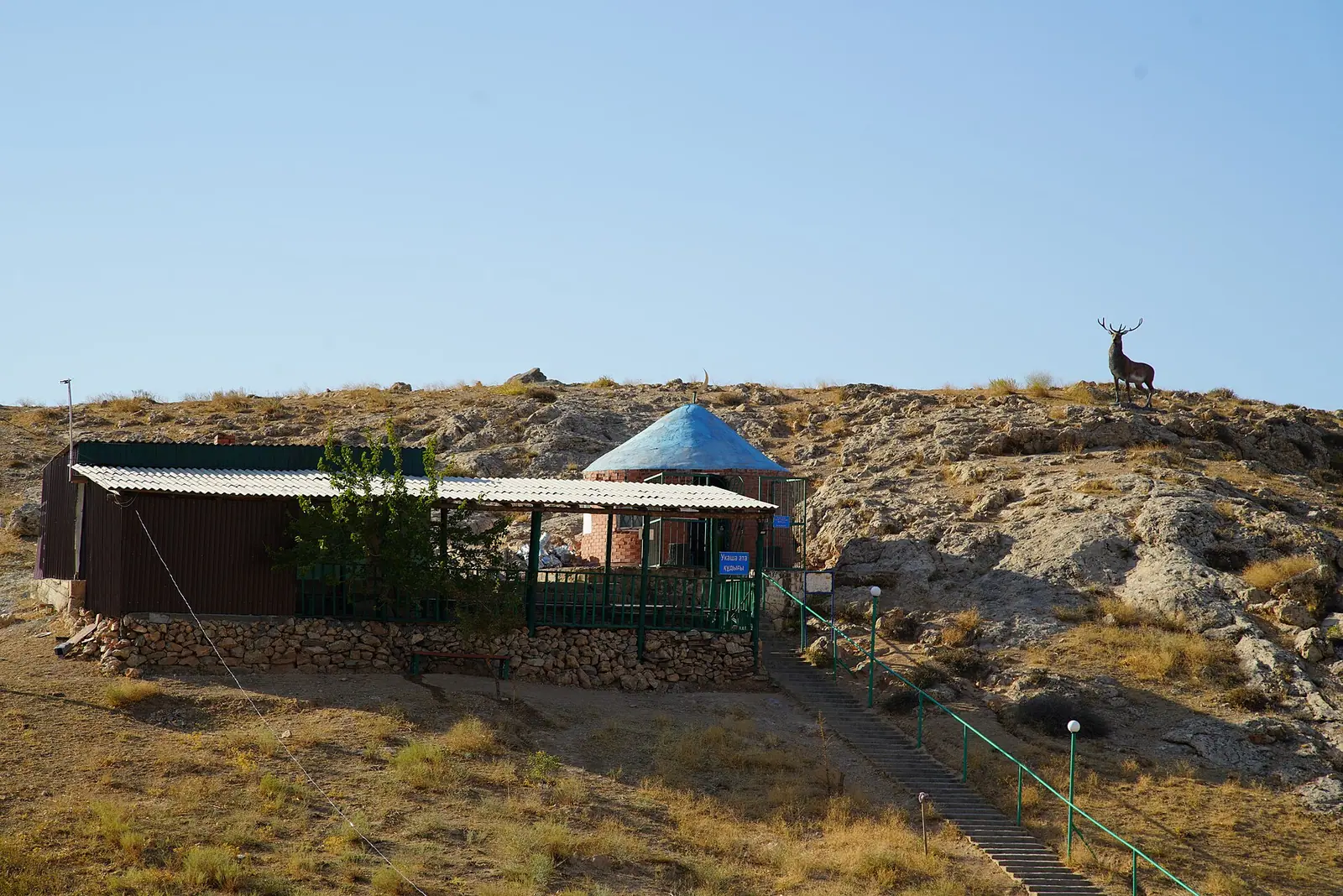
The well sits over a crevice in the rock, and a small yurt-shaped building covers it. Kazakh Wikipedia gives this structure a diameter of 4.5 m and a height of 3.5 m. The water level is not constant, and Russian Wikipedia notes that pilgrims often fail to draw any water at all. Go expecting a ritual, not a reliable spring.
Tradition holds that a sinless person lowering a bucket on a rope will raise it full, and a sinful one will raise it empty. If a stone comes up in the water, God grants that person the gift of a healer, writer, seer or musician. Nearby stands a tug, a pole where pilgrims tie ribbons.
The two Wikipedia articles disagree on where the well is: 600 m west of the mausoleum by the Russian article, 200 m west by the Kazakh one. Either way it is a short walk.
The mausoleum and its giant tombstones
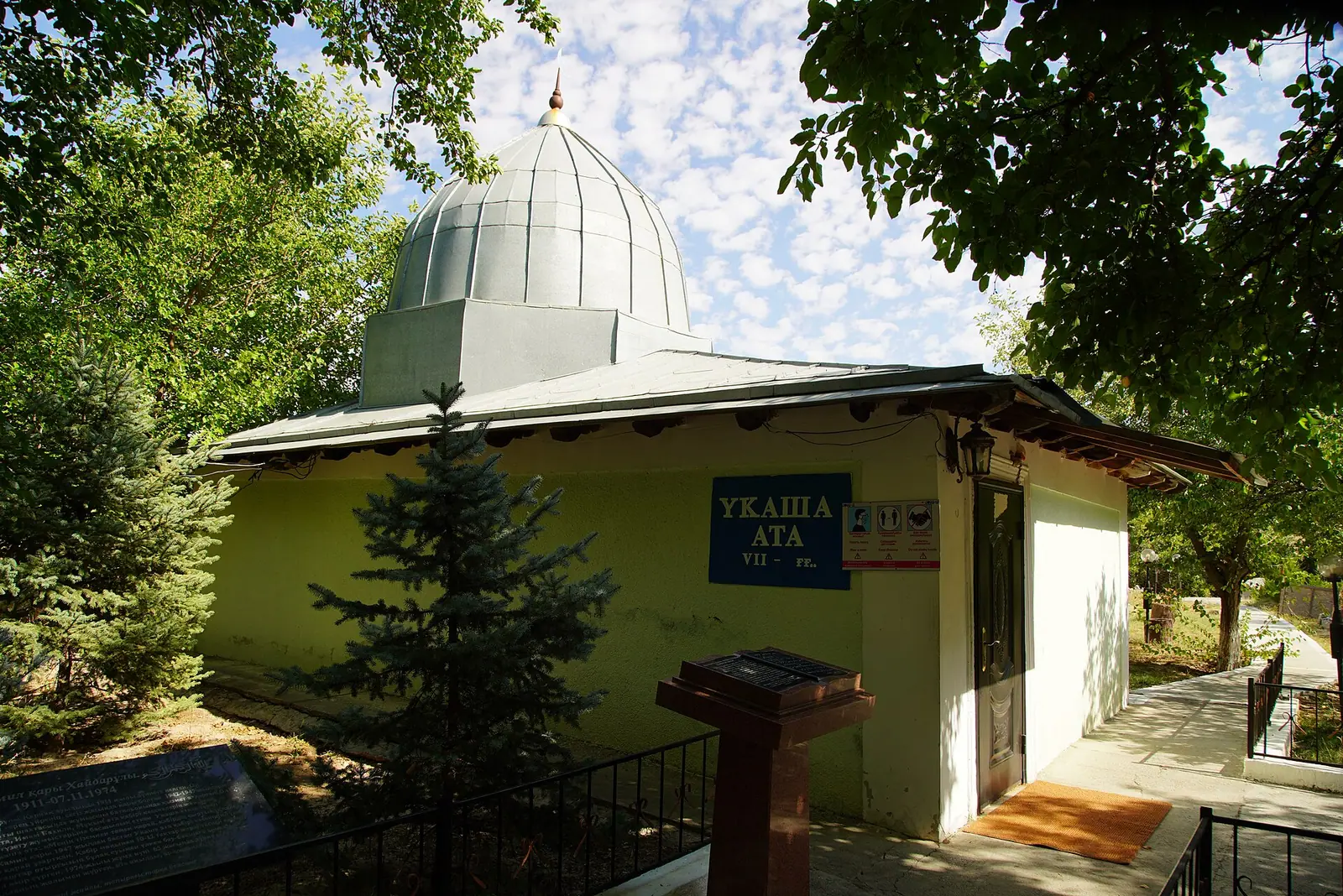
The mausoleum has two rooms: a small vestibule and a long main chamber with seven small windows. Inside lies a tombstone that Russian Wikipedia calls one of the largest in Kazakhstan. Outside is a second monumental grave, 12 m long, said to belong to Er-Koyan batyr, a companion of Ukasha Ata. A modern guest house for pilgrims stands beside the mausoleum.
The published measurements do not agree, and the table shows both versions. Expect a long, low building with a much longer grave inside than you would see at most tombs.
| Feature | Russian Wikipedia | Kazakh Wikipedia |
|---|---|---|
| Distance from Turkistan | 35 km north | 55 km north |
| Main chamber | 22.2 m long, 4.6 m wide, 4 m high | 25 m long, 8.6 m wide (building overall 16 x 5 m, 3.5–4 m high) |
| Tombstone inside | 21 m long | about 12 m long, 160–170 cm high |
| Well depth | about 22–25 m | 23 m |
| Well from mausoleum | 600 m west | 200 m west |
Kazakh Wikipedia also describes a sheet-metal dome, 3.5–4 m in diameter and 4–4.5 m high, on the west side and walls of mountain stone rendered in white and grey cement with gravel. Its explanation for the tomb’s length is a legend: the saint’s head rolled 12 m when he was struck, and he was buried together with his blood.
How old is Ukash Ata: the sources disagree
There is no settled date for the complex. Modern historiography, as summarised by Russian Wikipedia, dates it to the 9th–10th centuries and links the giant tombstones to a South Arabian, Yemeni tradition that spread in Central Asia under the Karakhanids.
The Margulan Institute of Archaeology takes the opposite view: all objects tied to the cult are new constructions, and the mausoleum was built by local people in 1989–1990. Another version holds that a building stood long before the 20th century and was rebuilt many times. In Soviet years the shrine was destroyed several times in anti-religious campaigns and later restored, the last time destroyed in 1986 and rebuilt in the early 1990s.
Kazakh Wikipedia adds that at first there was only a grave. In the 1940s the first keeper, Kamil qari, built a 32 m grave structure over it and enclosed 5 hectares with a stone wall to plant a garden. For the visitor this means the walls you see are recent; the weight of the place lies in the cult, not the masonry.
The legends of Ukasha
Legend identifies Ukasha Ata with Ukkasha ibn Mihsan, a companion of the Prophet Muhammad mentioned in al-Bukhari’s hadith collection. Historical sources do not confirm that he ever reached Central Asia.
In the local story he preached Islam among the Turkic peoples and could not be defeated in battle. His enemies bribed his wife, who told them he could be killed during prayer. They struck off his head while he prostrated; it rolled into the mountain crevice and travelled by an underground river to Mecca. The Kazakh version says the well connects with the Zamzam spring and that the head was buried at the feet of the Prophet, fulfilling Ukasha’s wish. The well was built over the crevice, and the mausoleum where his blood was spilt.
A second legend tells how Ukasha claimed a debt from the Prophet: two blows of a whip on bare shoulders. When the Prophet removed his shirt, a divine radiance appeared, Ukasha threw the whip away, and the Prophet said that whoever visits Ukasha will escape the fire of hell. This is a living pilgrimage site, so behave as you would in any mosque or shrine.
When to go to Ukash Ata
Spring and autumn are the comfortable windows: April, May, September and October. The figures below are ERA5 reanalysis normals for 2011–2020 at a grid point at 484 m, not readings from a weather station. The shrine sits on Karatau foothill ground and we could not confirm its exact elevation, so the site may differ from these figures.
Day high, °C / Night low, °C · Rain/snow, mm
A computed reanalysis normal for these coordinates, not weather station records.
Monthly figures
| Month | Day high, °C | Night low, °C | Rain/snow, mm |
|---|---|---|---|
| Jan | 1.3 | -5.6 | 44 |
| Feb | 3.3 | -5.3 | 38.9 |
| Mar | 12 | 2 | 46.6 |
| Apr | 19.5 | 8.6 | 34.2 |
| May | 26.7 | 14.4 | 24.7 |
| Jun | 31.8 | 18.4 | 6.1 |
| Jul | 34.2 | 20.5 | 2.7 |
| Aug | 32.4 | 19.3 | 2.7 |
| Sep | 26.3 | 13.2 | 2.2 |
| Oct | 17.8 | 5.8 | 17.2 |
| Nov | 7.8 | -1.8 | 44.6 |
| Dec | 1.9 | -5.9 | 53.2 |
July averages a daytime high near 34 °C and June to August stay above 31 °C, with almost no rain, so midday in summer is hard work in open country. Winter days barely rise above freezing, nights fall to about −6 °C, and November to March bring the most precipitation, around 41–56 mm a month.
| Period | What to expect |
|---|---|
| Dec–Feb | Highs 1.5–3 °C, frosty nights, wettest months |
| Mar | Highs near 11.5 °C, still wet |
| Apr–May | Highs 19–26 °C, moderate rain, comfortable |
| Jun–Aug | Highs 31.5–34 °C, nearly dry, go early morning |
| Sep–Oct | Highs 26 °C falling to 17 °C, dry September |
| Nov | Highs near 7 °C, rain returns |
Combining Ukash Ata with other sites near Turkistan
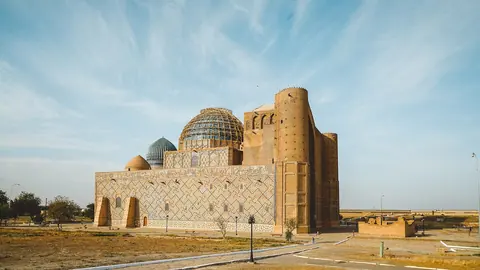
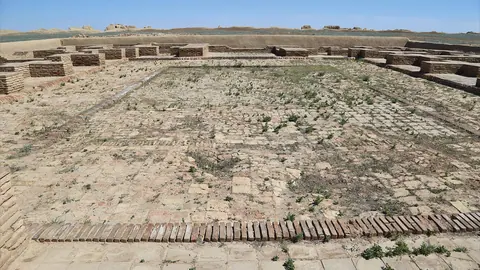
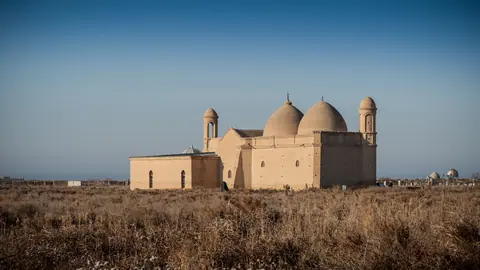
Ukash Ata pairs naturally with the shrines and ruined cities around Turkistan. The medieval city of Sauran is about 41 km in a straight line from the well. Further south, Arystan Bab and Otrar are both about 85 km in a straight line, usually a separate day. We could not confirm road times between these sites.
- Whether any bus or shared taxi runs from Turkistan to Ukash Ata, and the road condition
- Opening hours and any entry fee set by the Azret Sultan museum-reserve
- Dress code and rules for visitors at the mausoleum and well
- Whether the pilgrim guest house accepts foreign travellers
- The exact elevation of the site compared with the 484 m climate grid point
Ukash Ata well and mausoleum: tips before you go
- Visit Ukash Ata from April to May or in September to October; June to August highs exceed 31 °C with almost no rain.
- Do not count on drawing water: the well's level is not constant and pilgrims often raise the bucket empty.
- The well is 200–600 m west of the mausoleum depending on the source, so allow time to walk between them.
- Arrange transport in Turkistan, about 35 km away in a straight line; we could not confirm any bus to the site.
More to see nearby


Frequently asked questions
What is the secret of the Ukash Ata well?
How deep is the Ukash Ata well?
How far is Ukash Ata from Turkistan?
Who is buried at Ukasha Ata?
Is the Ukash Ata mausoleum ancient?
Sources
Read also
 Almaty Zoo in Kazakhstan: opening hours and how to visit
 Ayusai Gorge, Almaty: visitor centre and waterfall trail
 Gorelnik Gorge above Medeu: waterfalls, trail and season
 Kamenskoe Plateau above Almaty: observatory and trails
 Pervomaiskie Ponds near Almaty: location, swimming, season
 Saty village: base for the Kolsai and Kaindy lakes