Torysh Valley of Balls: the stone spheres of Mangystau
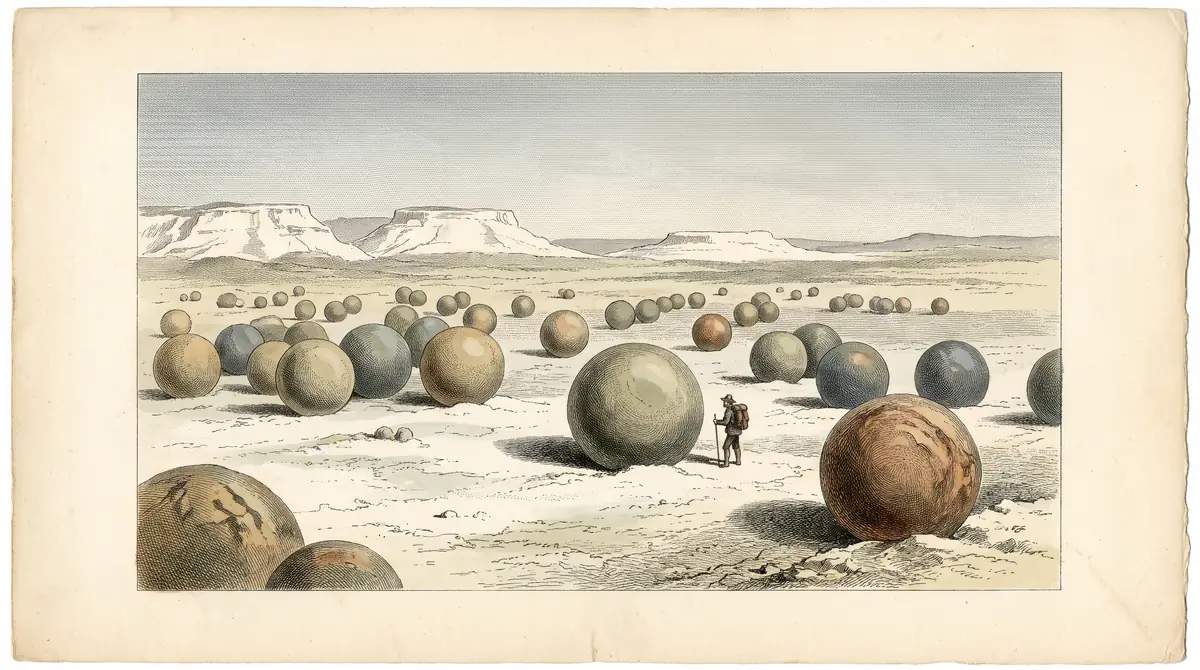
A tract at the northern end of the Western Karatau hills where stone concretions from 10–15 cm to 4 m across lie scattered over the steppe. The valley has no protected status.
- Getting there
- 90–150 km from Aktau
- When
- May, Sepbest timeNow: off season
- Size
- Spheres up to 4 m
- Where
- 17.5 km from Taushyk
- Transport
- 50–60 km to Sherkala
- Note
- Not a protected area
Torysh Valley of Balls: when to go, month by month
November · now- January: off season
- February: off season
- March: possible
- April: good
- May: best time
- June: possible
- July: possible
- August: possible
- September: best time
- October: possible
- November: off season
- December: off season
May to September, but summer tops +40 °C: mid-April to May and the second half of September are the comfortable windows.
Torysh Valley of Balls: why go
The Torysh Valley of Balls
About a thousand stone concretions from 10–15 cm to 4 m across lie scattered over the steppe, and most of them are still buried.
Spheres from the Tethys seabed
Minerals grew in layers around shells, bones and plant remains on the floor of an ancient ocean; when the water left, the balls surfaced.
How old are the balls?
Wikipedia says 40–60 million years, geologist B. Tolegenuly the Cretaceous (145–66 million), and Tengrinews 180–120 million years.
Torysh has no protection
The valley is not a protected area: in 2023 stones were hauled off with a forklift, and in 2024 it joined a list of 39 sites for future protection.
Torysh, Sherkala, Shakpak-Ata
Sherkala is 50–60 km away and the Shakpak-Ata underground mosque another 50–70 km: the opening stops of a five-day Mangystau loop.
The Torysh Valley of Balls is a tract at the northern tip of the Western Karatau hills in Mangystau Region, western Kazakhstan, where stone spheres from 10–15 cm to 4 m across lie scattered over the steppe. Sources put it 90 to 150 km from Aktau, and the nearest village, Taushyk, is 17.5 km away. Go in May or September and pair it with Sherkala Mountain, 50–60 km away. The valley has no protected status, so whether the balls survive depends largely on the people who visit.
| Torysh Valley of Balls: quick answers | |
|---|---|
| From Aktau | 90 to 150 km, sources differ |
| Nearest village | Taushyk, 17.5 km |
| Size of the balls | 10–15 cm to 4 m |
| When to go | May or September |
| Nearby | Sherkala Mountain, 50–60 km |
| Status | no protected status; do not take stones |
The stone balls are concretions, not carved or fallen objects
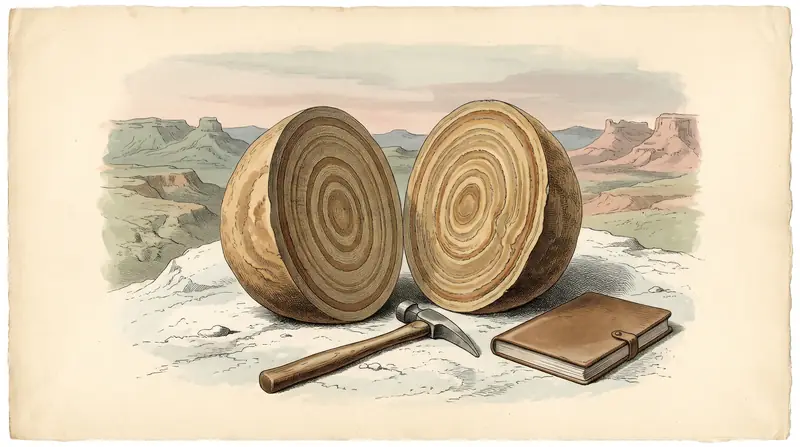
The Torysh spheres are concretions, mineral masses that grew layer by layer around a core such as a shell, an ammonite, a fish bone or a plant fragment. Where the surrounding sediment was uniform, the result was an almost perfect ball. Wikipedia links their formation to the floor of the ancient Tethys Ocean. When the water retreated, wind and rain stripped away the softer rock and left the spheres exposed.
According to geologist Bekbolat Tolegenuly (Lada.kz, 2024), most of the balls are still underground. What you see on the surface is only part of the field.
The ocean explanation is not the only one in print. Tengrinews (2020) cites Professor Asima Koshim, who suggests the rock melted during an earthquake in a zone of tectonic faults, and geologist Gennady Tarasenko, who linked the balls to electrical discharges and ball lightning. By that outlet’s assessment, there is no scientific consensus. Lada.kz (2023) places the valley between the Karatau ridge and the northern and southern chinks (escarpments) of Aktau.
Koi-Tas: the local name and the legends
Locals call the place Koi-Tas, “stone sheep” (Tengrinews, 2020).
Two legends circulate. In one, a hero fired a cannon and the cannonballs landed across the steppe. In the other, the balls are enemies turned to stone after people prayed to their ancestors for protection.
How old and how big the Torysh spheres are
Sources disagree sharply on age, and we are not going to pick one figure.
| Fact | Value | Source |
|---|---|---|
| Diameter | 10–15 cm to 4 m | Wikipedia |
| Number | about a thousand | Lada.kz (2024) |
| Age | 40–60 million years | Wikipedia |
| Age | Cretaceous, 145–66 million years | geologist B. Tolegenuly, Lada.kz (2024) |
| Age | 180–120 million years, Mesozoic | Tengrinews (2020) |
| Nearest village | Taushyk, 17.5–18 km | Wikipedia; Lada.kz |
| Coordinates | 44°21′41″ N, 51°33′40″ E | Wikipedia |
The age estimates span from 40 to 180 million years, so treat any single figure you see on signs or social media with caution. Save the coordinates on an offline map before you leave Aktau.
Torysh is not the only concretion field in the region. Tolegenuly also names the area near Onda village, Zharmysh, the surroundings of Sherkala, Zhyngyldy and spots further towards Beket-Ata, all along a fault in the northern Karatau.
Getting to the Valley of Balls from Aktau takes a 4x4
Plan on a prepared off-road vehicle: about two-thirds of Tengri Auto’s loop is unpaved. Distances from Aktau vary widely between sources.
| Source | Distance from Aktau |
|---|---|
| Ministry of Tourism and Sport (2026) | about 90 km |
| Tengrinews (2020) | about 100 km |
| Wikipedia; Lada.kz (2024) | about 150 km |
Part of the gap comes from counting straight-line versus road distance, so budget time for the longer figure. Even the district differs: Wikipedia puts the tract in Mangystau District, the ministry in Tupkaragan District.
On Tengri Auto’s five-day loop (2026), Torysh is the second stop after Sherkala, 50–60 km between them depending on the track. The Shakpak-Ata underground mosque is another 50–70 km on, with Taushyk village as the landmark. About two-thirds of that loop (around 65%) is dirt, salt flat and stony plateau, so the outlet recommends a 4x4 with good clearance, more than one spare tyre, and travelling in a group.
When to visit: mid-April to May or late September
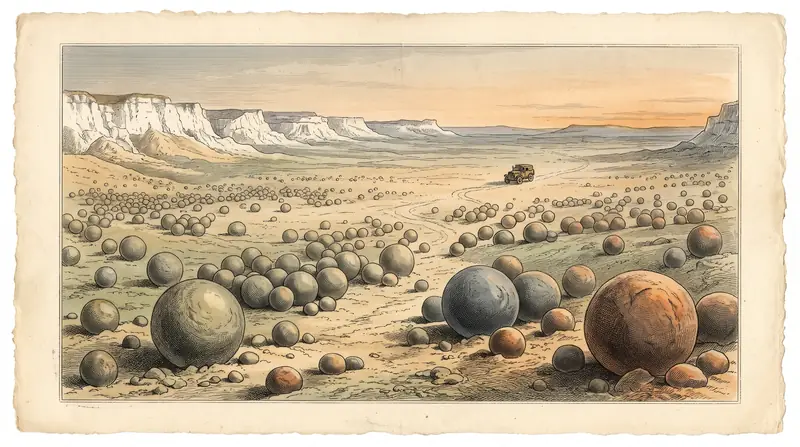
The comfortable windows are mid-April to late May and the second half of September, as for the rest of Mangystau. Tengrinews (2020) suggests May to September, but summer heat in the region easily passes +40 °C, and desert nights are 20–30 degrees colder than the day (Tengri Auto, 2026).
| Period | What to expect |
|---|---|
| Mid-April to late May | Most comfortable window |
| June to August | Heat can pass +40 °C; no shade on site |
| Second half of September | Second comfortable window |
| Any season | Night temperatures 20–30 degrees below daytime |
There is no shade at all among the balls. Bring a hat, sturdy shoes, food and drinking water, and bring warm clothes for the cold nights.
No protection, and stones are being taken
The Valley of Balls is not a protected natural area. The Forestry and Wildlife Committee confirmed this, and in May 2023 the regional akimat said it could not fund protection from the local budget (Lada.kz). The balls are classed as natural objects, not historical or cultural monuments.
The results are visible. In May 2023 a video showed stones being loaded with a forklift; the men got away with a “preventive talk” and were told to return them. Lada.kz mentions large stones being hauled off in dump trucks, and Tengrinews wrote back in 2020 that the spheres decorate streets, hotels and private yards in Aktau. In November 2024 police were looking for tourists filmed rolling one of the balls out of place (Newtimes.kz).
In 2017 the akimat applied for UNESCO natural heritage status for the tract, without success. In 2024 Torysh was included among 39 natural sites planned for a local protected area, with the scientific justification meant for the 2025 budget (Lada.kz, November 2024).
Rules to follow at Torysh
Treat the field as you would a fragile site, since nobody else guards it.
- Do not take, move or crack the balls, not even the small ones.
- Do not dig around them: most concretions are still below ground.
- Keep your car on the existing track, not between the spheres.
- Expect no signal and no hotels; fuel only in Aktau, Zhanaozen and Shetpe. See our before you go checklist.
What to combine with the Valley of Balls
Torysh is the second stop after Sherkala on Tengri Auto’s five-day loop (2026).
- Sherkala Mountain: the “lion’s fortress”, 50–60 km away, with the Akmysh oasis at its foot.
- Shakpak-Ata underground mosque: 50–70 km further on. Mangystau’s rock mosques joined the UNESCO World Heritage List in 2026.
- Bozzhyra and Mangystau: Kyzylsay fees, fuel, signal and desert safety.
Torysh Valley of Balls: tips before you go
- Do not take or move the balls, even small ones; most concretions are still underground.
- There is no shade: bring a hat, sturdy shoes, food and drinking water.
- Save the spot on an offline map: no source describes the last stretch from Taushyk.
- Fuel is only available in Aktau, Zhanaozen and Shetpe — none out in the steppe.
More to see nearby


Frequently asked questions
How far is the Torysh Valley of Balls from Aktau?
How did the stone balls at Torysh form?
How old are the Torysh balls?
How big are the balls?
Is Torysh a protected area?
When should I visit Torysh?
Can I take a small ball as a souvenir?
Sources
- Торыш — Russian Wikipedia
- The place where the gods played bowling: the mysterious Torysh tract — Tengrinews, 28 Apr 2020 (in Russian)
- Spherical stones in Mangystau — Lada.kz, 17 Jul 2024 (in Russian)
- Valley of Balls: is concretion theft being stopped? — Lada.kz, 17 Nov 2024 (in Russian)
- Mangystau akimat: protecting the Valley of Balls from the local budget is impossible — Lada.kz, 16 May 2023 (in Russian)
- Tourists moved ancient stone balls in Mangystau — Newtimes.kz, 19 Nov 2024 (in Russian)
- 10 summer destinations in Mangystau Region — Ministry of Tourism and Sport, 21 Jul 2026 (in Russian)
- Sherkala, Sultan-Epe: a route through the most mysterious region — Tengri Auto, 13 Jun 2026 (in Russian)
Read also
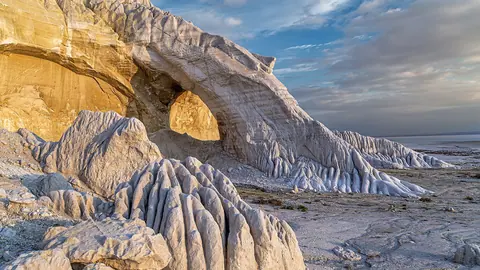 Tuzbair salt flat: getting there, the after-rain mirror and fees
 Karagiye Depression, the deep karst basin near Aktau
 Ustyurt Plateau: visiting the Ustyurt Reserve in western Kazakhstan
 Shakpak-Ata underground mosque: getting there and what to know
 A Mangystau itinerary for 3 or 5 days, planned out from Aktau
- Trips from Aktau, Kazakhstan: the coast, the desert and the Mangystau hills