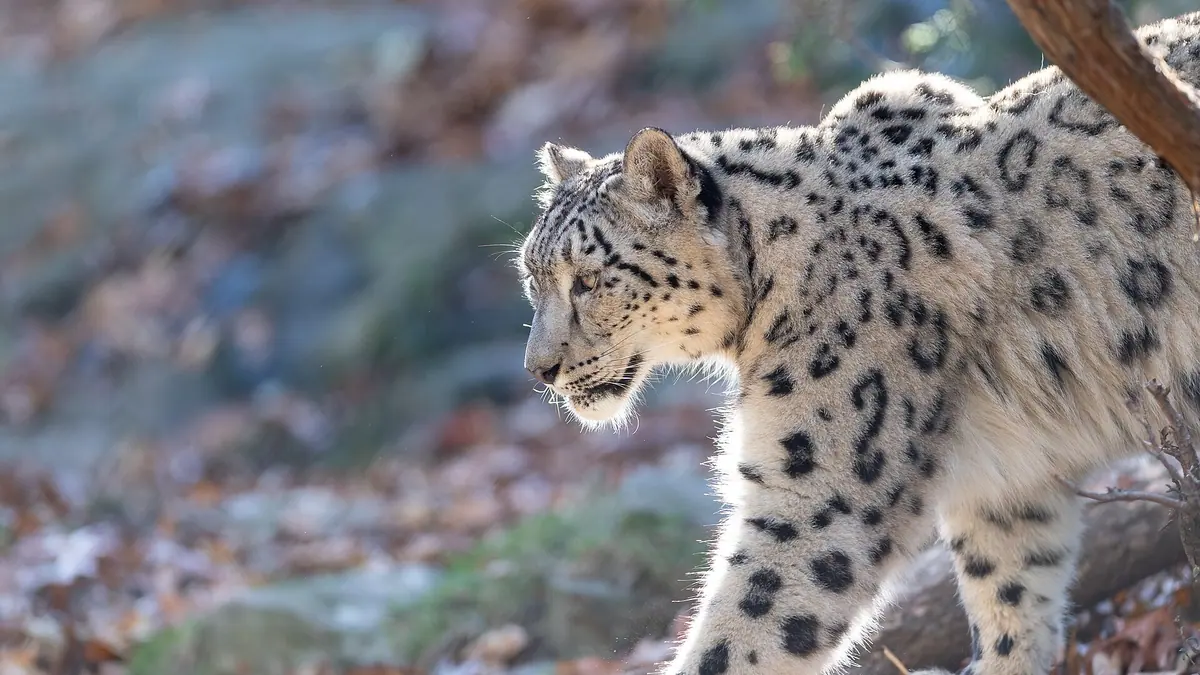
Where the snow leopard lives in Kazakhstan, and what a traveller can realistically expect: when to go, month by month
- January: good
- February: good
- March: good
- April: possible
- May: possible
- June: possible
- July: possible
- August: possible
- September: possible
- October: possible
- November: good
- December: good
Snow leopards come down to about 1,200-2,000 m in winter and stay high in summer, so the lower zone is likelier in winter, though sightings stay rare all year.
Where the snow leopard lives in Kazakhstan, and what a traveller can realistically expect: why go
Snow leopard on Almaty's doorstep
Thirty-five camera traps set on Almaty's outskirts in late 2020 recorded snow leopards 65 times in the Ile-Alatau within about a year.
A cat built for cliffs and snow
Broad furred paws spread its weight on snow, and a tail over three-quarters of its body length helps it balance on broken rock.
Tracks rather than sightings
Most visitors will only ever find signs: large round prints with no claw marks, and ground scrapes left where the cat marks its route.
Snow leopard winter descent
In summer it stays at 2,700-6,000 m above the tree line; in winter it moves down to roughly 1,200-2,000 m, following its prey.
The big cat that cannot roar
Its vocal folds are only 9 mm long, so instead of roaring it meows, grunts, moans and snorts, and it purrs on the exhale.
Where the snow leopard lives in Kazakhstan, and what a traveller can realistically expect in photos
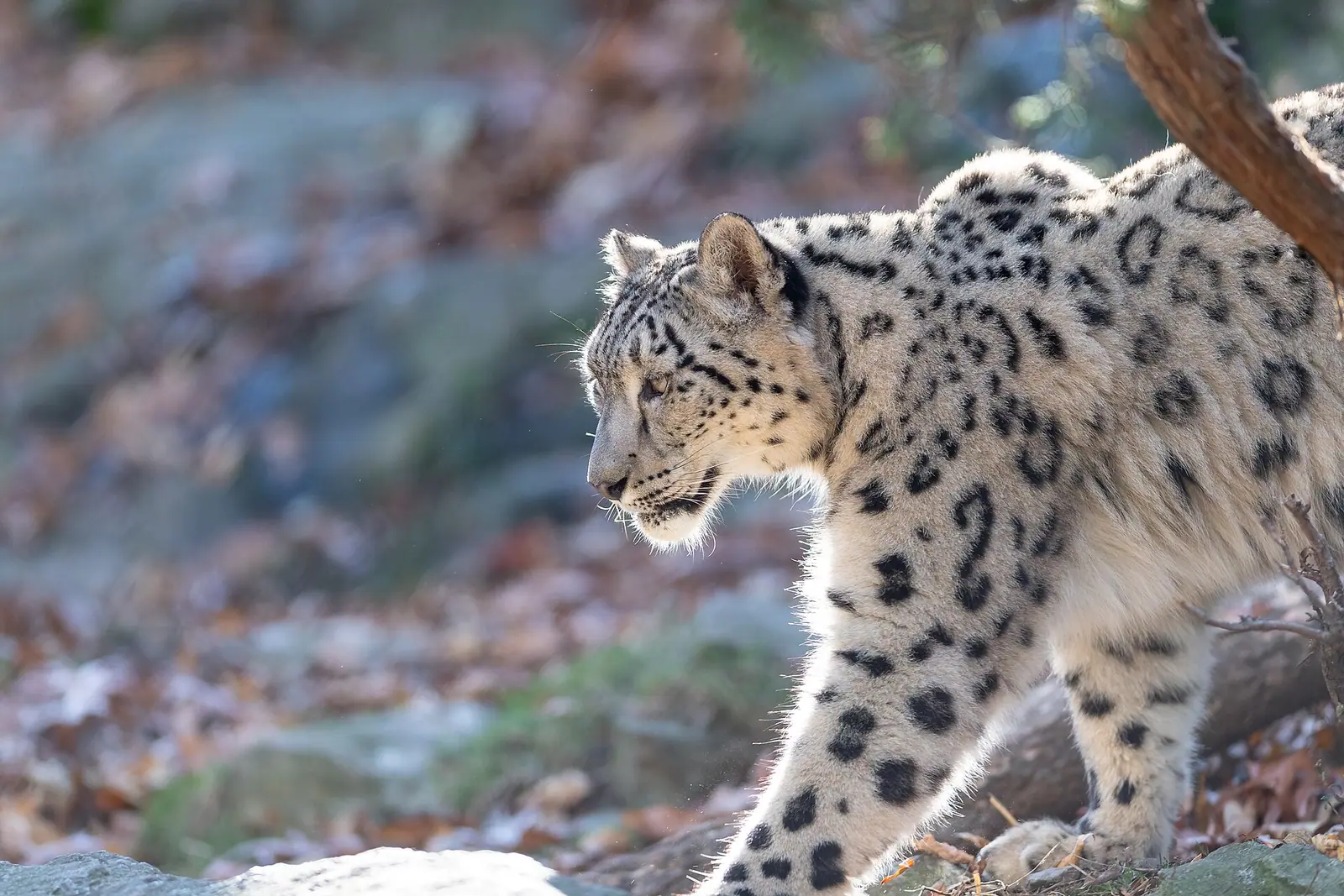
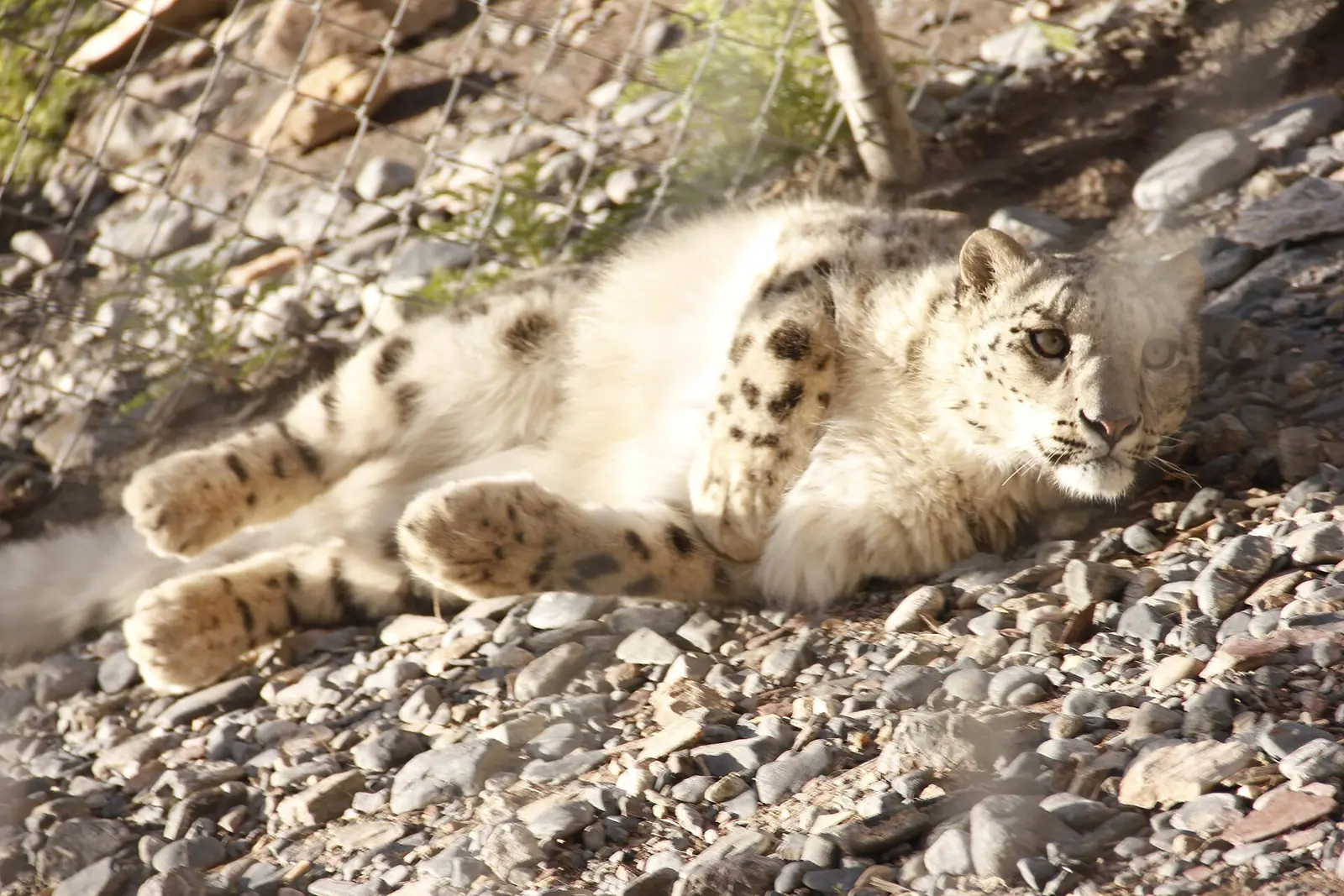
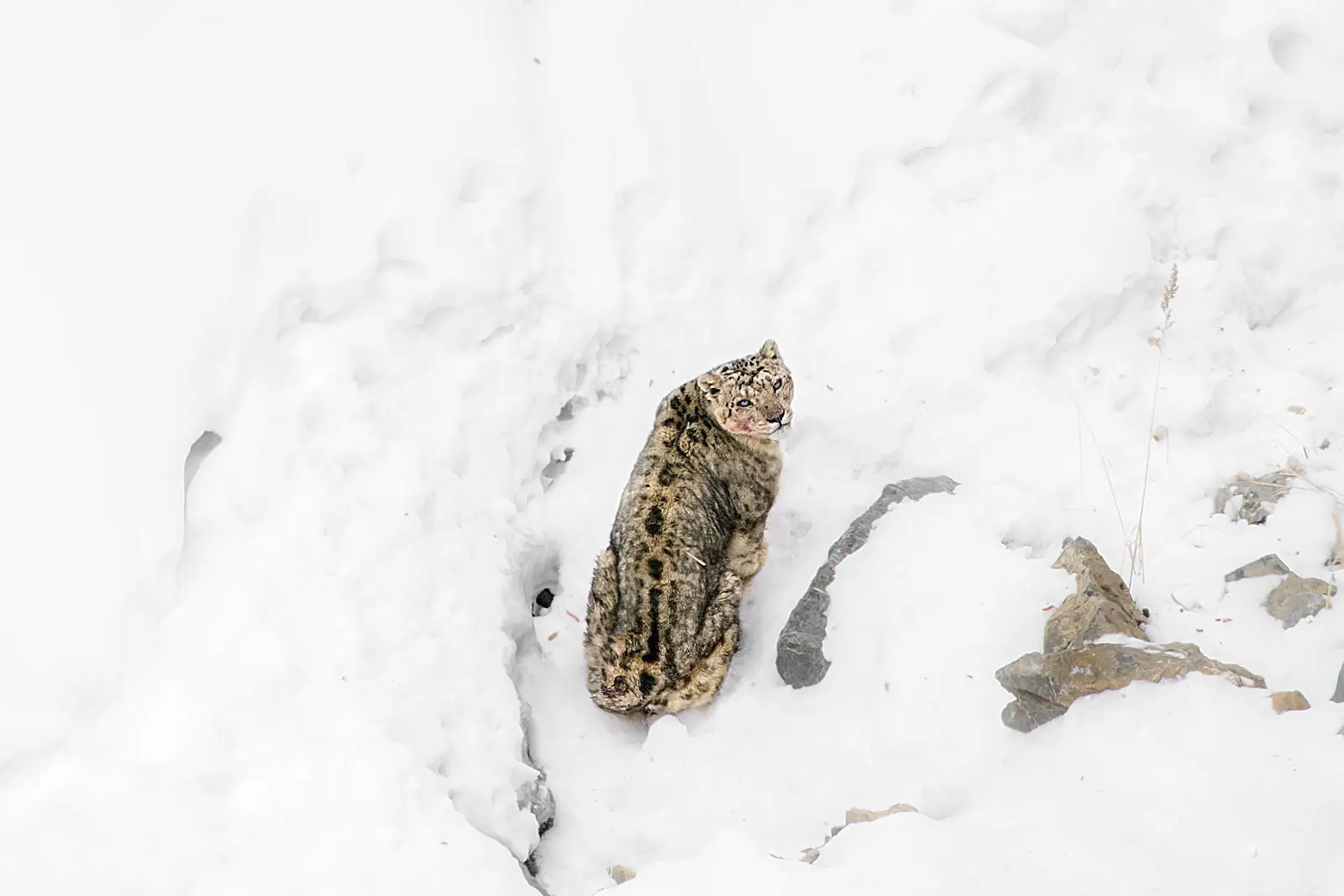
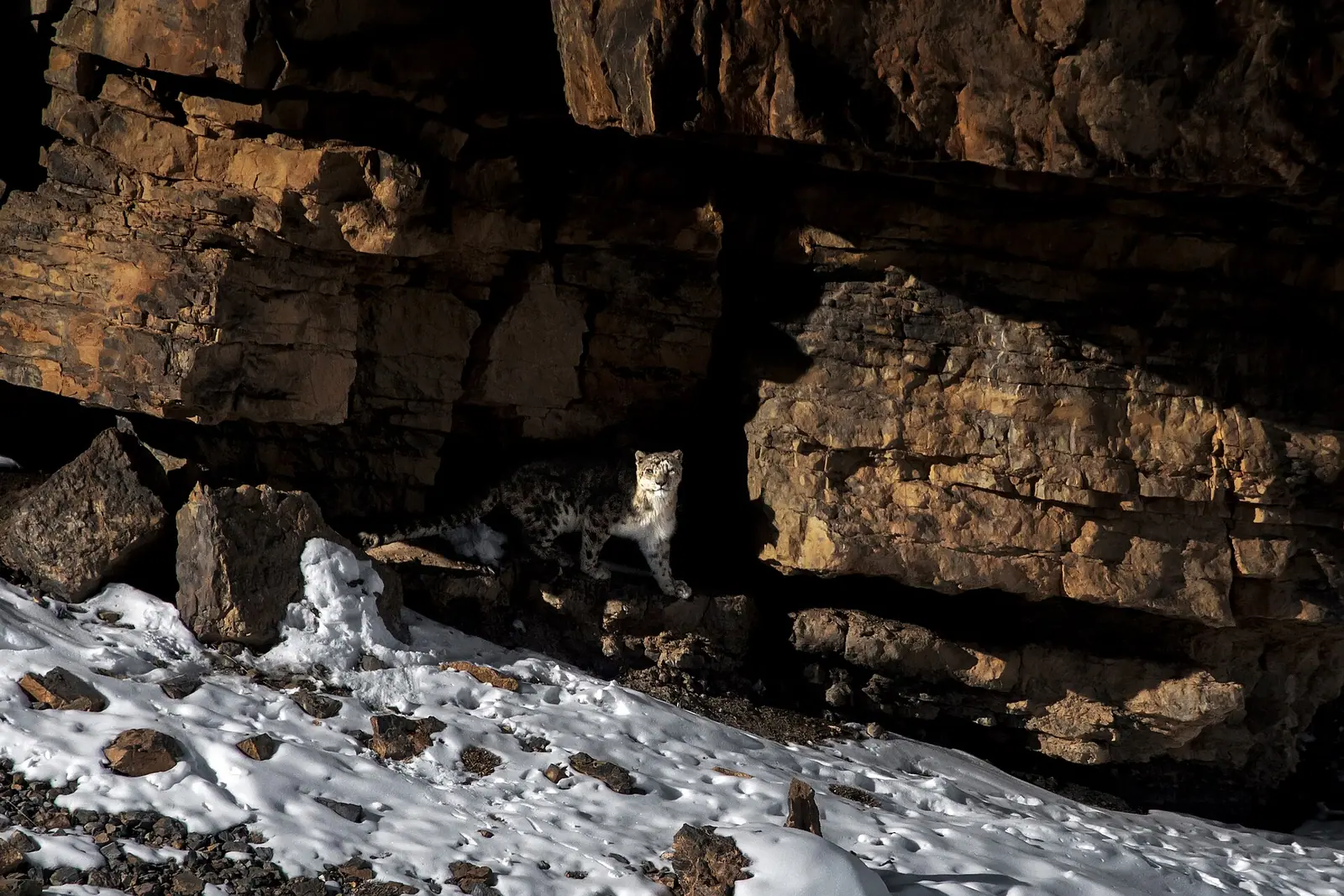
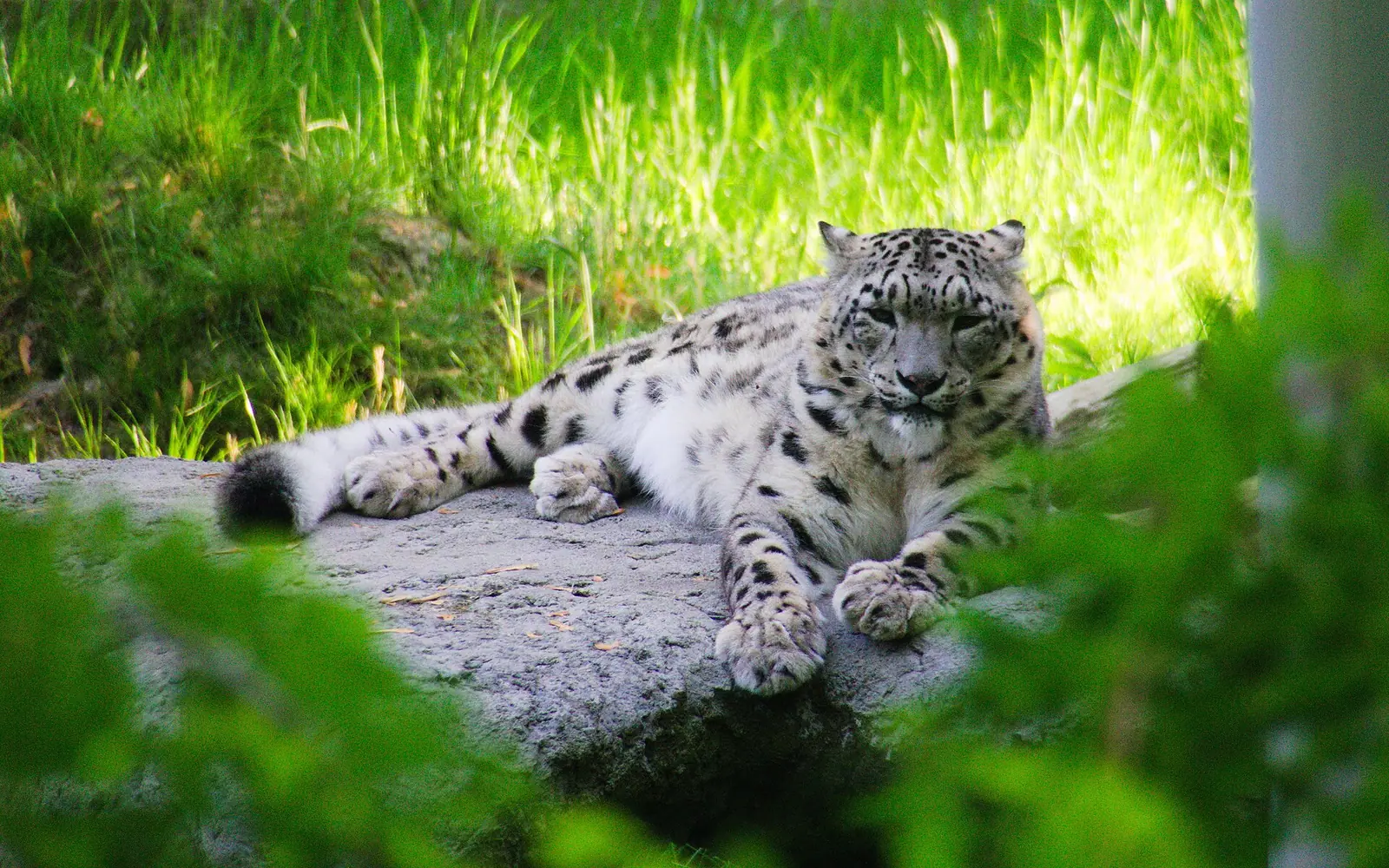
Real photos by travellers (Pexels, Unsplash, Wikimedia Commons); author and licence are given in each caption.
The snow leopard lives in Kazakhstan’s high mountains, part of a range that runs through the Tian Shan to the Pamirs, Altai and Himalayas. The best-documented local evidence comes from the Ile-Alatau (Trans-Ili Alatau) on the edge of Almaty, where camera traps filmed the cat dozens of times. It is a rare, solitary animal of cliffs and ridges, so treat this page as a guide to where and how it lives, not as a promise of a sighting.
Snow leopards in Kazakhstan live in the Tian Shan, including the Ile-Alatau above Almaty
Kazakhstan is one of the 13 countries listed in the snow leopard’s range, alongside Kyrgyzstan, Tajikistan, Uzbekistan, China, Mongolia, Russia and the Himalayan states. The cat’s range crosses the Tian Shan, the mountain system that rises south and east of Almaty.
The clearest recent evidence is local. At the end of 2020, 35 cameras were installed on the outskirts of Almaty to catch footage of snow leopards. In November 2021 the Russian branch of the World Wildlife Fund announced that the cats had been recorded 65 times on these cameras in the Trans-Ili Alatau since installation, according to English Wikipedia.
For a visitor this means the animal shares mountains that are reachable from Kazakhstan’s largest city. It does not mean it appears on the hiking paths. We could not confirm a current population figure for Kazakhstan or a list of the protected areas where it is surveyed.
Seeing one is unlikely, and the odds come down to its habits
The snow leopard is solitary, lives at low density and is mostly active at dawn until early morning, and again from afternoon into early evening. It rests near cliffs and ridges that give it shade and a lookout. Its camouflage is built for exactly that terrain: smoky, almost white grey fur with blurred dark rosettes that vanish against dark rock, snow and ice.
The numbers explain why researchers rely on cameras. Where prey is plentiful, up to 10 animals share 100 sq km; where prey is sparse, 1,000 sq km may hold only five. Studies in Nepal and the Gobi recorded home ranges of 12-39 sq km and 83-270 sq km respectively, and one male could cover up to 7 km in a night.
What a traveller can realistically find is signs: large, round tracks without claw marks, and scrapes where the cat marks territory before leaving urine or droppings, sometimes spraying rocks. We could not confirm whether any wildlife-watching trips for snow leopards operate in Kazakhstan, or what permits they would need. In the city, Almaty Zoo is the other place to look, though the last report of a snow leopard there dates from September 2023.
Altitude by season: high in summer, lower in winter
The snow leopard follows altitude with the seasons, and that is the most useful fact for anyone hoping to be in the right zone. Across its range it lives mostly at 3,000-4,500 m, but in the northern part of the range, which includes Kazakhstan, it also uses lower ground.
| Season | Typical elevation | Terrain |
|---|---|---|
| Summer | 2,700-6,000 m | Alpine meadows and rock above the tree line |
| Winter | about 1,200-2,000 m | Lower slopes, following prey downhill |
| All year | varies | Broken, rocky ground; uses existing animal trails, can move in snow 85 cm deep |
In practice, summer puts the cat in remote high country that needs serious mountain trekking. Winter brings it lower. These elevation figures are general for the species, not measured for Kazakhstan, and we have no climate data for its Kazakh habitat, so check mountain conditions separately.
How to recognise a snow leopard, and where the sources disagree on size
A snow leopard looks like a smaller, stockier leopard with very long fur, short legs, a small round head and an enormous tail. The tail is more than three-quarters of the body length, thick with fur and fat, and the cat wraps it over its face when it sleeps. The ears are short and round, almost hidden in winter fur.
The two encyclopedias give different weights, and the gap is large:
| Measure | Russian Wikipedia | English Wikipedia |
|---|---|---|
| Head and body | 103-130 cm | 75-150 cm |
| Tail | 80-105 cm | 80-105 cm |
| Shoulder height | about 60 cm | 56 cm |
| Weight | 22-40 kg | males 45-55 kg, females 35-40 kg; extremes 75 kg and under 25 kg |
The safe takeaway: a cat roughly 2-2.3 m long including the tail, weighing somewhere from the low 20s to the 50s in kilograms. Unlike lions or tigers, it cannot roar; it meows, grunts, moans and makes a soft snort called prusten.
Status: vulnerable, protected, and the population figures vary
The snow leopard is listed as Vulnerable on the IUCN Red List, is in CITES Appendix I, which bans international trade in the animal and its parts, and hunting it is banned in every country where it lives. Poaching and habitat loss are the main threats.
How many remain depends on the source:
| Estimate | Figure | Source |
|---|---|---|
| Global, 2003 | 4,000-7,000 | Russian Wikipedia |
| Global, 2020 | 2,700-3,400 | Russian Wikipedia |
| Global, current | fewer than 10,000 mature animals, expected to fall about 10% by 2040 | English Wikipedia, IUCN listing |
For travellers the practical point is simple: any skin, claw or other part offered for sale is illegal to trade across borders. Since 2013 the range countries have run a joint conservation programme covering anti-poaching work, protected areas and compensation to farmers who lose livestock. International Snow Leopard Day falls on 23 October, and the UN General Assembly adopted it in December 2024.
Local names: irbis, ilbirs and irviz
In Russian the cat is called irbis or snezhny bars, and you may meet both names in Russian-language material. Russian fur traders took the word from Turkic hunters in the 17th century. In Semirechye, the historical region of south-east Kazakhstan, the animal is called ilbirs, and in the districts east of Almaty bordering China, irviz. Knowing these words helps if you ask locals or read Russian-language material about the mountains.
- Whether any guided snow leopard watching trips operate in Kazakhstan, and on what terms.
- Which protected areas in Kazakhstan hold snow leopards, and what entry permits apply.
- A population figure for the Ile-Alatau alone. For the whole country, the Forestry and Wildlife Committee told Kazinform 152 to 189 in May 2025, and the cat is number 191 on the national Red Book list.
- Winter access and conditions in the Ile-Alatau at the altitudes where the cats descend.
Where the snow leopard lives in Kazakhstan, and what a traveller can realistically expect: tips before you go
- Snow leopards are most active from dawn to early morning and again in late afternoon; time any mountain watching to those hours.
- In winter they drop to about 1,200-2,000 m, in summer they stay at 2,700 m and above; pick your altitude by season.
- Learn the track: large, round, with no claw marks. It is the sign you are far more likely to find than the cat itself.
- Snow leopard parts are under CITES Appendix I; never buy skins, claws or souvenirs claimed to come from one.
Frequently asked questions
Are there snow leopards in Kazakhstan?
Can you see a snow leopard near Almaty?
What does the snow leopard eat?
How many snow leopards are left?
Sources
Read also
 Almaty Zoo in Kazakhstan: opening hours and how to visit
 Ayusai Gorge, Almaty: visitor centre and waterfall trail
 Gorelnik Gorge above Medeu: waterfalls, trail and season
 Kamenskoe Plateau above Almaty: observatory and trails
 Pervomaiskie Ponds near Almaty: location, swimming, season
 Saty village: base for the Kolsai and Kaindy lakes