Shopan-Ata: when to go, month by month
- January: possible
- February: possible
- March: possible
- April: best time
- May: good
- June: possible
- July: possible
- August: possible
- September: good
- October: best time
- November: possible
- December: possible
Spring and early autumn bring mild, dry days, while summer averages above 33 °C and winter nights fall below freezing.
Shopan-Ata: why go
Shopan-Ata underground mosque
A 7.1 × 5.1 m hall cut into a ravine wall, lit only by a round ceiling shaft 1.2 m across, with a pole hung with cloth and argali horns.
Oghuz-Kipchak tombs
The south-western part holds the oldest graves, from the 10th–13th centuries: enclosures, domeless mausoleums and stelae worn by weather into ruins.
A long desert drive
The site lies north of Senek in Karakiya district, about 179 km in a straight line from Aktau, on the old Khorezm caravan route.
Spring and autumn at Shopan-Ata
April–May and September–October bring daytime highs of roughly 17–28 °C. July averages 35.7 °C, with almost no rain.
Rainwater for a cave mosque
Channels on the rock above fed pits holding 10–15 cubic metres of water, which supplied the mosque's residents all year.
Shopan-Ata in photos
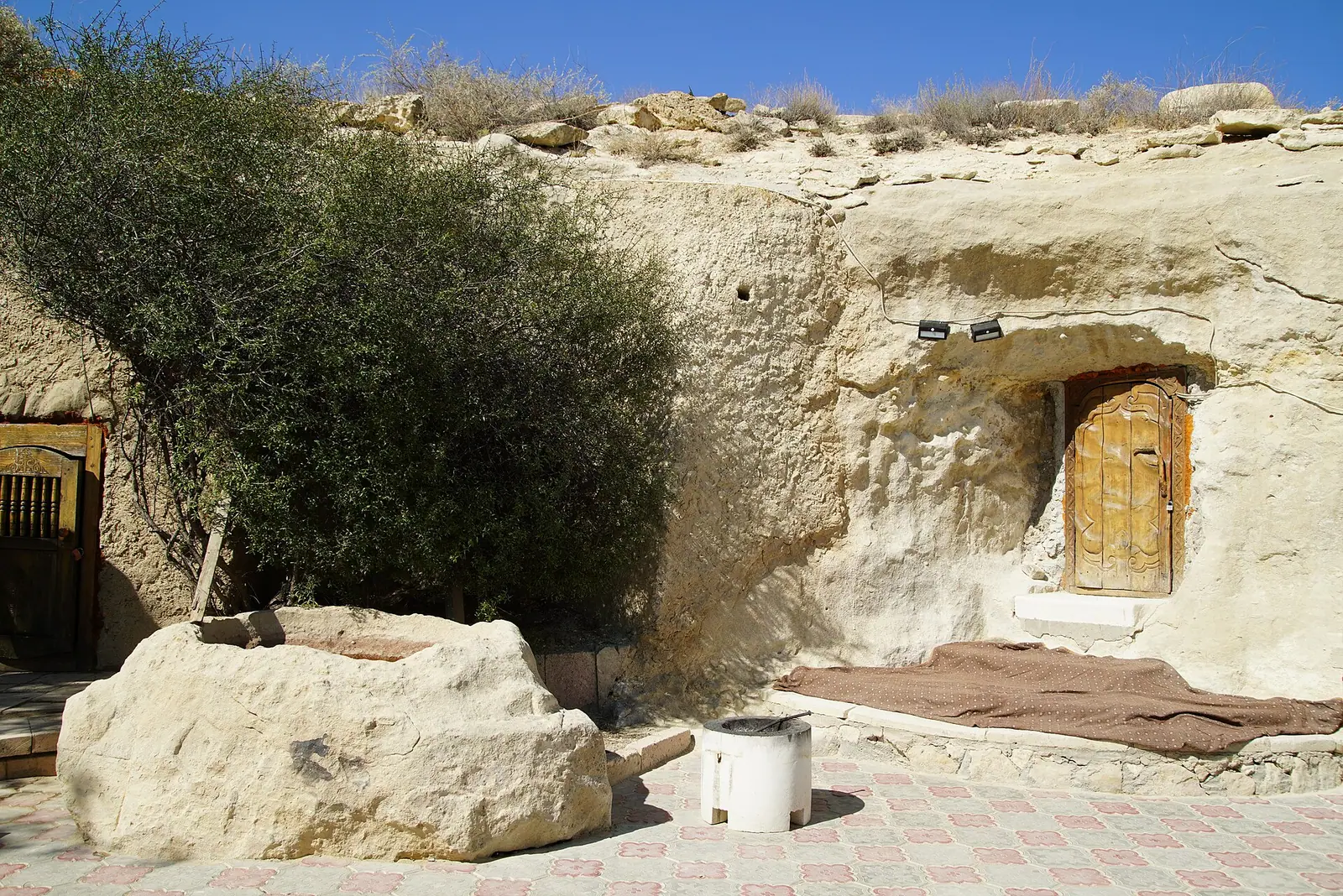
Real photos by travellers (Pexels, Unsplash, Wikimedia Commons); author and licence are given in each caption.
Shopan-Ata is a sacred site in the Mangystau region of western Kazakhstan. It is made up of an underground mosque cut into rock and a necropolis whose graves date from the 10th to the 19th century. Kazakh Wikipedia calls it a sacred place for Muslims, and it lies deep in the desert, about 179 km in a straight line from Aktau.
Where Shopan-Ata is and what the trip demands
Shopan-Ata lies in the Karakiya district of Mangystau region, north of the village of Senek. Russian Wikipedia puts it 21 km from Senek and Kazakh Wikipedia says 25 km. Kazakh Wikipedia also places it 42 km north-east of Kyzylsay village, south of the Tuyesu sands, in the south-east of the Mangyshlak peninsula.
The nearest city on the list is Aktau, about 179 km away in a straight line. Road distance will be longer. This is the far west of the country, on the Caspian side. Visitors flying into Almaty or Astana should plan a separate trip to reach it. We could not confirm any public transport to the site, road conditions on the last stretch from Senek, or whether fuel and food are available along the way. Without a car and some Russian or Kazakh, expect to rely on a driver arranged in Aktau.
An underground mosque, then a field of graves
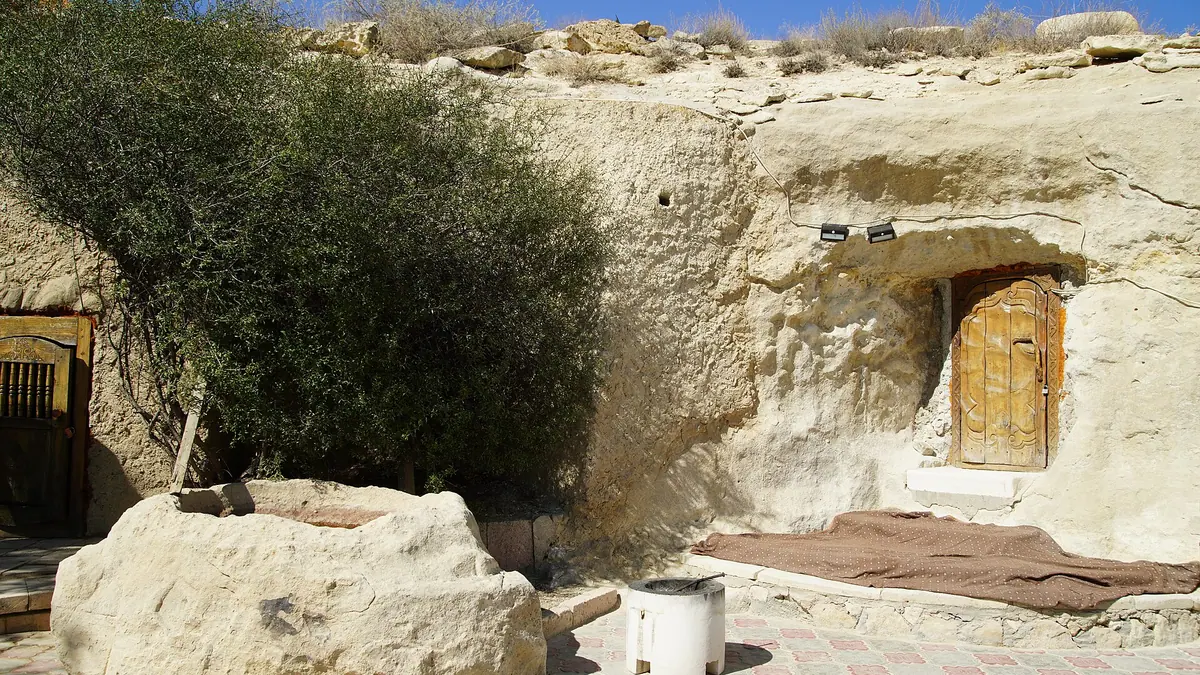
The main sight is the mosque, cut into the rock above a ravine. Its central hall measures 7.1 × 5.1 m and gets daylight through a round shaft in the ceiling, 1.2 m across. A wooden pole leans against the shaft, hung with strips of cloth and argali horns. A ramp that was once a staircase climbs from the south-west corner to a prayer room and two burial chambers. By tradition, one holds Shopan-Ata and the other his daughter.
Kazakh Wikipedia adds some details. Channels on the rocky ground above the mosque fed water into pits of 10–15 cubic metres, and these supplied the residents all year. There is also a well below the mosque, and a mulberry tree planted in front of small rock-cut rooms by the entrance. The walls carry almost no decoration, so the experience is about space and light rather than ornament.
The necropolis surrounds the mosque. The oldest graves, belonging to the Oghuz-Kipchak tribes of the 10th–13th centuries, lie in the south-western part. They include simple enclosures, domeless mausoleums called saganatam and stelae called kulpytas and koitas. Weathering has left many of them as shapeless ruins. The east and north-east hold domeless and a few domed mausoleums from the 19th and early 20th centuries.
| Item | Detail |
|---|---|
| Type | Underground mosque and necropolis |
| Age | 10th–19th centuries; the mosque may be older than the cemetery |
| Central hall | 7.1 × 5.1 m, lit by a 1.2 m ceiling shaft |
| Protection | Monument of national significance since 1982 |
| UNESCO | Inscribed in 2026 as part of “Rock mosques and associated sacred sites of Mangystau” |
| Location | Old Khorezm caravan route, south-east Mangyshlak |
Don’t expect a museum with displays.
Three legends behind the name
Tradition names Shopan-Ata as a patron of shepherds and a disciple of Khoja Ahmed Yasawi, the preacher from Turkestan. In one story, Yasawi throws his staff out of a mosque window and tells his pupils to find it. Everyone rushes off except Shopan-Ata. He explains that the staff lies far away by a great sea and that a long road needs preparation. He walks to Mangyshlak, finds that the staff has grown into a mulberry tree, and builds a mosque on the spot.
In a second version, a young man named Musa lifts a heavy well cover so two girls can water their sheep. He then works as a shepherd for their blind father. After nine years every lamb is born white, and a year later piebald. The old man marries him to his younger daughter and names him Shopan-Ata, the protector of sheep. A third tale has Temir-baba visiting. Shopan-Ata cooks a sheep, the two eat without touching the bones, and he wraps the bones in the skin and brings the animal back to life.
The site’s research history is short. Expeditions studied the underground complex in 1951–1952 under M. M. Mendikulov, again in 1977–1978, in 1982, and in 2004.
When to go: spring and early autumn
Aim for April–May or September–October. Summer heat and winter cold make the other months harder.
Day high, °C / Night low, °C · Rain/snow, mm
A computed reanalysis normal for these coordinates, not weather station records.
Monthly figures
| Month | Day high, °C | Night low, °C | Rain/snow, mm |
|---|---|---|---|
| Jan | 1.3 | -5.5 | 13.8 |
| Feb | 3 | -6 | 9.1 |
| Mar | 11.7 | 0.8 | 23 |
| Apr | 19.6 | 7.3 | 25.9 |
| May | 28.3 | 15.4 | 16.9 |
| Jun | 33.6 | 20.2 | 8.5 |
| Jul | 36.2 | 23.2 | 7.8 |
| Aug | 34.1 | 20.8 | 4 |
| Sep | 27.3 | 13.9 | 5.6 |
| Oct | 17.9 | 5.7 | 6.8 |
| Nov | 7.4 | -1.6 | 15 |
| Dec | 1.9 | -4.9 | 16.1 |
These figures are ERA5 reanalysis normals for 2011–2020 at a grid point at 130 m, not readings from a weather station. July averages a daytime high of 36.2 °C with nights near 23.2 °C. June and August are only a little cooler. There is almost no rain in late summer, with 4.0 mm in August, so expect strong sun and very little shade on the open necropolis. From December to February daytime highs hover around 2–3 °C and nights fall to about −5 °C.
| Period | Day / night | What it means |
|---|---|---|
| Dec–Feb | 2–3 °C / about −5 °C | Cold, short days; possible with warm clothing |
| Apr–May | 19–28 °C / 7–15 °C | Comfortable for walking among the graves |
| Jun–Aug | 33–36 °C / 21–24 °C | Intense heat; go early in the day |
| Sep–Oct | 27–17 °C / 15–7 °C | Comfortable, dry |
Visiting a living sacred place
Kazakh Wikipedia calls Shopan-Ata a sacred place for Muslims, so treat it as a place of prayer. The pole in the hall is hung with strips of cloth; treat it with respect. Kazakh Wikipedia describes cauldrons, samovars, kettles and ewers kept along the north wall, though the text does not say whether they are still in use.
We could not confirm the dress code, rules on photography inside the mosque, opening hours, or whether visitors are expected to come with a guide or a local custodian. Modest clothing covering shoulders and legs is a safe default at any mosque. Ask before photographing people at prayer.
Combining Shopan-Ata with the rest of Mangystau
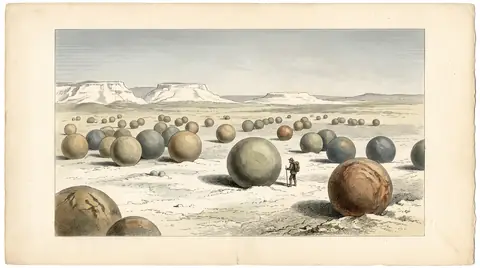
Shopan-Ata sits in the same region as the desert landscapes of Bozzhyra and the Mangystau plateau, about 117 km away in a straight line. The rock outcrop of Sherkala is about 136 km away and the stone spheres of Torysh about 172 km, both in a straight line. A multi-day route from Aktau could link several of these. Distances between them on the ground are large, though, and we could not confirm road times.
- Road conditions and driving time from Aktau and from Senek to the site
- Any public transport or shared transfers to Shopan-Ata
- Opening hours, dress code and photography rules inside the mosque
- Whether water, food, fuel or pilgrim lodging are available nearby
Shopan-Ata: tips before you go
- Check the distance to Senek locally: Wikipedia sources give 21 km and 25 km, and the last stretch is the part to plan carefully.
- Avoid June–August: daytime highs average 33–36 °C, and the open necropolis has little shade.
- Leave the cloth strips and horns on the pole in the hall untouched.
- Combine the visit with Sherkala or Torysh, about 136 and 172 km away in a straight line, on a multi-day Mangystau route.
More to see nearby


Frequently asked questions
Who was Shopan-Ata?
How far is Shopan-Ata from Aktau?
Is Shopan-Ata a UNESCO World Heritage site?
How old is the Shopan-Ata necropolis?
What is inside the Shopan-Ata underground mosque?
Sources
Read also
- The Mausoleum of Khoja Ahmed Yasawi and the other shrines and Silk Road cities of Kazakhstan
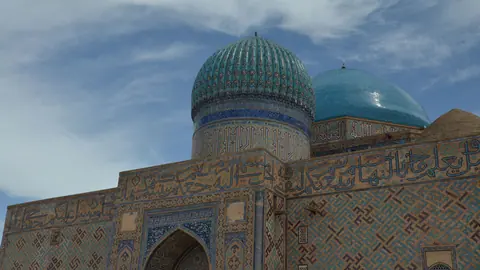 Visiting mausoleums and underground mosques in Kazakhstan: etiquette and rules
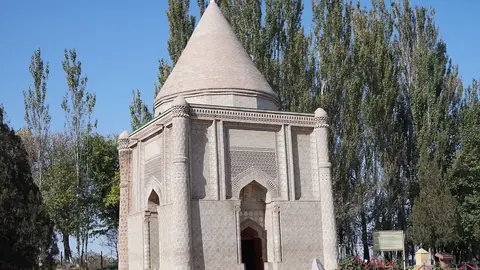 Visiting the Aisha Bibi Mausoleum, a carved terracotta tomb outside Taraz
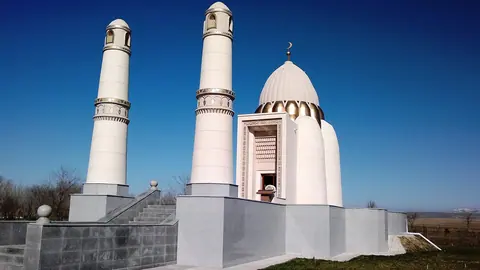 Domalak Ana Mausoleum, a revered shrine on the southern slope of the Karatau
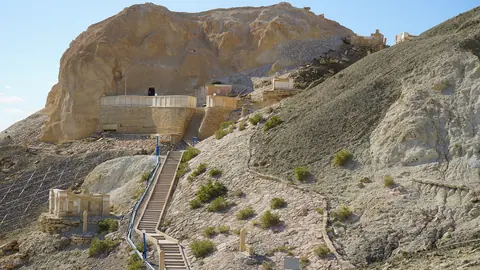 Beket-Ata underground mosque at Oglandy
- Sacred places of Kazakhstan and how to choose which to visit