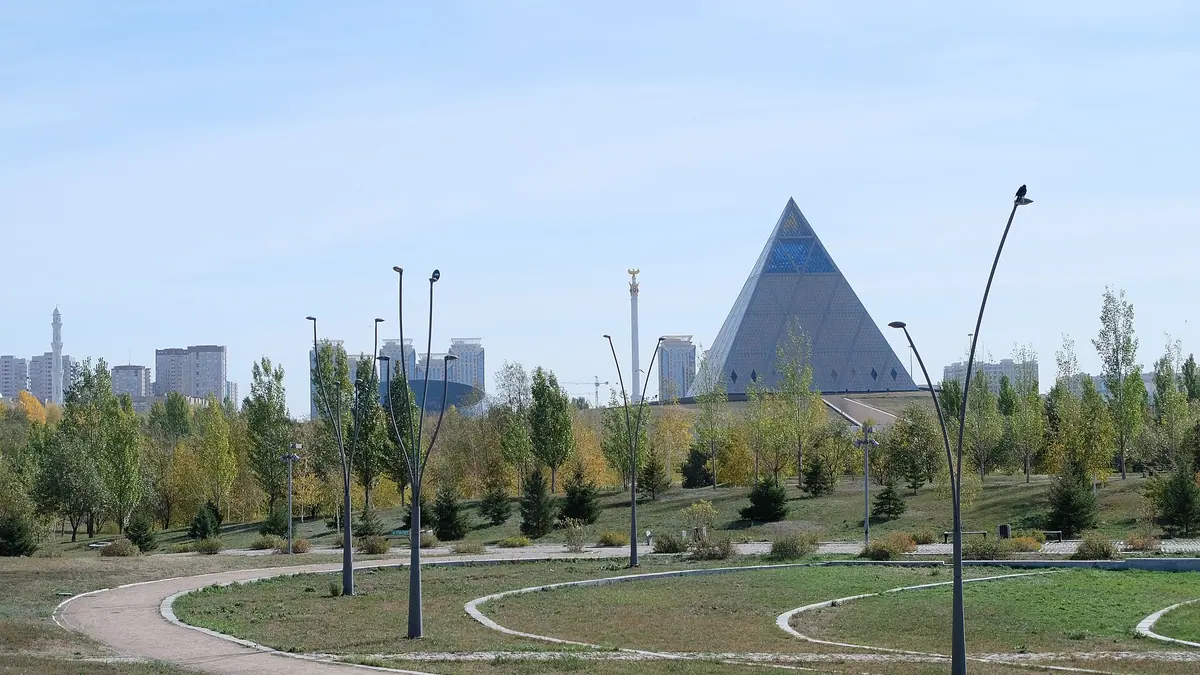
The Palace of Peace and Reconciliation in Astana: when to go, month by month
- January: possible
- February: possible
- March: possible
- April: good
- May: best time
- June: best time
- July: good
- August: best time
- September: best time
- October: good
- November: possible
- December: possible
The interior works year-round, but highs stay below zero from November to March, so the park and exterior are best from May to September.
The Palace of Peace and Reconciliation in Astana: why go
The Astana pyramid's glass apex
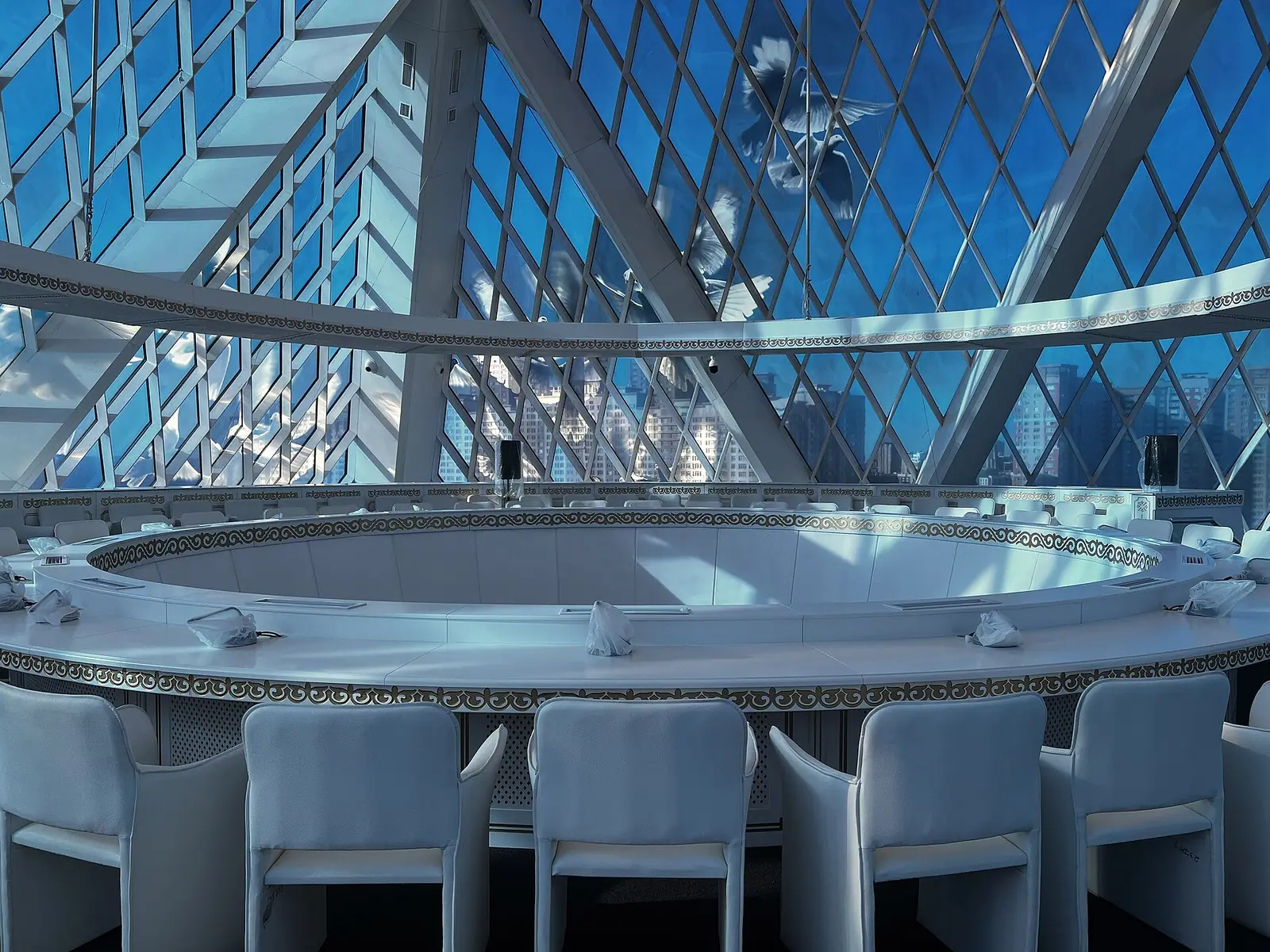
Brian Clarke's stained glass covers the top two rows of triangles, about 9,700 sq ft, printed with doves in flight; local sources count 130 of them.
A home for a religious congress
The palace was built for the Congress of Leaders of World and Traditional Religions, which meets every three years in a round chamber at the apex.
A city stop, not a road trip
The pyramid stands in Presidential Park on Tauelsizdik Avenue, about 4 km in a straight line from Astana's reference point, so it fits a city day.
Short summer, long cold
ERA5 normals give average highs of 18–26 °C from May to September and about −11 °C in January, so outdoor time is easiest in the warm months.
A building on bridge bearings
Built for swings from −40 to over 40 °C and up to 30 cm of expansion, the pyramid has one fixed corner and three on bridge bearings.
The Palace of Peace and Reconciliation in Astana in photos
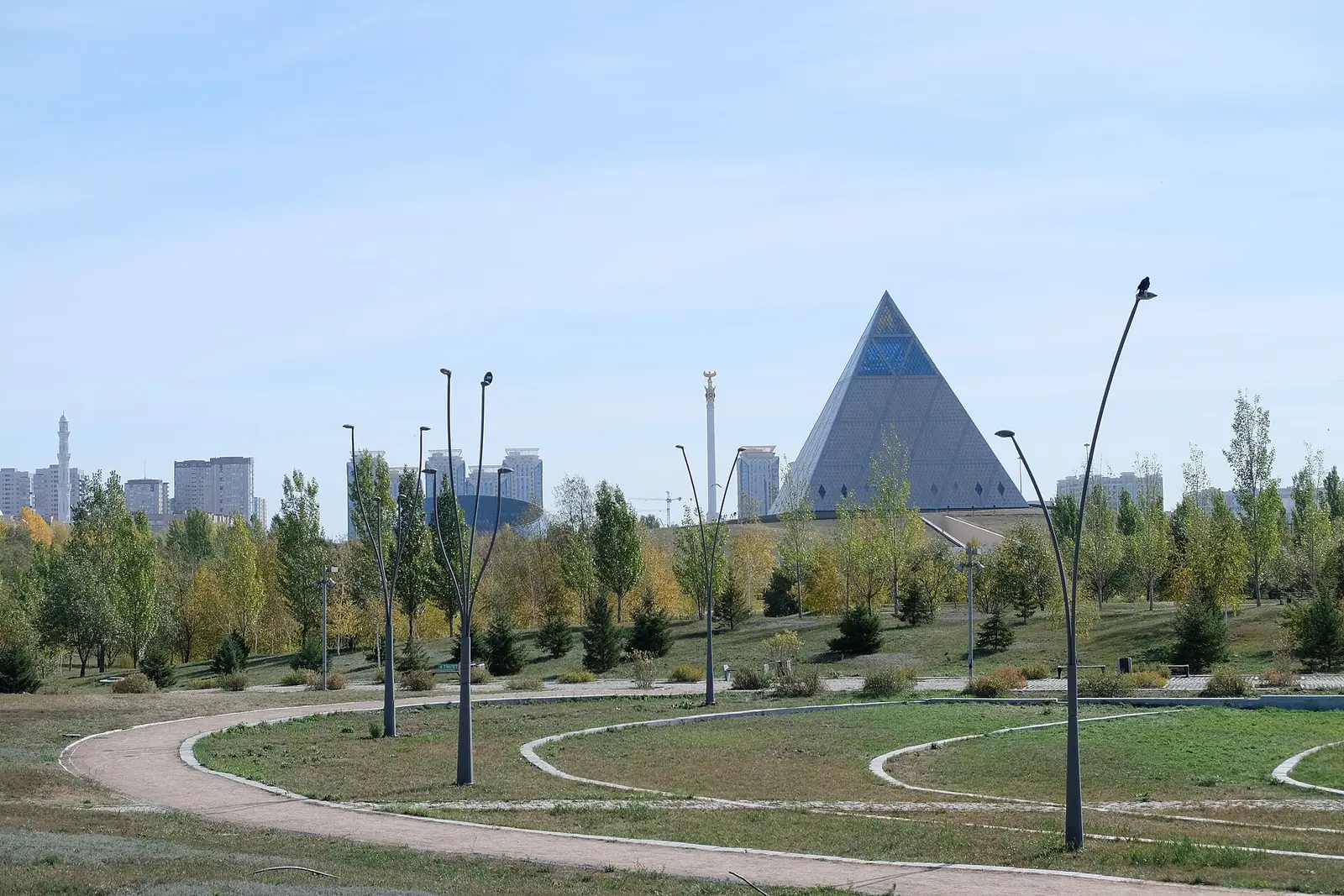
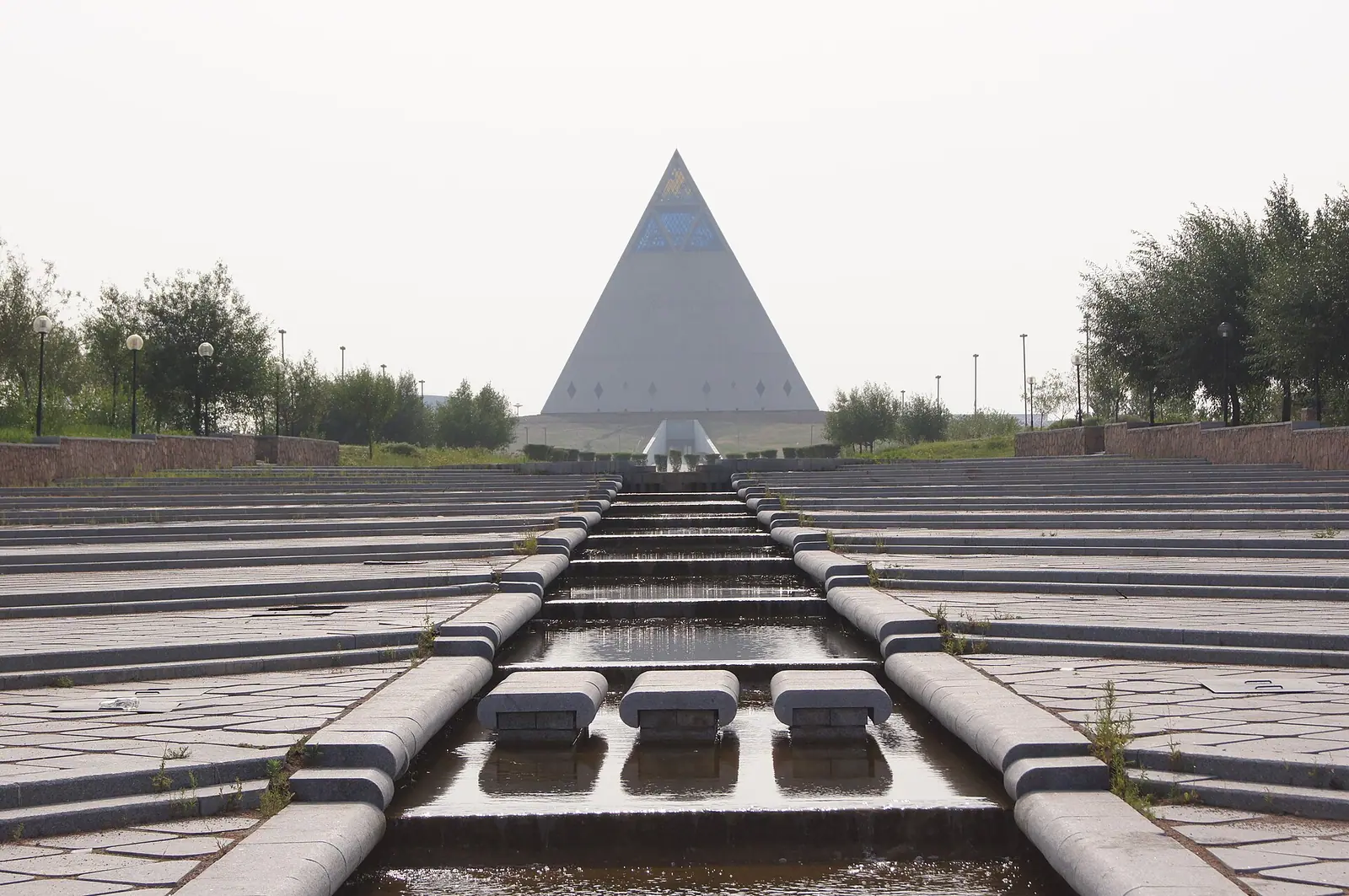
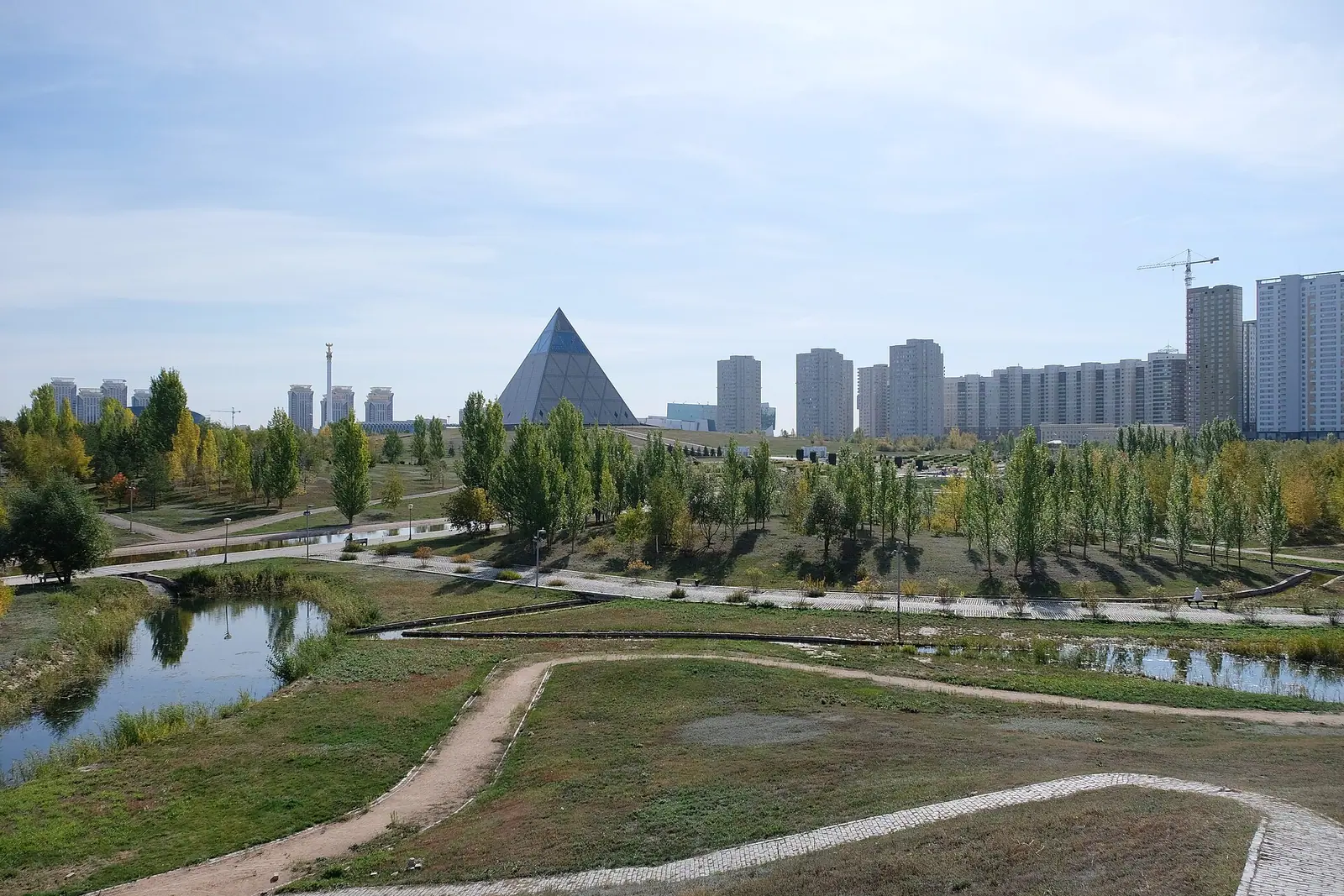
Real photos by travellers (Pexels, Unsplash, Wikimedia Commons); author and licence are given in each caption.
The Astana Palace of Peace and Reconciliation is a 62-metre pyramid in Kazakhstan’s capital, designed by Foster and Partners and completed in 2006. It was built as the permanent venue for the Congress of Leaders of World and Traditional Religions and also holds an opera hall, galleries and exhibition spaces. For a visitor it is an architecture stop within the city, about 4 km in a straight line from the reference point for Astana.
What the pyramid is and why it was built
The building is a non-denominational spiritual centre and event venue, conceived to house the Congress of Leaders of World and Traditional Religions. The congress meets every three years in a circular chamber at the apex, modelled on the UN Security Council meeting room in New York. The idea was presented at the first congress in Astana on 23–24 September 2003, and the second congress was held in the new palace in 2006.
The Turkish firm Sembol built the pyramid in 13 months. Foster and Partners led the design, Tabanlıoğlu Architects prepared construction information, and Buro Happold handled structural and services engineering. Russian Wikipedia dates the opening ceremony to 1 September 2006, Kazakh Wikipedia to 2 September 2006. In 2011 and 2013 the building also hosted the International Astana Action Film Festival.
The building in numbers
The core figures agree across sources, but the opera hall capacity does not. The table gives what a visitor is likely to want, with the disagreement shown.
| Feature | Figure |
|---|---|
| Height of the pyramid | 62 m |
| Base | 62 × 62 m |
| Floor area | 25,500 m² |
| Plinth | 15 m earth-covered block, all above ground |
| Opera hall | 1,302 seats (Russian Wikipedia), 1,300 (English), 1,500 (Kazakh) |
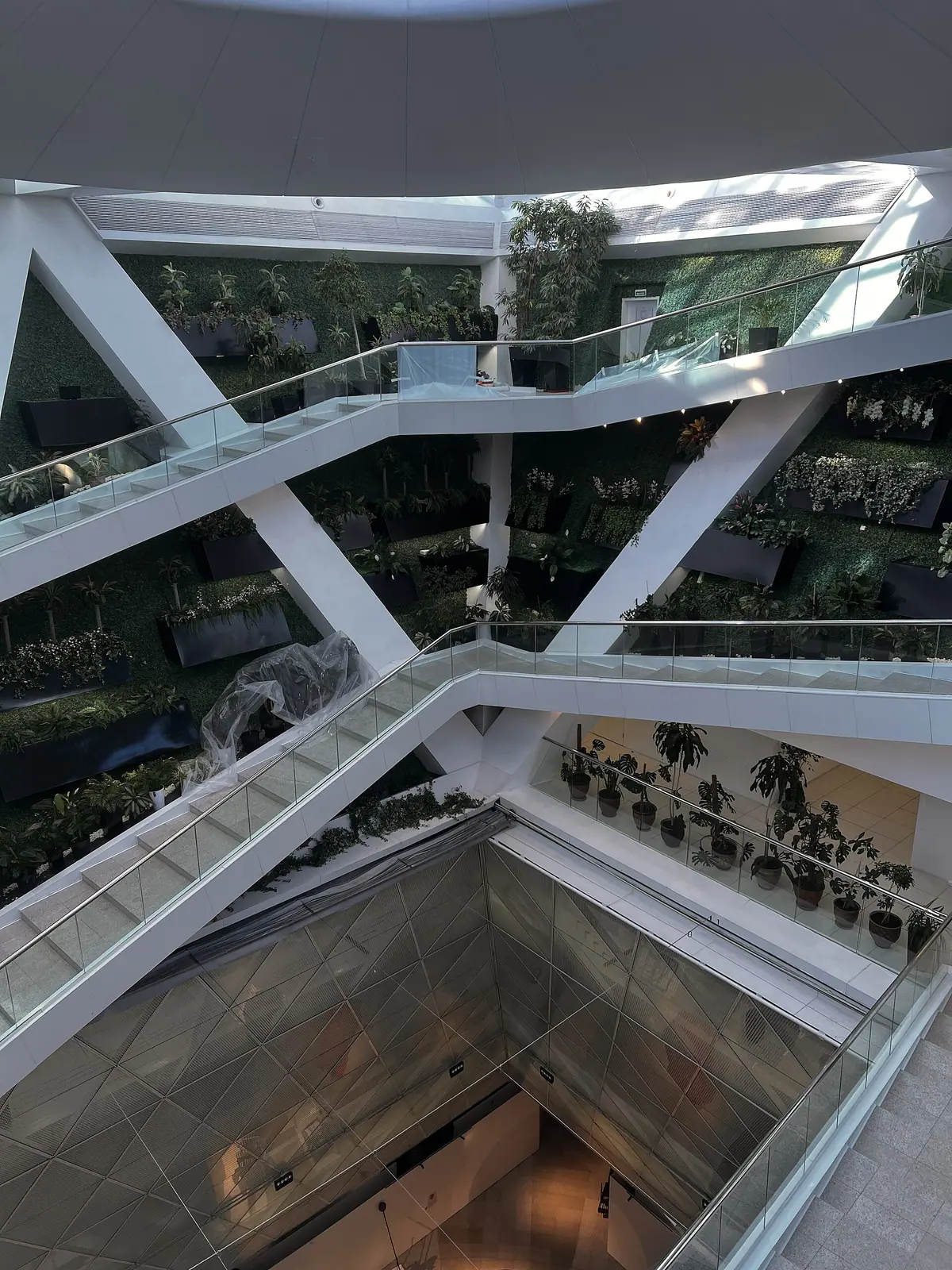
| Khufu (Cheops) Atrium | over 2,000 m², more than 1,000 guests |
| Address | 57 Tauelsizdik Avenue |
The lower levels look like basements because the landscaping of Presidential Park rises over them, but they are above ground. Kazakh Wikipedia says only that the entrance is underground.
The stained-glass apex and what to look for inside
The top two rows of triangles are clad in about 9,700 sq ft of stained glass by the architectural artist Brian Clarke. Its screen-printed imagery shows doves in flight; Russian and Kazakh Wikipedia count 130 of them, each standing for one of the peoples of Kazakhstan. Twenty-eight diamond-shaped stained-glass windows on the lower level repeat the motif.
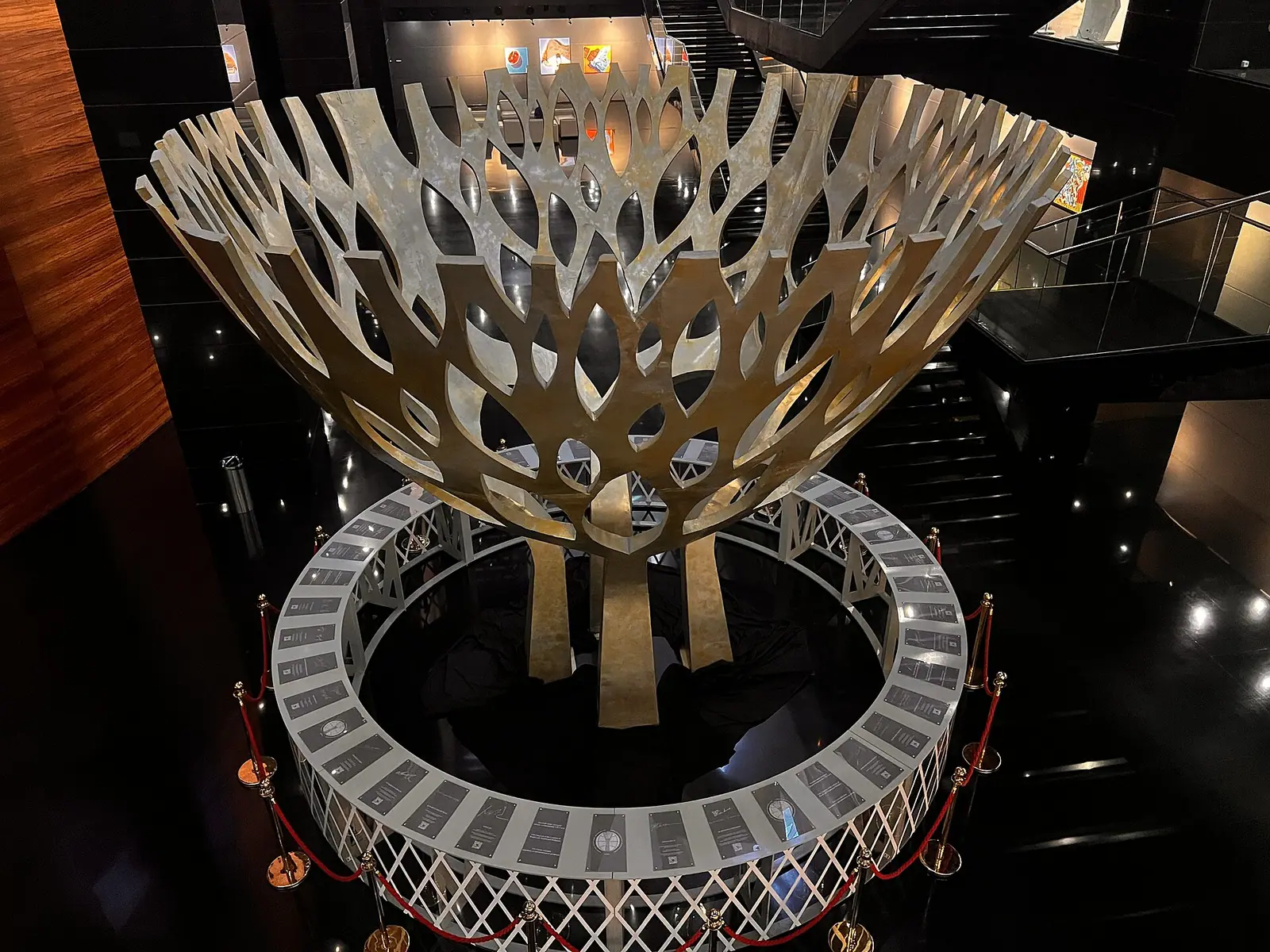
The top-floor hall under the glass is called the Cradle (Kolybel). Kazakh Wikipedia says it gives a panoramic view over the capital. Other spaces named in the sources include the Khufu Atrium with a display of Astana’s development plan to 2030, the Kulanshy centre of contemporary art and the Shezhire gallery, a library and a research centre on world religions. We could not confirm which of these halls are open to casual visitors and which only during events.
An engineering detail worth knowing
The pyramid was designed for temperature swings of more than 80 °C, from about −40 to over 40 °C, which can make the building expand by up to 30 cm. To cope, the engineers fixed one corner and set the other three on bridge bearings, a technique from bridge building that English Wikipedia says was used in a building for the first time. The structure is a steel frame over concrete lower levels, clad in pale granite below the glass.
When to visit Astana for the pyramid
The interior can be visited in any season, but walking Presidential Park and photographing the exterior is pleasant only from late spring to early autumn. The figures below are computed normals from the ERA5 reanalysis for 2011–2020 at a grid point at 353 m, not a weather station.
Day high, °C / Night low, °C · Rain/snow, mm
A computed reanalysis normal for these coordinates, not weather station records.
Monthly figures
| Month | Day high, °C | Night low, °C | Rain/snow, mm |
|---|---|---|---|
| Jan | -11.2 | -18.6 | 15.4 |
| Feb | -9.5 | -17.6 | 15.1 |
| Mar | -1 | -9.3 | 23.8 |
| Apr | 13.2 | 1.5 | 28.4 |
| May | 20.4 | 7 | 30.5 |
| Jun | 25.3 | 12.9 | 43.1 |
| Jul | 26.2 | 14.4 | 59.8 |
| Aug | 25.3 | 12.6 | 27.7 |
| Sep | 18.6 | 6.5 | 23.4 |
| Oct | 9 | -0 | 33.7 |
| Nov | -3.1 | -9.8 | 30 |
| Dec | -8.8 | -15.8 | 24.4 |
May to September have average highs of 19–26 °C; July is the warmest and also the wettest month, with about 60 mm. From November to March highs stay below zero, and January averages −11 °C by day and about −19 °C at night, so any walk around the outside becomes short. April and October are transitional, with nights near freezing.
| Period | Outside | What it means |
|---|---|---|
| Dec–Feb | highs −11 to −9 °C | Go for the interior only, by taxi |
| Mar, Nov | highs around 0 to −3 °C | Cold, short park walks |
| Apr, Oct | highs 9–13 °C | Workable with layers |
| May–Sep | highs 18–26 °C | Park and exterior at their easiest |
Fitting it into a trip to Kazakhstan
The pyramid is a city sight in Astana, the capital in the north of the country, far from the mountain landscapes around Almaty. It makes sense as part of a day of architecture in Astana, not as a reason to fly in on its own. If you are building a nature trip from the capital, the nearest pages on this site are Zerenda, a pine-hill lake about 257 km away in a straight line, and Ulytau, granite hills in the central steppe about 424 km away. Lake Balkhash lies further south.
We could not confirm public transport routes to the palace, whether guided tours run in English, or the rules for entering without an event ticket. A visitor with no Russian or Kazakh should check these before setting a day aside.
- Opening hours and days for casual visitors
- Whether entry or guided tours require a ticket, and whether tours run in English
- Which halls, including the top-floor chamber, are open outside events
- Public transport routes to Presidential Park
- Photography rules inside the building
The Palace of Peace and Reconciliation in Astana: tips before you go
- Kazakh Wikipedia says the entrance is underground; check how to enter before you go.
- January highs average −11 °C; in winter plan the visit as an indoor stop and use a taxi rather than walking the park.
- July is the wettest month at about 61 mm; May, June, August and September are drier for exterior photos.
- Opera hall capacity is given as 1,300 to 1,500 seats; check the event schedule if you want to see the hall in use.
More to see nearby


Frequently asked questions
How tall is the Palace of Peace and Reconciliation in Astana?
Who designed the Astana Palace of Peace and Reconciliation?
When did the Palace of Peace and Reconciliation open?
Is there an opera hall inside the pyramid?
What is the pyramid in Astana used for?
Sources
Read also
 Almaty Zoo in Kazakhstan: opening hours and how to visit
 Ayusai Gorge, Almaty: visitor centre and waterfall trail
 Gorelnik Gorge above Medeu: waterfalls, trail and season
 Kamenskoe Plateau above Almaty: observatory and trails
 Pervomaiskie Ponds near Almaty: location, swimming, season
 Saty village: base for the Kolsai and Kaindy lakes