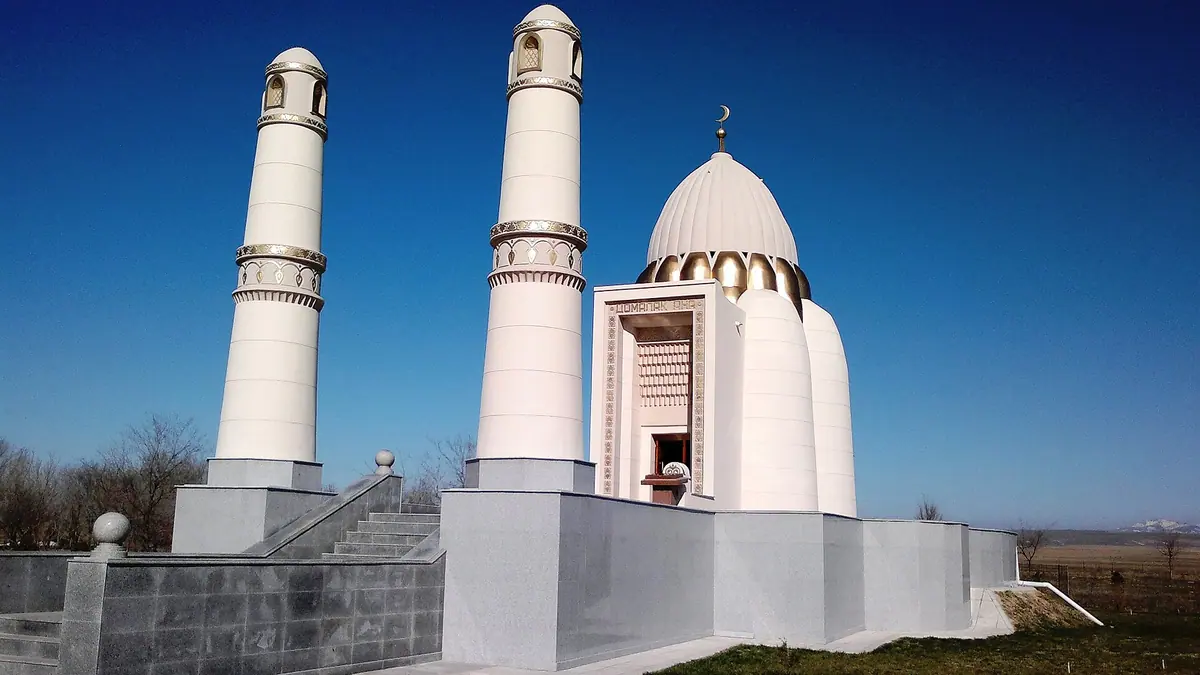
Domalak Ana Mausoleum, a revered shrine on the southern slope of the Karatau: when to go, month by month
- January: possible
- February: possible
- March: good
- April: best time
- May: best time
- June: good
- July: possible
- August: possible
- September: best time
- October: good
- November: possible
- December: possible
May and September–October avoid both the 31–34 °C summer heat and the cold, wet months from November to April.
Domalak Ana Mausoleum, a revered shrine on the southern slope of the Karatau: why go
The Domalak Ana Mausoleum
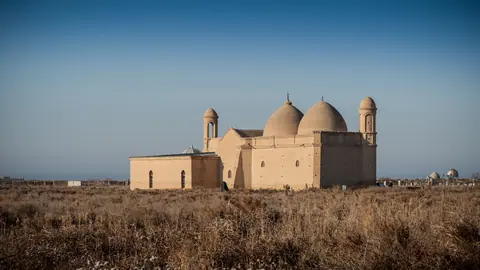
A 12-metre domed shrine over the grave of Nurila Ali Sylankyzy, the present building dating from 1998.
Five centuries of rebuilding
First built in 1456 by a master from Bukhara, destroyed several times and rebuilt, in 1908 and 1957 among other years, with stone from Mangystau.
Getting to Akbastau
The shrine lies 2 km south of Akbastau village, about 60 km in a straight line from Shymkent; no public transport confirmed.
Dry autumn at Domalak Ana
September and October bring highs of about 27 °C to 19 °C and little rain, while July averages near 34 °C.
The two sacred stones
Legend holds that two sacred stones in the mausoleum let only a person with a pure soul pass between them.
Domalak Ana Mausoleum, a revered shrine on the southern slope of the Karatau in photos
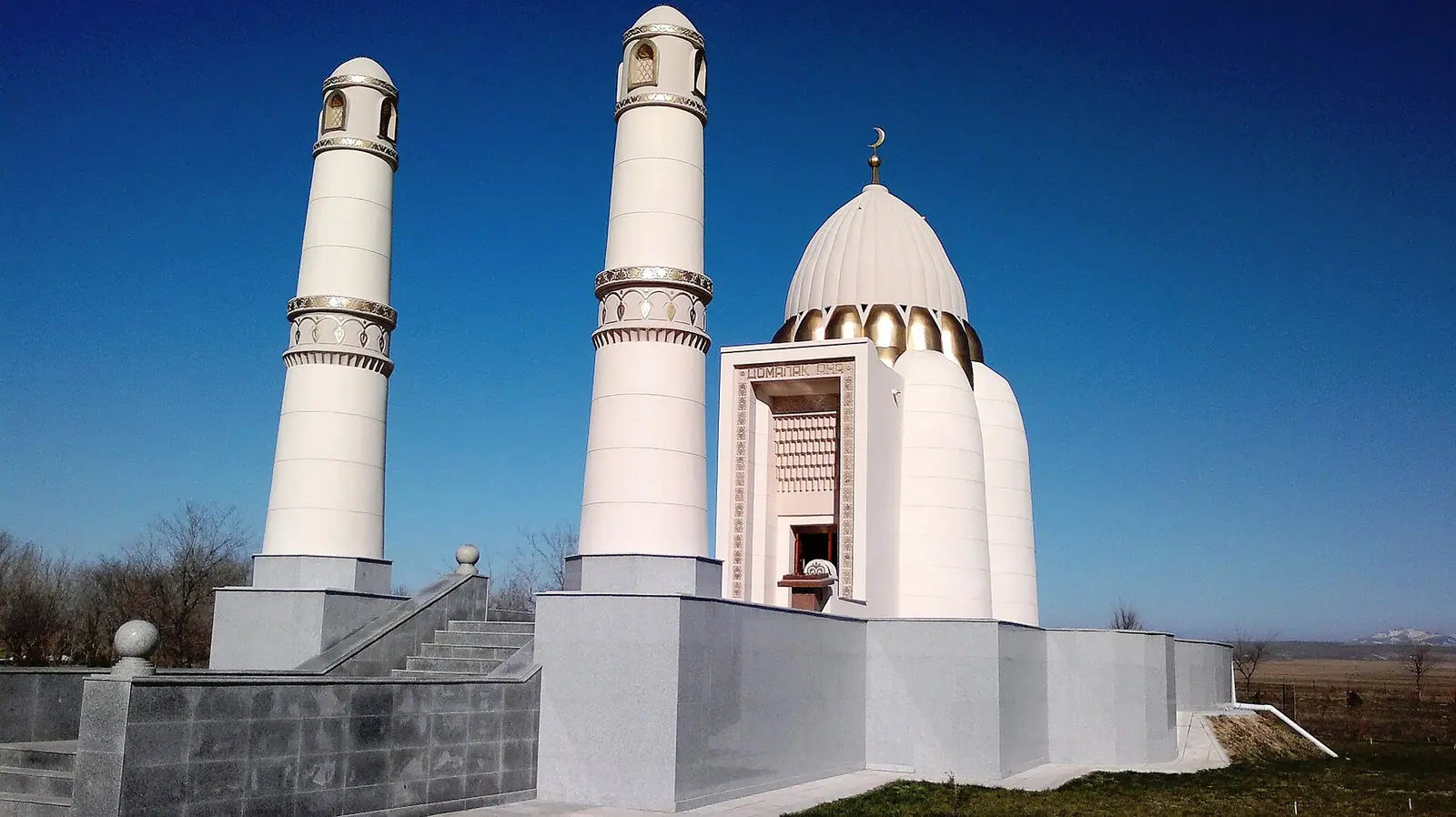
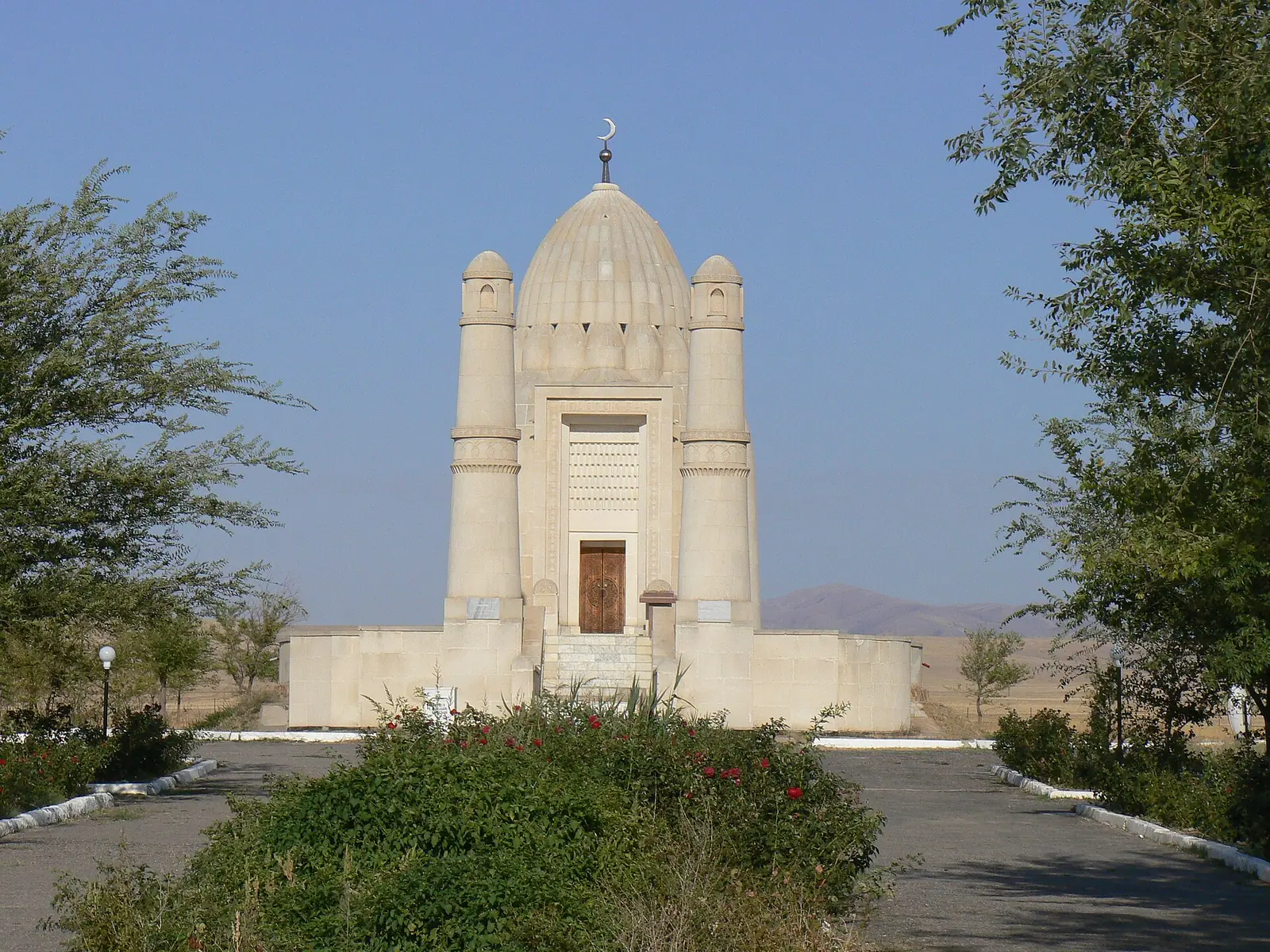
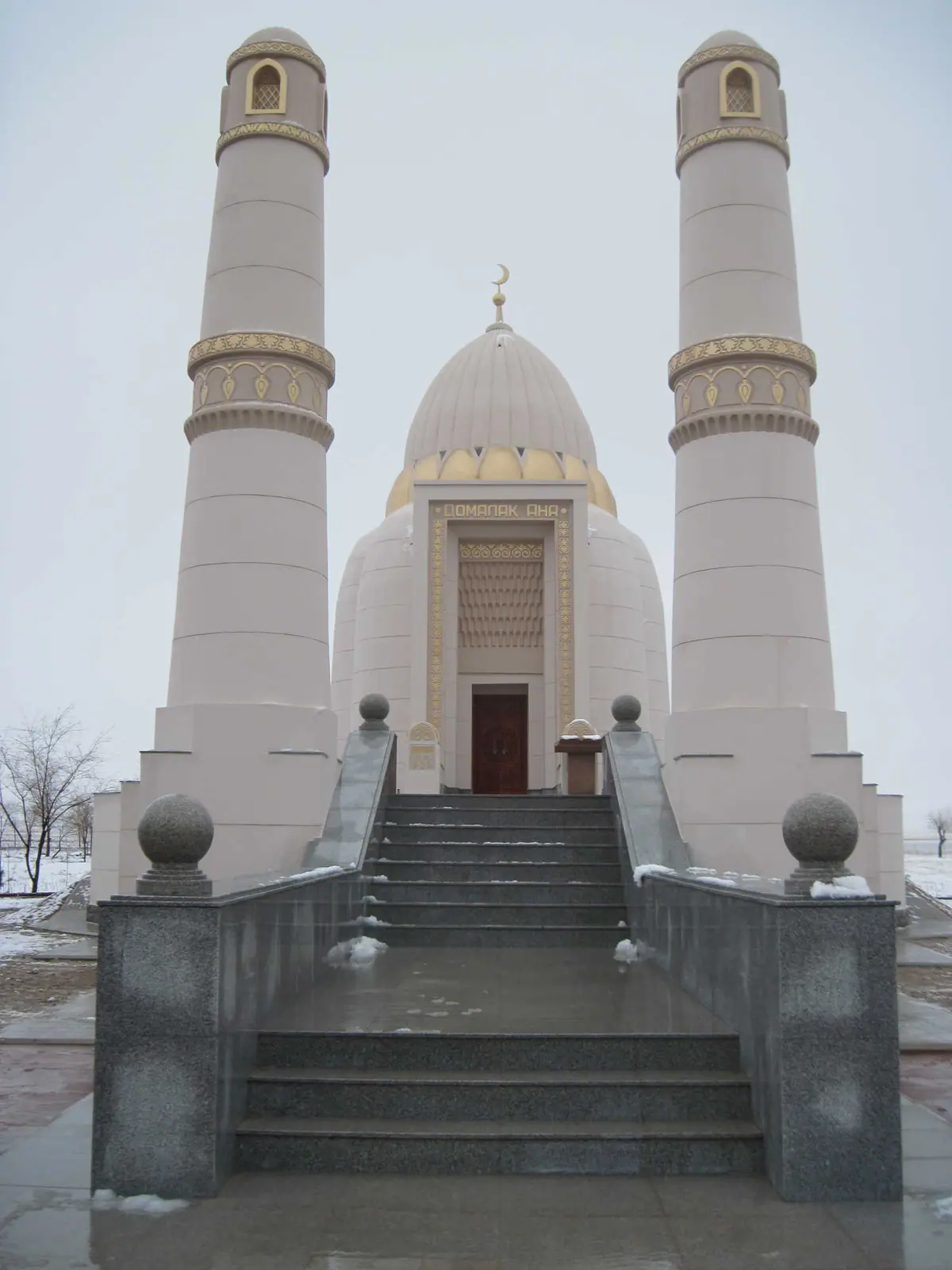
Real photos by travellers (Pexels, Unsplash, Wikimedia Commons); author and licence are given in each caption.
Domalak Ana Mausoleum is a domed shrine in Baydibek District of Turkistan Region, in southern Kazakhstan. It stands 2 km south of the village of Akbastau, on the southern slope of the Karatau range in the Balabogen river valley, over the grave of a 15th-century woman revered as a saintly mother. The building you see today is modern, but the place has been rebuilt and visited for more than five centuries.
Where it is and what kind of trip it takes
The mausoleum is a rural site, not a city sight. The nearest large city is Shymkent, about 60 km in a straight line. Turkistan is about 124 km and Taraz about 138 km, both straight-line figures, so road distances will be longer. Almaty is roughly 595 km away in a straight line, which makes this a southern Kazakhstan trip, not a day out from Almaty. The closest neighbours are Baidibek Ata Mausoleum and Akmeshit Cave, about 25 and 15 km away in a straight line by our count.
For most foreign visitors it pairs with Shymkent or with the shrines and ruins around Turkistan. We could not confirm any public bus to Akbastau, so plan on a car or a driver hired in Shymkent. Signs and local conversation will be in Kazakh or Russian.
| Key point | Detail |
|---|---|
| Location | 2 km south of Akbastau, Baydibek District, Turkistan Region |
| Setting | Southern slope of the Karatau, Balabogen river valley |
| Height of the building | 12 m, dome over the main structure |
| Status | Monument of history and culture of local significance |
| Nearest city | Shymkent, about 60 km in a straight line |
Who Domalak Ana was
Domalak Ana is the popular name of Nurila Ali Sylankyzy, wife of Baydibek Karashuly, a figure central to Kazakh genealogy. The Kazakh Wikipedia describes her as his third wife and gives her life as 1378 to 1456, with death on 28 May 1456. It says she was born in Yassy, the old name of Turkistan, and was raised by her grandfather Maktym Agzam after her mother died of a snakebite while bathing in the Karashyk river.
The same source traces her family to Gauhar Bibi, daughter of Khoja Ahmed Yasawi, whose mausoleum is in Turkistan. The name Nurila is explained as Arabic for “light of Allah”. In Persian she was called “Dikhnat mama”, meaning saintly mother, and over time Dikhnat turned into Domalak. Accounts praise her for decency, wisdom and honesty, qualities behind the title “ana”, mother.
The Russian article is much shorter and does not give her birth year or birthplace, so treat these biographical details as tradition recorded in one source.
Rebuilt again and again since 1456
The first mausoleum went up in the year of her death. By the Kazakh Wikipedia, her grandson Dulat brought a master named Abdulla Sheri from Bukhara, who built a four-winged domed tomb. What stands now dates from the late 1990s. The intervening centuries were a cycle of damage and rebuilding.
| Year | What happened |
|---|---|
| 1456 | Four-walled domed mausoleum built over the grave |
| 1906–1908 | Monuments at the site destroyed |
| 1908 | Poet Orynbay Taymanov has a new domed monument built |
| Early 20th century | A round structure with 6 niches and a dome |
| 1942–1943 | Destroyed again |
| 1957 | Restored once more, but did not survive |
| 1966 or 1996 | Rebuilt with white stone brought from Mangystau |
| 1998 | Present mausoleum built, architect Sain Nazarbekov |
| 2000 | Landscaping of the grounds completed |
The sources disagree on the white-stone rebuild: the Russian Wikipedia says 1996, the Kazakh one 1966. For a visitor the point is simple: you are seeing a modern building on a very old grave, not a medieval structure. If original medieval architecture is what you want, the older sites near Turkistan and Otrar fit that better.
When to go
The climate figures below are computed ERA5 reanalysis normals for 2011–2020 at a grid point at 437 m, not readings from a weather station at the shrine.
Day high, °C / Night low, °C · Rain/snow, mm
A computed reanalysis normal for these coordinates, not weather station records.
Monthly figures
| Month | Day high, °C | Night low, °C | Rain/snow, mm |
|---|---|---|---|
| Jan | 4 | -3.4 | 85.1 |
| Feb | 5.8 | -2.8 | 77.6 |
| Mar | 13.5 | 4 | 85.6 |
| Apr | 19.9 | 10.2 | 86.1 |
| May | 26 | 15.2 | 65 |
| Jun | 30.9 | 18.9 | 15.7 |
| Jul | 33.6 | 21.5 | 4.3 |
| Aug | 32 | 20.2 | 6.3 |
| Sep | 26.6 | 14.3 | 5.5 |
| Oct | 18.9 | 7.7 | 41.6 |
| Nov | 9.7 | 0.8 | 78.4 |
| Dec | 4.6 | -3.6 | 81.3 |
Summer is hot and almost rainless: July averages a daytime high of about 34 °C, with only around 4 mm of precipitation, and June to September stay very dry. Winter hovers around freezing, with January highs near 4 °C and lows near −3 °C, and November to April are the wet months at roughly 75–85 mm each. The comfortable windows are May, when highs reach about 26 °C, and September to early October, with highs from about 27 °C down to 19 °C and little rain.
| Period | What to expect |
|---|---|
| Dec–Feb | Near freezing, wet; possible but cold and muddy |
| Mar–Apr | Mild, the wettest stretch of the year |
| May | Warm, drying out; a good month |
| Jun–Aug | Hot, highs 31–34 °C, very dry |
| Sep–Oct | Warm to mild, dry; a good time |
| Nov | Cool and wet again |
The shrine sits on a mountain slope, and its exact elevation could not be confirmed; if it is higher than the grid point, expect slightly cooler conditions.
Visiting a working shrine
Domalak Ana is a place of active pilgrimage, described as a site that many come to venerate. Treat it as you would any sacred site: modest clothing, quiet voices, and care with photographing people at prayer. We could not confirm any written dress code or photography rules on site.
The Kazakh Wikipedia mentions a Domalak Ana museum holding old manuscripts and handmade objects. We could not confirm its opening hours, whether it charges admission, or whether it has labels in any language other than Kazakh.
- Opening hours of the mausoleum and the museum
- Whether there is an entry fee or donation expected
- Public transport from Shymkent to Akbastau
- Road condition on the final stretch to the village
- Dress code and photography rules on site
Domalak Ana Mausoleum, a revered shrine on the southern slope of the Karatau: tips before you go
- Base yourself in Shymkent, the nearest city at about 60 km in a straight line, and arrange a car there.
- Avoid July: average highs near 34 °C with almost no rain make the midday visit hard going.
- March and April get about 83 mm each, close to the January peak of about 85 mm.
- Combine with Turkistan, about 124 km in a straight line, where the Yasawi line her family traced to is centred.
More to see nearby


Frequently asked questions
What is the legend of Domalak Ana?
When was Domalak Ana Mausoleum built?
How far is Domalak Ana from Shymkent?
How tall is the mausoleum?
Who was Domalak Ana married to?
Sources
Read also
 Beket-Ata underground mosque at Oglandy
- Sacred places of Kazakhstan and how to choose which to visit
- Mosques in Kazakhstan: which to visit and how to behave inside
 Shopan-Ata: a rock-cut mosque and old necropolis in Mangystau
- The Mausoleum of Khoja Ahmed Yasawi and the other shrines and Silk Road cities of Kazakhstan
 Visiting mausoleums and underground mosques in Kazakhstan: etiquette and rules