Botai settlement: a Copper Age horse people's village in North Kazakhstan
Botai is the type site of a culture that lived on the northern Kazakh steppe around 3700–3100 BC and kept horses on a scale that still fuels scientific debate. It is an archaeological site, not a prepared attraction, and the visitor side is largely unconfirmed.
Botai settlement: when to go, month by month
- January: off season
- February: off season
- March: off season
- April: possible
- May: good
- June: best time
- July: best time
- August: best time
- September: good
- October: possible
- November: off season
- December: off season
Only June to August combine mild days of 23–24 °C with tolerable nights, while winter highs stay well below freezing for five months.
Botai settlement: why go
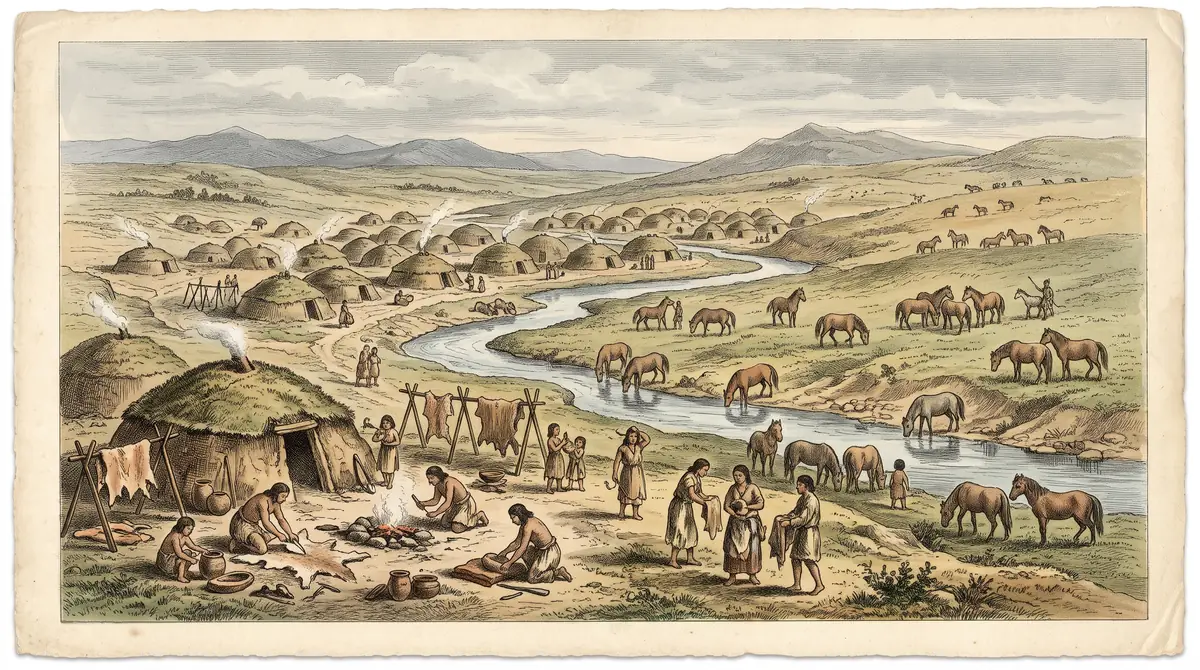
The Botai pit-house village
Around 150–160 pit-houses over about 15 ha, built with shared walls in closed blocks, some of around 30 dwellings; 158 house sites were excavated in 1981–1983.
Botai and the first tamed horses
Bit wear on jaws, horse dung, corrals and a leopard-spotted coat gene point to managed horses; dental studies and genetics push back on the claim.
A long drive from Kokshetau
About 117 km from Kokshetau and 353 km from Astana in a straight line, in rural Aiyrtau district; transport and road conditions are unconfirmed.
Short summer on the Botai steppe
June to August highs reach 23–24 °C with nights near 13 °C; July is wettest at about 78 mm, while January nights average around −18 °C.
Botai kin of Przewalski's horse
Genetics show Przewalski's horses are feral descendants of Botai horses rather than a never-tamed line.
Botai settlement in photos
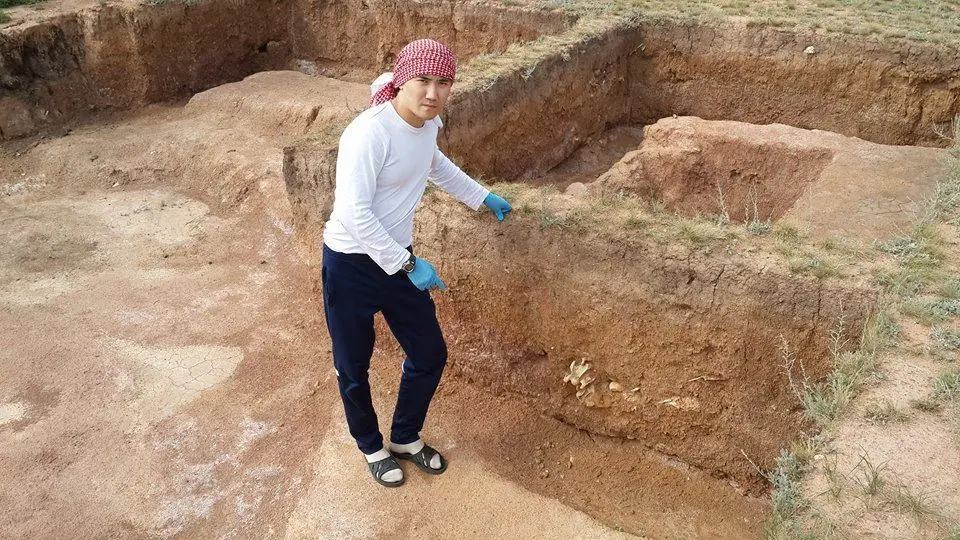
Real photos by travellers (Pexels, Unsplash, Wikimedia Commons); author and licence are given in each caption.
The Botai settlement is a Copper Age village of pit-houses on the Imanburlyq river in North Kazakhstan, dated to about 3700–3100 BC and named for the culture it represents. It sits about 117 km in a straight line from Kokshetau and about 353 km from Astana, far from Almaty and the usual tourist routes. Go if early horse domestication interests you more than visible ruins; we could not confirm what a visitor can see on the ground today.
What Botai is and why archaeologists care
Botai is the site that gave its name to the Botai culture, a group of steppe people who moved from a nomadic hunting life to large, permanent villages with a diet built heavily on horse meat. Around 20 settlements of the culture are known along steppe rivers including the Imanburlyq, Tersakkan, Tobol, Turgay, Ubagan and Chaglinka, by Russian Wikipedia. Krasnyi Yar and Vasilkovka are the two other large sites.
The Botai site itself was found in 1980 near the village of Nikolskoye in Aiyrtau district by a team led by Viktor Zaibert. Kazakh Wikipedia places it 1.5 km south-east of Nikolskoye and says excavations in 1981–1983 by the North Kazakhstan University expedition uncovered 158 house sites over about 15 hectares. Houses were built with shared walls in closed blocks, some holding around 30 dwellings.
The people worked stone, bone and clay. There is no evidence of metalworking, even though metal-using cultures existed elsewhere on the steppe at the same time. Finds include flint knives, spearheads, varied arrowheads, harpoons, needles, grey unglazed pottery with geometric patterns, and horse toe bones engraved with notches and shapes.
| Key data | Figure |
|---|---|
| Date of the culture | c. 3700–3100 BC |
| Location | Imanburlyq river, a tributary of the Ishim, near Nikolskoye, Aiyrtau district |
| Discovered | 1980, team of Viktor Zaibert |
| Area | about 15 ha (Kazakh Wikipedia) |
| Houses | at least 153; over 160; 158 excavated, depending on source |
| Main activities | horse keeping, hunting, fishing |
The house count differs between the English, Russian and Kazakh articles, so treat it as roughly 150–160 rather than an exact number.
Were the Botai the first horse domesticators? The evidence is split
Nobody can say for certain, and that open question is the main reason to know Botai. Kazakh sources present it as the place where people first tamed the horse; international research has moved back and forth.
| Argument | For domestication | Against or limiting |
|---|---|---|
| Bones and dung | Huge quantities of horse bones, corral-like enclosures, horse dung | Kosintsev (2008) classed Botai horse remains as wild |
| Milk | 2009 report of mare’s milk residue in pottery | Later dental calculus studies found no dairy consumption |
| Bridles | Damgaard et al. (2018) describe tooth and bone wear from bits | Supposed bone cheek-pieces lack drilled holes; tooth damage may be natural wear |
| Genetics | Leopard-spotted coat gene, unlikely to survive without human protection | Botai horses mainly ancestral to Przewalski’s horses; only 2.7% ancestry in modern domestic horses |
For a visitor this means Botai is a story about people who managed horses very early, not the confirmed origin of the horse you ride today. Modern domestic breeds came from other centres. Przewalski’s horses turn out to be feral descendants of Botai horses.
Who the Botai people were
Genetic work on a handful of individuals shows the Botai were distinct from the Yamnaya and later western steppe peoples. Their ancestry was mostly Ancient North Eurasian and Eastern hunter-gatherer-like, with an East Asian-related share estimated at about 12–30%.
Only five skulls are available to anthropologists, by Russian Wikipedia; one shows two trepanation holes. Remains of one Botai individual are held at the North Kazakhstan regional museum association in Petropavl. The culture faded at the start of the Bronze Age without a clear successor, and Russian Wikipedia links its crisis to a drier climate phase.
Linguists disagree on what language the Botai spoke. Parpola links the Proto-Ugric word for horse to an unknown Botai language, Napolskikh instead derives that word from Proto-Tocharian, and Gamkrelidze proposed a form of Yeniseian.
Getting there: a long trip into the northern steppe
Botai is a remote rural site, so plan it as a self-drive or hired-car day from Kokshetau. Straight-line distances are about 117 km from Kokshetau, 200 km from Petropavl, 268 km from Kostanay and 353 km from Astana; road distances will be longer. We could not confirm road conditions, public transport to Nikolskoye or signage at the site. Syrymbet, with the Ualikhanov estate museum, lies about 29 km away in a straight line and can share the trip.
Without Russian or Kazakh, arranging local transport and finding the exact spot will be the hard part. The settlement is also partly destroyed by river erosion that is still going on, and by management of the wooded area, so do not expect reconstructed houses. If you are already in the Kokshetau area, Zerenda, a lake among pine hills about 107 km away in a straight line, is a natural pairing.
When to go to Botai
Late May to early September is the realistic window; winters here are severe.
Day high, °C / Night low, °C · Rain/snow, mm
A computed reanalysis normal for these coordinates, not weather station records.
Monthly figures
| Month | Day high, °C | Night low, °C | Rain/snow, mm |
|---|---|---|---|
| Jan | -11.9 | -19.3 | 19.3 |
| Feb | -9.9 | -17.8 | 14.8 |
| Mar | -1.7 | -10 | 28.8 |
| Apr | 11.2 | 0.7 | 37.6 |
| May | 19.2 | 6.3 | 46.5 |
| Jun | 23 | 11.3 | 50 |
| Jul | 24.3 | 13.3 | 83.9 |
| Aug | 23.5 | 11.7 | 51 |
| Sep | 16.9 | 6.1 | 38.5 |
| Oct | 7.7 | -0.4 | 43 |
| Nov | -3.2 | -9.3 | 26.9 |
| Dec | -9.4 | -16.4 | 24.6 |
These are ERA5 reanalysis normals for 2011–2020 at a grid point at 262 m, not a weather station. June to August bring daytime highs of about 23–24 °C and nights around 11–13 °C, comfortable for walking open steppe. July is also the wettest month at about 84 mm. May and September are cooler at 17–19 °C by day with nights of 6 °C. From November to March daytime highs stay below freezing and January nights average about −19 °C, which makes a field visit pointless.
- Whether anything is marked, fenced or interpreted for visitors at the site today
- Road condition and any public transport to Nikolskoye in Aiyrtau district
- Whether Botai finds are on public display in Petropavl or Kokshetau museums, and their opening hours
- Whether any permission is needed to walk on the excavation area
Botai settlement: tips before you go
- Go between June and August: daytime highs of 23–24 °C versus below-freezing days from November to March.
- Pack rain gear in July, the wettest month at about 78 mm, and expect dirt tracks near the river to soften.
- Use Kokshetau, about 117 km away in a straight line, as your base and arrange a car with a Russian or Kazakh speaker.
- Do not expect rebuilt houses: river erosion is still eating into the site, so ask locally what is visible before setting out.
More to see nearby


Frequently asked questions
What is the Botai culture known for?
Where exactly is the Botai settlement?
Who discovered and studied Botai?
Do modern horses descend from Botai horses?
Is Botai near Burabay?
Sources
Read also
 Almaty Zoo in Kazakhstan: opening hours and how to visit
 Ayusai Gorge, Almaty: visitor centre and waterfall trail
 Gorelnik Gorge above Medeu: waterfalls, trail and season
 Kamenskoe Plateau above Almaty: observatory and trails
 Pervomaiskie Ponds near Almaty: location, swimming, season
 Saty village: base for the Kolsai and Kaindy lakes