Baikonur launch: how tourists watch a rocket lift off
You can only watch a launch at Baikonur as part of an organised trip: the town and cosmodrome need a permit, which a tour operator usually files for you. Spectators watch from a 400-seat observation point, and more than 7,500 tourists saw the first four launches of 2026.
- Getting there
- Kyzylorda ~210 km, straight
- When
- May, Sepbest timeNow: possible
- Season
- Foreigner permit: 10 days
- With kids
- Viewing point: 400 seats
- Good to know
- Crewed launches: Site 31/6
- Note
- Permit only, usually via a tour
Baikonur launch: when to go, month by month
November · now- January: possible
- February: possible
- March: possible
- April: good
- May: best time
- June: good
- July: possible
- August: possible
- September: best time
- October: good
- November: possible
- December: possible
Launches run all year on Roscosmos's schedule; the weather is kindest in May and September, with July highs near 35 °C and January nights near −12 °C.
Baikonur launch: why go
7,500 spectators for four launches
Between January and early April 2026 four rockets lifted off, watched by more than 7,500 tourists (tourism ministry via Kazpravda).
Site 31 back in service
The service platform collapsed during the Soyuz MS-28 launch on 27 November 2025. Roscosmos declared repairs complete on 3 March 2026; Soyuz MS-29 flew on 14 July.
Faster permits
Approval for foreigners dropped from 30–45 days to 10. Processing for Kazakh and Russian citizens is being cut to five days.
Declare your gear
The permit application lists vehicles and equipment, including cameras and drones. Tell your operator about a long lens up front.
Yes, tourists can watch a Baikonur launch, but not on their own. Baikonur is leased to Russia until 2050, entry is through checkpoints by permit, and in practice a tour operator files it. Foreign visitors now need 10 days for approval. You watch from an official observation point with 400 seats, on a date Roscosmos sets and can move.
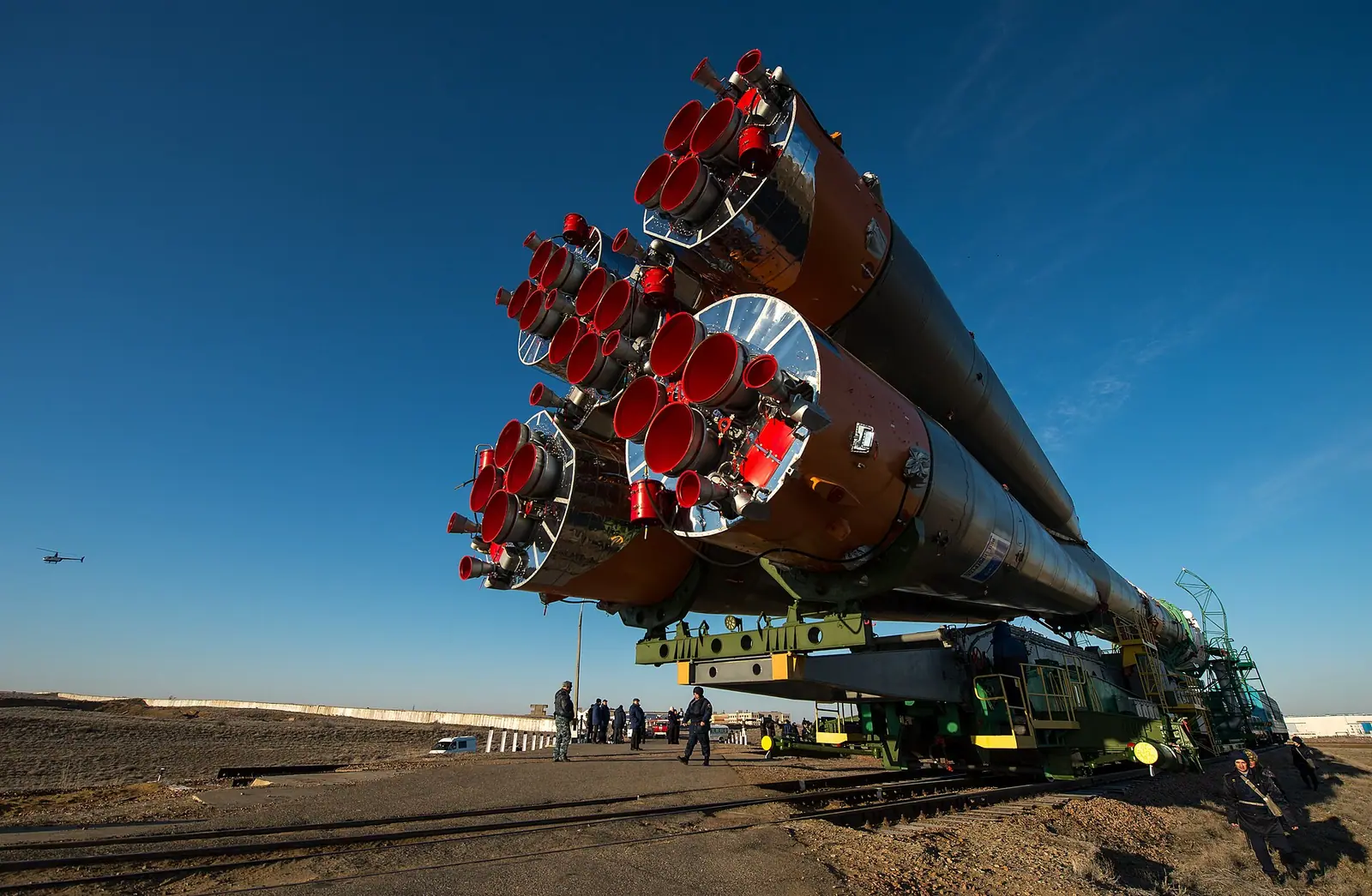
This page covers only how to see a launch. For the cosmodrome’s history, Gagarin’s Start and the town itself, see our Baikonur Cosmodrome guide.
In short
| Question | Answer |
|---|---|
| Permit lead time (foreigners) | 10 days (was 30–45) |
| Who files it | your tour operator, via the Baikonur administration or TsENKI |
| Where you watch | 400-seat observation point |
| Crewed launch pad | Site 31/6 |
| Typical 3-day tour | ≈ $1,000 (450,000–470,000 ₸), one agency’s price |
| Schedule | Roscosmos announcements; dates slip |
Permits: what you need and how long it takes
Everyone entering Baikonur needs a pass: Kazakh and Russian citizens, foreigners and tourists alike. According to Tengrinews (8 July 2026), applications go through the Baikonur city administration or the authorised bodies of Kazakhstan and Russia; on the Russian side that is Roscosmos’s TsENKI.
The application lists your full name, citizenship, passport details, purpose of visit, dates and route, the sites you will visit and any vehicle or equipment, including cameras and drones. Declare a long lens or a drone up front. Hardly anyone does this alone: the operator collects your documents and submits them.
Approval for foreign citizens now takes up to 10 days, down from 30–45 days, Kazakhstan’s tourism minister told the government in June 2026 (Lada.kz, citing Kazinform). Operators had often turned clients away because of the old deadlines. For Kazakh and Russian citizens, the Kazakh–Russian intergovernmental commission in November 2025 instructed TsENKI to cut processing to five days; we have not seen a report confirming it is in force.
There is no state online platform to buy a Baikonur tour yet. A digital “single window” is planned, with the cosmodrome’s security as the priority.
Where you watch from
Kazpravda (12 April 2026) reports a 400-seat observation point open to tourists. Crewed Soyuz flights to the ISS now leave from Site 31/6; Gagarin’s Start (Site 1/5) has had no launches since 25 September 2019.
How close you stand is not published officially. Accounts from travellers and operators range from 1.4 to 3 km from the pad, but they describe different years, pads and viewpoints, so ask your operator which spot your group uses. Launch-day logistics run on a fixed timetable built around lift-off.
Numbers give a sense of the crowd. Four launches between January and early April 2026 drew more than 7,500 tourists, and more than 11,000 people visited the complex in 2024 (Kazpravda). The Soyuz MS-29 crewed launch on 14 July 2026, the only crewed launch of the year, drew more than 3,500 spectators, and a tent was set up at one of the viewpoints (Vokrug Sveta, a sponsored travel feature). Baikonur has seven hotels with about 700 rooms, so book crewed launches early.
Launch pad damage at Site 31 and the repair
On 27 November 2025, during the launch of Soyuz MS-28 to the ISS, the pad at Site 31/6 was damaged. The Moscow Times describes the casualty as the service cabin, the movable structure engineers use to reach the lower sections of the rocket; Wikipedia, citing Reuters, says the mobile service platform collapsed into the flame trench. Because Site 31/6 has been Russia’s only operational pad for crewed Soyuz flights since 2020, the next launch, the Progress MS-33 cargo ship, had to wait.
Roscosmos announced on 3 March 2026 that repairs were complete and set Progress MS-33 for 22 March. In July the crewed Soyuz MS-29 flew from the repaired pad. The lesson for visitors: launches can slip for hardware reasons as well as weather.
Finding the Baikonur launch schedule
We don’t publish a launch calendar, because it changes and an outdated date is worse than none. Follow Roscosmos announcements and the programmes of operators selling a trip for a specific launch. Crewed Soyuz launches are rare, one in 2026, and draw the most visitors; Progress cargo flights use the same pad and are also sold as tours. Ask in advance what happens to your tour and tickets if the date moves.
What a tour costs and includes
Prices are not regulated. Tengrinews cites one agency’s three-day tour at about $1,000, roughly 450,000–470,000 ₸. It typically includes:
- Transfer from Kyzylorda airport or railway station.
- Permit processing and the checkpoint.
- Hotel with breakfast and dinner.
- The museum complex: the Buran orbiter, the Korolev and Gagarin cottages, an open-air display.
- A climb up a decommissioned service tower, launch pads, the underground control centre and evacuation tunnel.
- The launch itself, the Baiterek assembly and test complex, and a night of stargazing in the steppe.
A one-day format also exists: for the July 2026 launch a morning charter flew from Moscow straight to Krainy airfield inside Baikonur (Vokrug Sveta).
Getting there
Most trips go through Kyzylorda, about 210 km from the cosmodrome in a straight line; tours include the transfer. The nearest railway station is Toretam. Vokrug Sveta also mentions flying into Aktobe. If you have time, the Korkyt-Ata memorial near Zhosaly is slated for the planned new excursion route (Tengrinews). More of the region is in our Kyzylorda Region guide.
Launch-day weather
Launches run all year and the steppe weather is harsh. ERA5 reanalysis normals for the cosmodrome (1991–2020, a model, not a station) give July highs of 34.6 °C and lows near 21 °C, and January highs of −5.1 °C with lows of −11.9 °C. From June to October there is about 5 mm of rain a month. Bring sun protection and water in summer, proper winter layers from December to February, and a warm layer for a night launch in any season.
What changes by 2030
Kazakhstan’s concept for tourism at the Baikonur complex runs to 2030. The aim is year-round visits, not only launch dates. Russia is releasing several historic sites for a new Kazakh route: Gagarin’s Start, the cosmodrome history museum, the Korolev and Gagarin cottages, the assembly and fuelling complex, a dynamic test stand, the QazCosmos viewing deck and Sites 43 and 45. No budget to 2030 has been set (Tengrinews, 8 July 2026).
- The exact distance from the observation point to the Site 31 pad.
- Whether you can legally watch a launch from outside Baikonur without a permit, and from where.
- Whether the five-day processing time for Kazakh and Russian citizens is already in force.
- Launch dates for 2027.
Baikonur launch: tips before you go
- Allow two or three spare days: launches slip for weather and hardware, as Site 31 showed in 2025–2026.
- Book crewed launches first: the town has seven hotels with about 700 rooms, and 3,500 spectators came in July 2026.
- Bring water and a hat in summer and warm layers in winter: the steppe near Toretam averages about 35 °C on July days and −12 °C on January nights.
More to see nearby


Frequently asked questions
Can tourists watch a rocket launch at Baikonur?
How far in advance do foreigners need a Baikonur permit?
Where can I find the Baikonur launch schedule?
How much does a Baikonur launch tour cost?
What happened to the Baikonur launch pad in 2025?
How close to the rocket do spectators stand?
Sources
- Свыше 7 тыс туристов посетили Байконур в 2026 году — Kazpravda, 12.04.2026
- Поездка на Байконур: как попасть, сколько стоит и что изменится — Tengrinews, 08.07.2026
- Казахстан ликвидирует советскую бюрократию на Байконуре — Lada.kz, 09.06.2026
- Байконур за один день: увидеть запуск ракеты и успеть домой к ужину — Vokrug Sveta, 03.08.2026
- Roscosmos Finishes Repairs to Damaged Baikonur Launchpad — The Moscow Times, 04.03.2026
- Baikonur Cosmodrome Site 31 — Wikipedia (Reuters, RIA Novosti on the repair, 03.03.2026)
- Open-Meteo Historical Weather API: ERA5 reanalysis
- Baikonur Cosmodrome — Wikipedia
Read also
-
Baikonur Cosmodrome in Kazakhstan: where it is, what launched here and what we could not confirm about visiting
-
Aralsk (Aral), Kazakhstan: the former port, ship graveyard and how to get there
- Astana Grand Mosque: visiting the largest mosque in Central Asia
 Chundzha weather by month and hot spring season
- Kokaral Dam (Kok-Aral dike): how it saved the North Aral Sea and how to get there
- Komsomol Peak (Nursultan Peak), Almaty: height, routes, history