Ancient Taraz: visiting the buried Silk Road city under modern Taraz
Ancient Taraz lies beneath the centre of a modern city of several hundred thousand people in the Talas valley. It was a Karakhanid capital in the 11th–12th centuries and was burnt by the Mongols in 1220.
Ancient Taraz: when to go, month by month
- January: possible
- February: possible
- March: good
- April: best time
- May: best time
- June: good
- July: possible
- August: possible
- September: best time
- October: best time
- November: possible
- December: possible
May and September have warm, mostly dry days, while July is hot and winter days hover around freezing.
Ancient Taraz: why go
The excavated city of Ancient Taraz
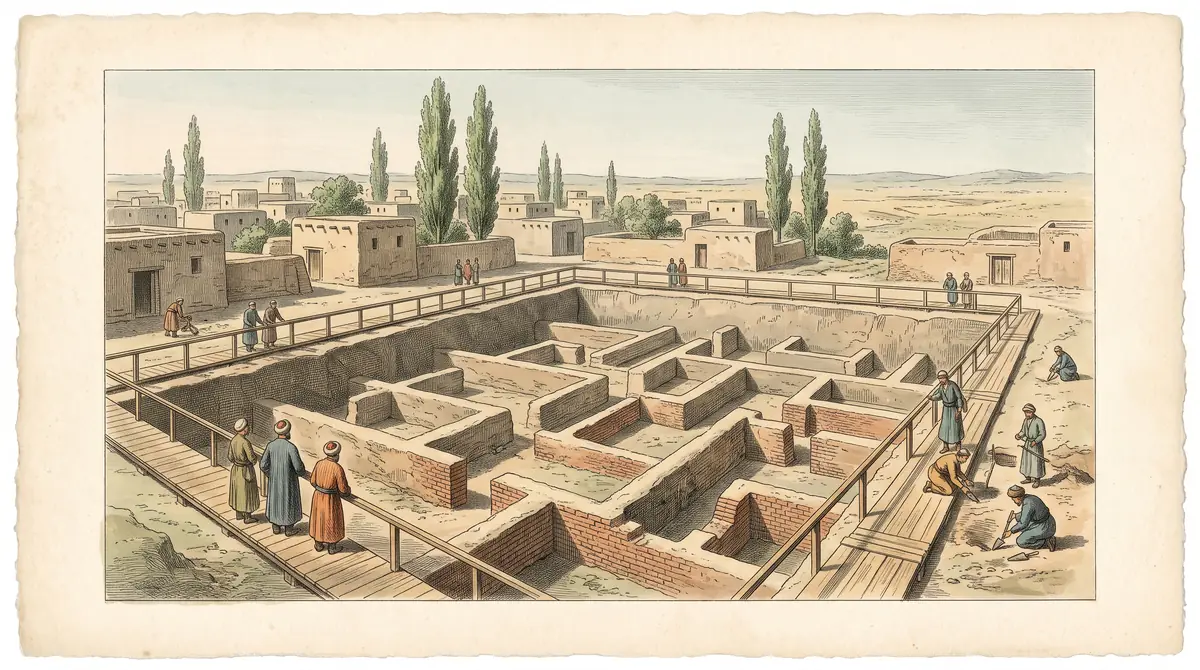
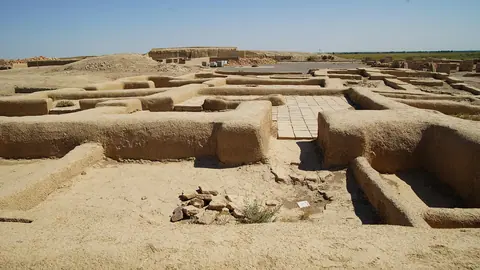
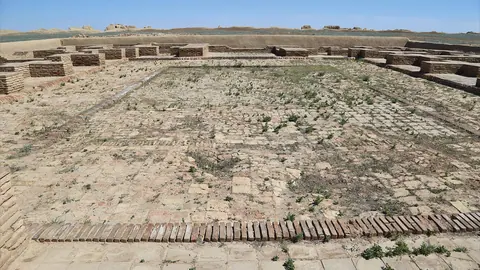
The medieval town lies under the former Green Bazaar. Markets were moved in 2012–2014 so the layers could be dug and shown to visitors.
Karakhanid capital at its peak
In the 11th–12th centuries Taraz had terracotta water pipes, paved streets, sewage collection and a multi-domed bathhouse of fired brick.
Taraz without a car
Flights from Almaty and Astana, a Talgo train from Astana in around 12 hours, and minibuses from Almaty in about 6 hours make the trip simple.
Spring and autumn in Taraz
May and September average about 25.5 °C by day. July reaches about 33.5 °C with almost no rain, which is hard going on an open site.
A date the sources dispute
Xuanzang's visit to Taraz is dated 629 or 630 by English Wikipedia and 485 by Russian Wikipedia. The 8–9 li city size matches in both.
Ancient Taraz in photos
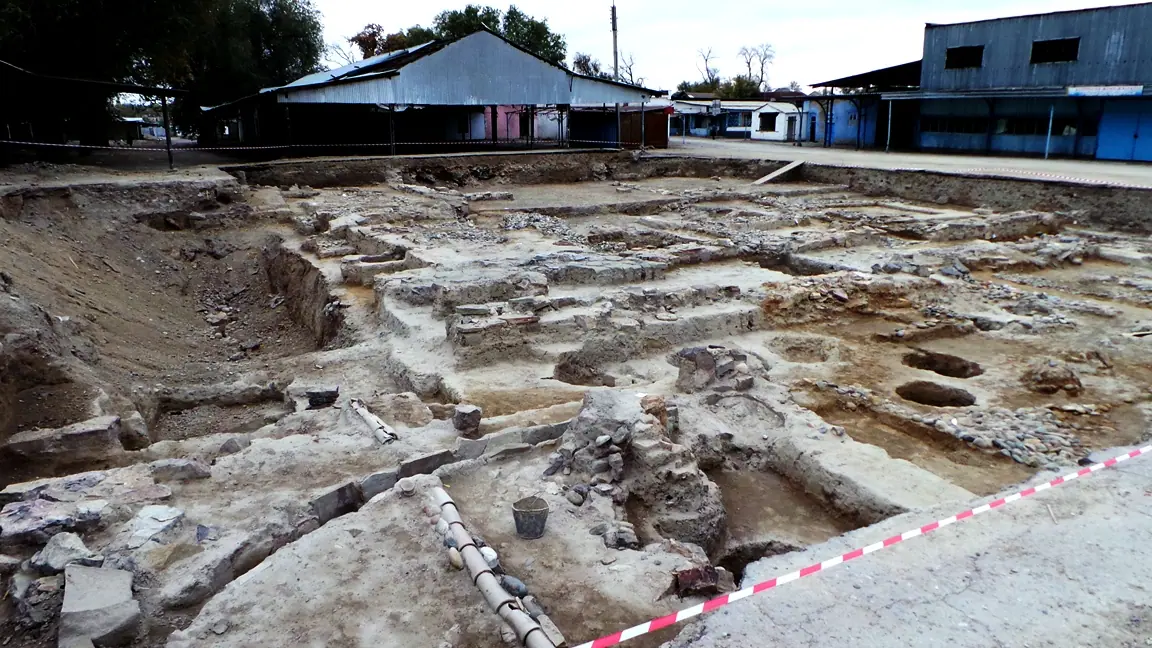
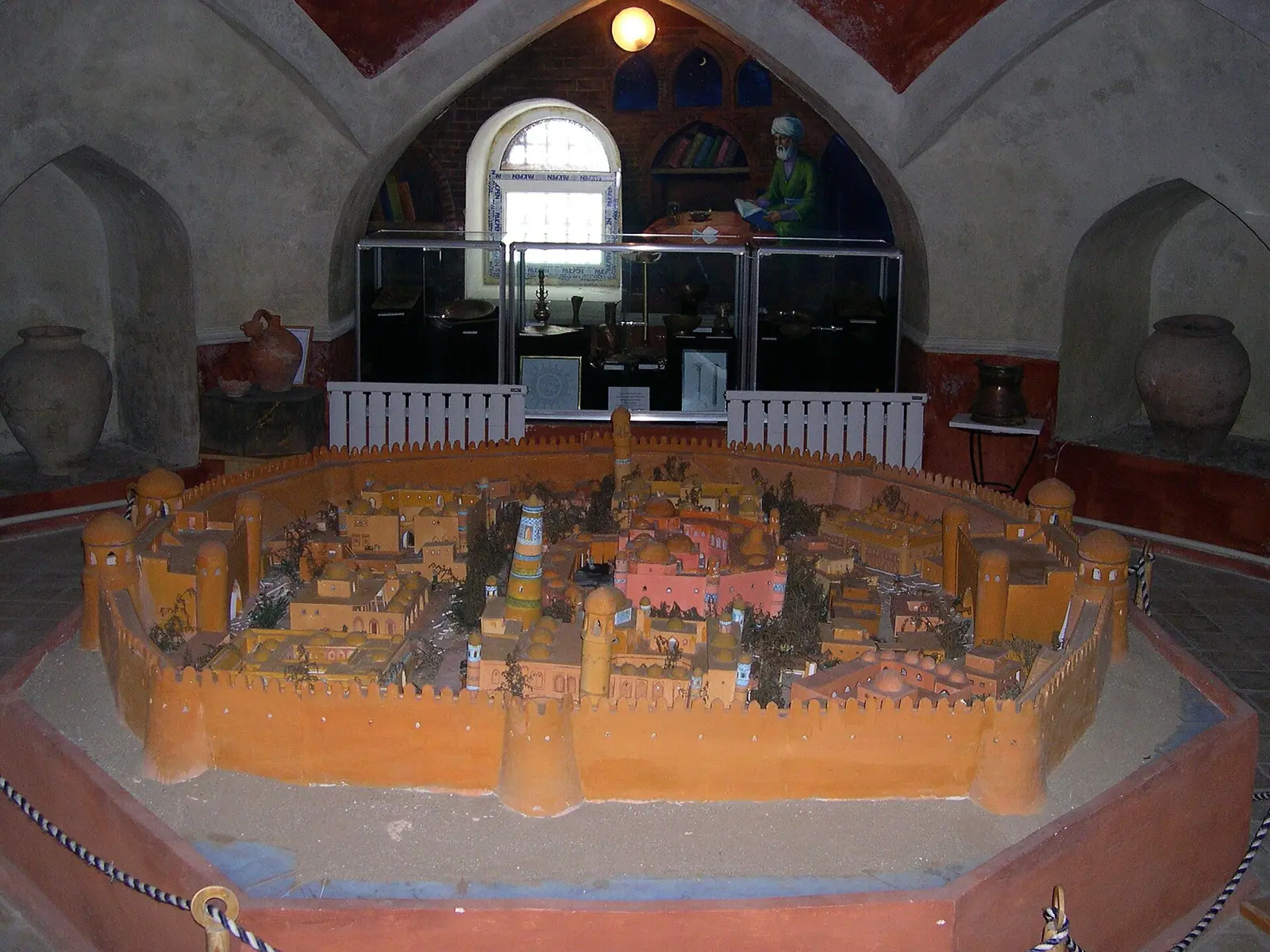
Real photos by travellers (Pexels, Unsplash, Wikimedia Commons); author and licence are given in each caption.
Ancient Taraz is the medieval Silk Road city that lies under the centre of present-day Taraz, in southern Kazakhstan near the Kyrgyz border. The site sat under a busy market for decades. The market was moved in 2012–2014 so the old city could be excavated and opened to visitors. It is a city visit, easy to reach by plane or train, and best combined with the mausoleums around Taraz.
What Ancient Taraz is and where to find it
Ancient Taraz is an excavated layer of the medieval city in the historic core of modern Taraz, the capital of Jambyl Region. Its location was lost for centuries. Research by Wilhelm Barthold placed it under the Green Bazaar, the old central market. In 1938 an expedition of the USSR Academy of Sciences led by A. Bernshtam and G. Patsevich dug to a depth of 2–6 metres to reconstruct the town.
The Central, Shahristan and Tazhibay markets were relocated in 2012–2014 to make room for excavation and tourism. In 2019 part of Tole Bi avenue in the historic district became a pedestrian street with a museum called Ancient Taraz. Locals call this street the ‘arbat’. Expect an urban archaeological site inside a living city, not a ruin in open steppe.
Why the site matters: a timeline
Taraz was a major trading stop on the northern branch of the Silk Road. Its high point came under the Karakhanids in the 11th–12th centuries. The sources do not agree on several early dates, so the table below shows both versions where they differ.
| Period | What happened |
|---|---|
| 1st century BC | Fortress of the Xiongnu ruler Zhizhi in the Talas valley, the basis of the claim to 2,000 years |
| 400 or 568 AD | First written mention: Russian Wikipedia gives 400 (Greek ‘Tolosa’), English Wikipedia gives 568 (Menander Protector) |
| 629–630 | Buddhist monk Xuanzang describes a merchant city 8–9 li across (Russian Wikipedia gives 485) |
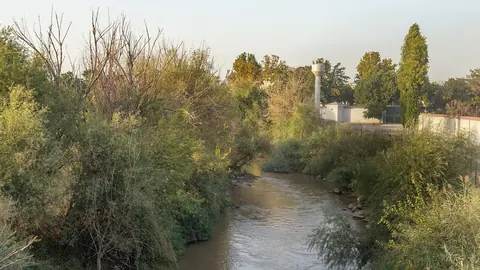
| 751 | Battle of Talas fought along the Talas River, upstream of the city |
| 893 | Samanids take Taraz; a large church becomes a mosque |
| 11th–12th c. | Karakhanid capital at its peak; Aisha Bibi and Karakhan mausoleums built |
| 1220 | Mongols destroy the city; excavations found burnt layers |
| 1864 | Russian troops take the Kokand fortress of Aulie-Ata |
| 1997 | City renamed Taraz after decades as Dzhambul/Zhambyl |
For the reader the key point is the Karakhanid layer. By English Wikipedia, the town of that era had underground water pipes of terracotta, paved streets and sewage collection, plus a multi-domed bathhouse of fired brick known as the Taraz Banya.
What else to see around Ancient Taraz
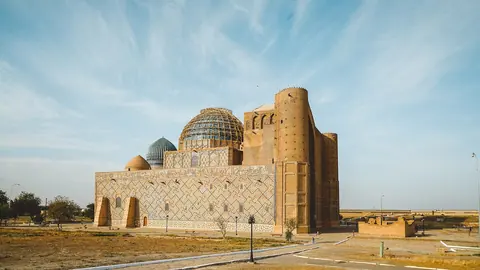
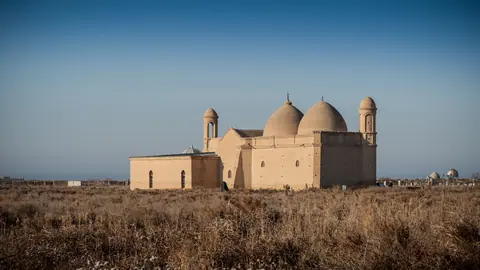
The excavated city is only one part of a day here. Several medieval monuments stand in and around Taraz. The Kazakh Wikipedia lists the mausoleums of Aisha Bibi, Babaji Khatun, Karakhan and Tekturmas, the Nametbay mosque and a medieval bathhouse. Outside the city, the same story continues at Kostobe and Akyrtas.
| Site | Where | Note |
|---|---|---|
| Karakhan mausoleum | City centre, near Dinamo stadium | Restored for the 2001 anniversary |
| Aisha Bibi mausoleum | About 18 km west of Taraz | 11th or 12th century, restored in 2002; free entry by Wikivoyage (2018) |
| Dautbek Shamansur mausoleum | Taraz area | Linked to a Mongol governor by Wikivoyage |
| Ancient Taraz museum | Pedestrian part of Tole Bi | Opened with the street in 2019 |
Dress modestly and keep your voice down inside the mausoleums. A Sunday animal market is also described by Wikivoyage, if you want a look at the region’s livestock trade.
Getting to Taraz from Almaty, Astana and Shymkent
Taraz is about 450 km in a straight line from Almaty and about 157 km in a straight line from Shymkent. It can be reached without a car by plane, train or minibus.
| From | Option | Notes |
|---|---|---|
| Almaty or Astana | Plane to Taraz Airport (DMB) | Wikivoyage, updated 2020 |
| Astana | Talgo train | Around 12 hours |
| Almaty | Marshrutka minibus | About 6 hours, from the main bus station north-east of the centre (2019) |
| Shymkent, Bishkek | Collective taxi | From the taxi station north of the city |
The railway station is 2 km south of the centre, and Wikivoyage mentions bus 47 from the centre. Train tickets can be booked in advance online. Wikivoyage notes that waiters at one kebab restaurant do not speak English. Taraz also works as a stop on a southern route towards Turkistan, Otrar and Sauran.
When to go to Ancient Taraz
Late spring and early autumn are the comfortable months for walking an open excavation. The figures below are computed ERA5 reanalysis normals for 2011–2020 at a grid point at 639 m, not weather-station readings.
Day high, °C / Night low, °C · Rain/snow, mm
A computed reanalysis normal for these coordinates, not weather station records.
Monthly figures
| Month | Day high, °C | Night low, °C | Rain/snow, mm |
|---|---|---|---|
| Jan | 1.3 | -7.3 | 34.1 |
| Feb | 2.8 | -7 | 34.1 |
| Mar | 11.9 | 0.7 | 50.4 |
| Apr | 19.2 | 6.8 | 58.2 |
| May | 26 | 11.7 | 32.8 |
| Jun | 31.2 | 16.5 | 21.6 |
| Jul | 33.7 | 18.6 | 5.8 |
| Aug | 31.9 | 16.7 | 7.7 |
| Sep | 25.8 | 10.8 | 6.7 |
| Oct | 17.2 | 4.2 | 31.7 |
| Nov | 6.4 | -3.8 | 43.7 |
| Dec | 1.7 | -7 | 29.1 |
July averages a daytime high of about 33.7 °C, with almost no rain, and there is little shade on a dig site. May (about 26.0 °C) and September (about 25.8 °C) are warm but manageable. April is the wettest month at about 58 mm. From December to February days barely rise above freezing and nights fall to around −7 °C. Wikipedia records extremes of +43.7 °C and −40 °C and wind gusts up to 30–32 m/s.
Russian Wikipedia notes that phosphate plants in the city have worsened air quality at times. We could not confirm current conditions.
- Opening hours and ticket rules of the Ancient Taraz museum and excavation area
- Whether the excavated zone can be walked freely or only viewed from set points
- Whether there are signs or guides in English
- Current flight and minibus schedules to Taraz, since the details are from 2019–2020
- Current air quality in the city
Ancient Taraz: tips before you go
- Visit the Karakhan mausoleum near Dinamo stadium on the same walk: it is in the city centre, close to the old core.
- Plan a separate trip to Aisha Bibi, about 18 km west of Taraz; Wikivoyage reported free entry in 2018.
- Avoid midday in July and August: highs average about 32–33.5 °C and there is little shade on an excavation.
- Taraz railway station is 2 km south of the centre; Wikivoyage lists bus 47 as the link.
More to see nearby


Frequently asked questions
How old is Ancient Taraz?
Is Ancient Taraz in the modern city?
How far is Taraz from Almaty?
Where was the Battle of Talas fought?
How far is the Aisha Bibi mausoleum from Taraz?
Sources
Read also
 Almaty Zoo in Kazakhstan: opening hours and how to visit
 Ayusai Gorge, Almaty: visitor centre and waterfall trail
 Gorelnik Gorge above Medeu: waterfalls, trail and season
 Kamenskoe Plateau above Almaty: observatory and trails
 Pervomaiskie Ponds near Almaty: location, swimming, season
 Saty village: base for the Kolsai and Kaindy lakes