Alasha Khan Mausoleum: when to go, month by month
- January: off season
- February: off season
- March: off season
- April: possible
- May: best time
- June: good
- July: good
- August: good
- September: best time
- October: possible
- November: off season
- December: off season
May and September have mild highs around 20–22°C, summer is hot and shadeless, and winter stays well below freezing.
Alasha Khan Mausoleum: why go
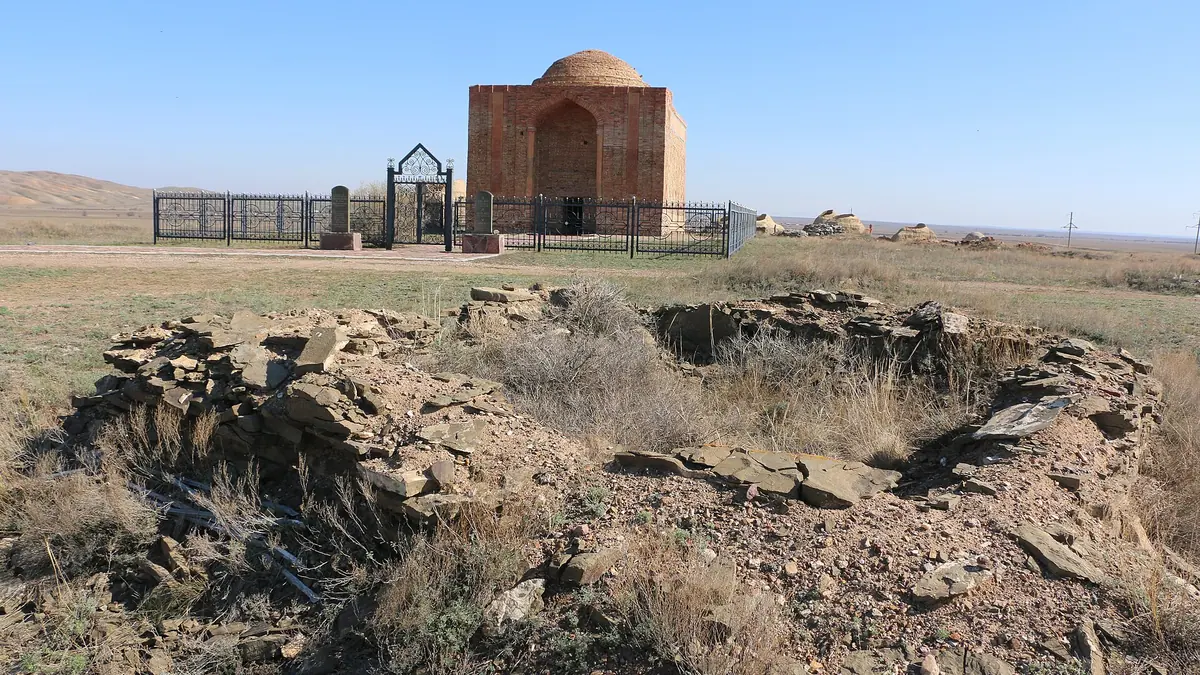
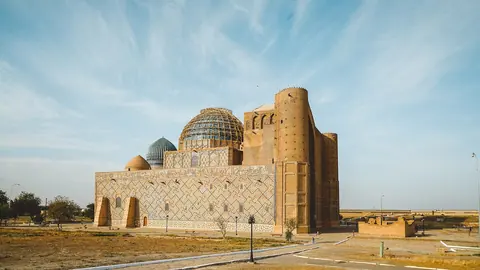
Alasha Khan's patterned brick walls
Coloured and shaped bricks cover every surface in geometric patterns compared to a carpet, on a tomb 9.73 × 11.9 m in plan and 10 m high.
Columns on three hemispheres
Hexagonal columns flank the facade, each resting on three hemispheres, a feature described as very rare in Central Asian architecture.
A steppe detour from Zhezkazgan
The site lies about 66 km in a straight line from Zhezkazgan and about 68 km from the Ulytau mountains, with no confirmed public transport.
Short seasons on the open steppe
May and September bring average highs of about 22°C and 20°C; January highs average -9°C and July highs near 29.5°C.
A date nobody agrees on
Estimates for the Alasha Khan Mausoleum run from the 10th–11th century to the 15th–16th, even within the same encyclopedia article.
Alasha Khan Mausoleum in photos
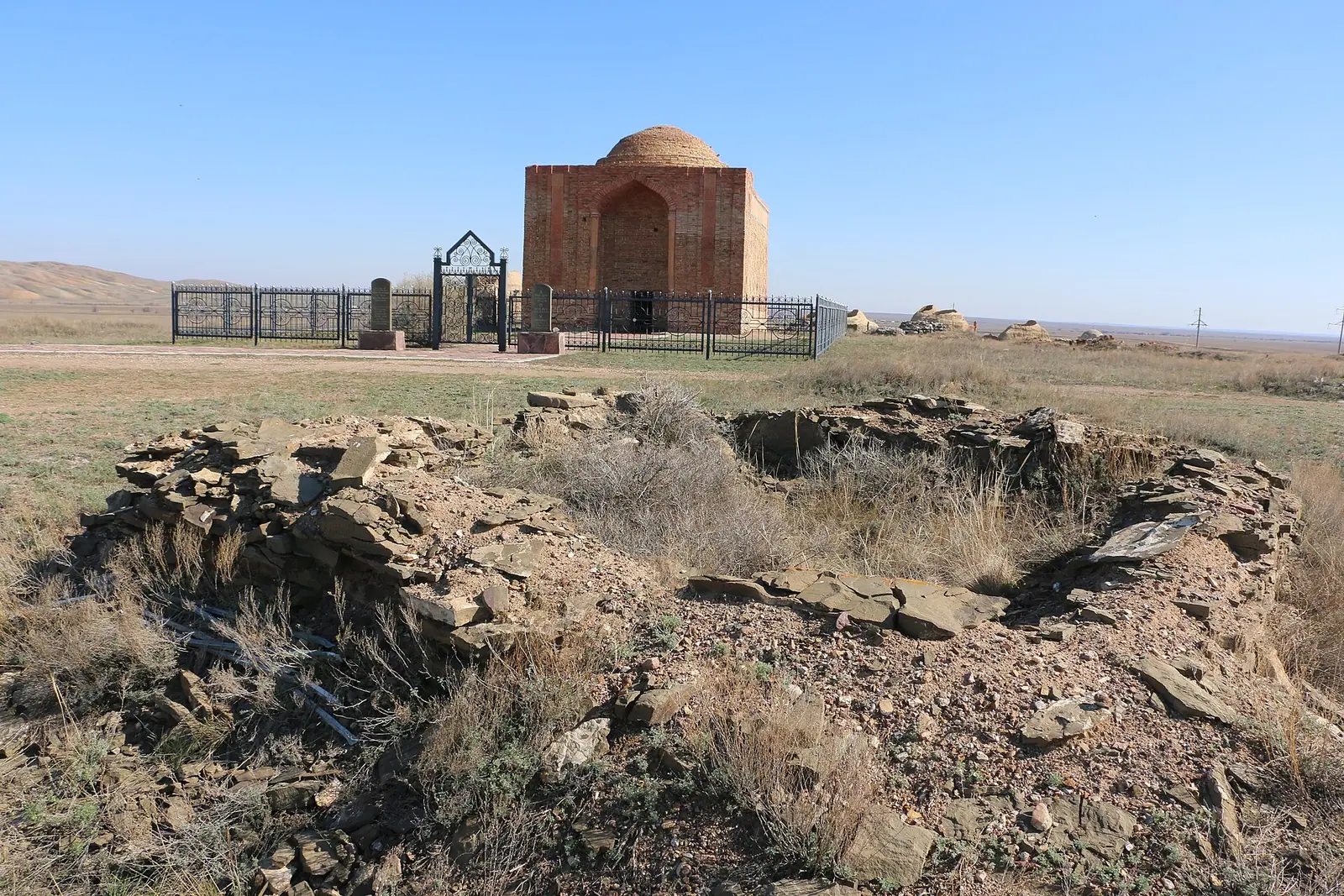
Real photos by travellers (Pexels, Unsplash, Wikimedia Commons); author and licence are given in each caption.
The Alasha Khan Mausoleum (Alasha Khan kumbezi in Kazakh) is a red brick domed tomb in the Ulytau district of central Kazakhstan, 2 km south-south-west of the village of Malshybai on the right bank of the Karakengir river. It is a remote site with no confirmed public transport, best combined with a wider trip to the Ulytau area. Go for the brickwork itself: walls laid in coloured, shaped bricks to look like an oriental carpet.
Where it is and what kind of trip it takes
The mausoleum lies deep in the central steppe, far from both of Kazakhstan’s main cities. The nearest town in our distance list is Zhezkazgan, about 66 km in a straight line; Astana is about 405 km and Karaganda about 415 km away, again in a straight line. Road distances will be longer, and we could not confirm the road condition to Malshybai.
For a visitor without a car or Russian, this is the hard part. We could not confirm any bus, taxi or shared-transport route to the site, so plan on arranging a driver from Zhezkazgan or visiting as part of a wider trip. The Ulytau mountains, about 68 km away in a straight line, are the natural pairing.
How old it is: the sources disagree
There is no agreed date. The Russian Wikipedia article calls it a 10th–11th century monument. The Kazakh Wikipedia article opens by calling it a 15th–16th century work of folk masters, then says scholars place it in Karakhanid, Oghuz-Kipchak era architecture of the 10th–13th centuries, while some researchers argue for the 15th–16th.
| Claimed date | Where it comes from |
|---|---|
| 10th–11th century | Russian Wikipedia |
| 10th–13th century (Karakhanid, Oghuz-Kipchak era) | Kazakh Wikipedia, citing scholars |
| 15th–16th century | Kazakh Wikipedia, as an alternative view |
For the traveller this means one thing: treat any single date you see on a sign or in a brochure as one opinion. The architect is unknown.
What you will see: the building in numbers
The tomb is a portal-and-dome building, rectangular in plan and modest in size, so a visit is short unless you study the details.
| Feature | Detail |
|---|---|
| Plan | 9.73 × 11.9 m |
| Height | 10 m |
| Material | Fired red brick; wood only for window and door frames |
| Entrance door | 2 m high, 1.2 m wide |
| Walls | Braced by eight buttresses |
| Dome | Rests on a 16-sided drum about 2.3 m high, with a circular gallery |
On the main facade a double-leaf door opens onto a deep two-arched niche framed by a recessed two-colour band and figured bricks. Hexagonal columns stand on either side, each resting on three hemispheres, a style the Russian article calls very rare in Central Asian architecture. The upper parts of the portal arch and side towers are lost, and nothing is left of the glazed tile facing on the portal and dome.
Why the brickwork matters
The ornament is the reason to make the detour. Bricks of different colours and sizes are laid to form geometric patterns across every surface, which the Kazakh article compares to a carpet. Brick sizes vary, for example 320 × 320 × 60 mm.
The Kazakh article links the style to Seljuk-period architecture found mostly in Turkmenistan, and compares the building with the Aisha Bibi, Jochi Khan and Khoja Ahmed Yasawi mausoleums, and especially Kok Kesene near ancient Syganak. It also says this patterning became a model for later local tombs such as Talmas Ata, Zhuban Ana, Bolgan Ana and Kaiyp Ata. If you are also heading south to Turkistan, seeing both gives a sense of how Kazakh tomb architecture developed.
A place of respect, studied since the 19th century
Early records of the mausoleum come from Russian travellers, surveyors and military men. Chokan Valikhanov mentioned it in his article on Kazakh graves and antiquities, and later accounts by Yu. A. Schmidt and N. I. Krasovsky, and volume 18 of the Complete Geographical Description of Russia, note its veneration by local people.
In 1982 it was listed as a historical and cultural monument of national significance and placed under state protection. A modern gravestone with inscriptions in Cyrillic and Old Turkic stands to the south-west. Treat the site as a grave as well as a monument: quiet behaviour and modest dress are the safe default.
The Kazakh article describes a narrow stairway in the left corner of the entrance leading up to the drum gallery and the roof. We could not confirm whether visitors are allowed to use it; given the building’s age and protected status, do not assume so.
When to go
Late spring and early autumn are the comfortable windows for this exposed steppe site.
Day high, °C / Night low, °C · Rain/snow, mm
A computed reanalysis normal for these coordinates, not weather station records.
Monthly figures
| Month | Day high, °C | Night low, °C | Rain/snow, mm |
|---|---|---|---|
| Jan | -9.9 | -17.4 | 13.2 |
| Feb | -8.7 | -17.6 | 15.6 |
| Mar | 1.9 | -8.1 | 21.8 |
| Apr | 15.4 | 2.5 | 24.1 |
| May | 22.7 | 8.3 | 17.9 |
| Jun | 27.9 | 14 | 17.6 |
| Jul | 29.8 | 16 | 18.1 |
| Aug | 28.1 | 14.3 | 14.5 |
| Sep | 20.9 | 7.4 | 11 |
| Oct | 11.5 | -0.1 | 14.8 |
| Nov | -0.4 | -8.2 | 20.3 |
| Dec | -7.9 | -14.9 | 21.7 |
These figures are ERA5 reanalysis normals for 2011–2020 at a grid point at 428 m, not a weather station. Winters are severe: daytime highs stay below freezing from November to February, with January nights around -17°C. July is the warmest month, with average highs near 29.8°C and little shade on the ridge. May and September, with highs of about 23°C and 18°C, are the easiest months. Rainfall is low all year, with no month above about 25 mm.
- Road distance and road condition from Zhezkazgan to Malshybai
- Any public transport or taxi option to the site
- Whether visitors may enter the interior or use the stairway to the gallery
- Any entry fee, opening hours or on-site facilities
Alasha Khan Mausoleum: tips before you go
- Arrange transport from Zhezkazgan in advance: we found no confirmed public route to Malshybai, about 66 km away in a straight line.
- In July average highs near 29.5°C on an exposed ridge mean carrying water and sun cover is justified.
- Avoid November to February: average daytime highs stay below freezing and January nights fall to around -17°C.
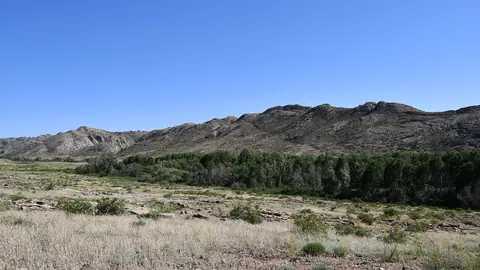
- Combine the visit with the Ulytau mountains, about 68 km away in a straight line, to make the long drive worthwhile.
More to see nearby


Frequently asked questions
What is Alasha Khan kesenesi?
How old is the Alasha Khan Mausoleum?
How far is the Alasha Khan Mausoleum from Zhezkazgan?
Is the mausoleum protected?
Sources
Read also
 Almaty Zoo in Kazakhstan: opening hours and how to visit
 Ayusai Gorge, Almaty: visitor centre and waterfall trail
 Gorelnik Gorge above Medeu: waterfalls, trail and season
 Kamenskoe Plateau above Almaty: observatory and trails
 Pervomaiskie Ponds near Almaty: location, swimming, season
 Saty village: base for the Kolsai and Kaindy lakes