Visiting the Aisha Bibi Mausoleum, a carved terracotta tomb outside Taraz: when to go, month by month
- January: possible
- February: possible
- March: possible
- April: good
- May: best time
- June: good
- July: possible
- August: possible
- September: best time
- October: good
- November: possible
- December: possible
May and September bring highs around 24 °C on an exposed outdoor site, while July nears 32 °C and winter highs stay close to freezing.
Visiting the Aisha Bibi Mausoleum, a carved terracotta tomb outside Taraz: why go
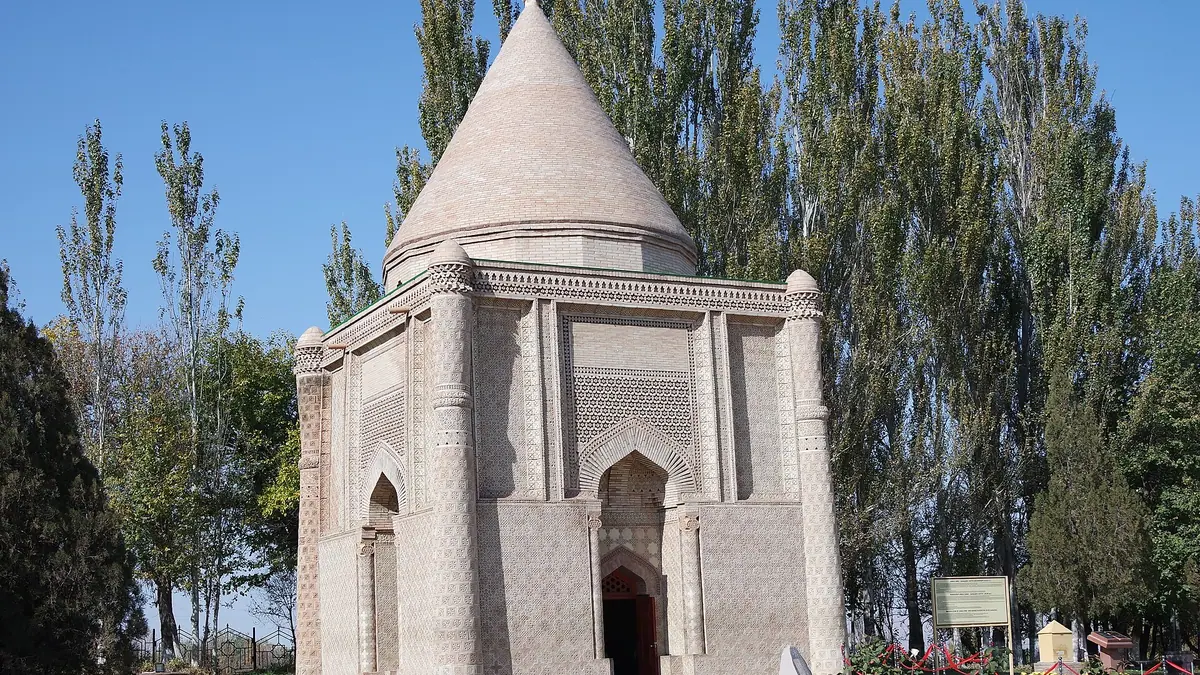
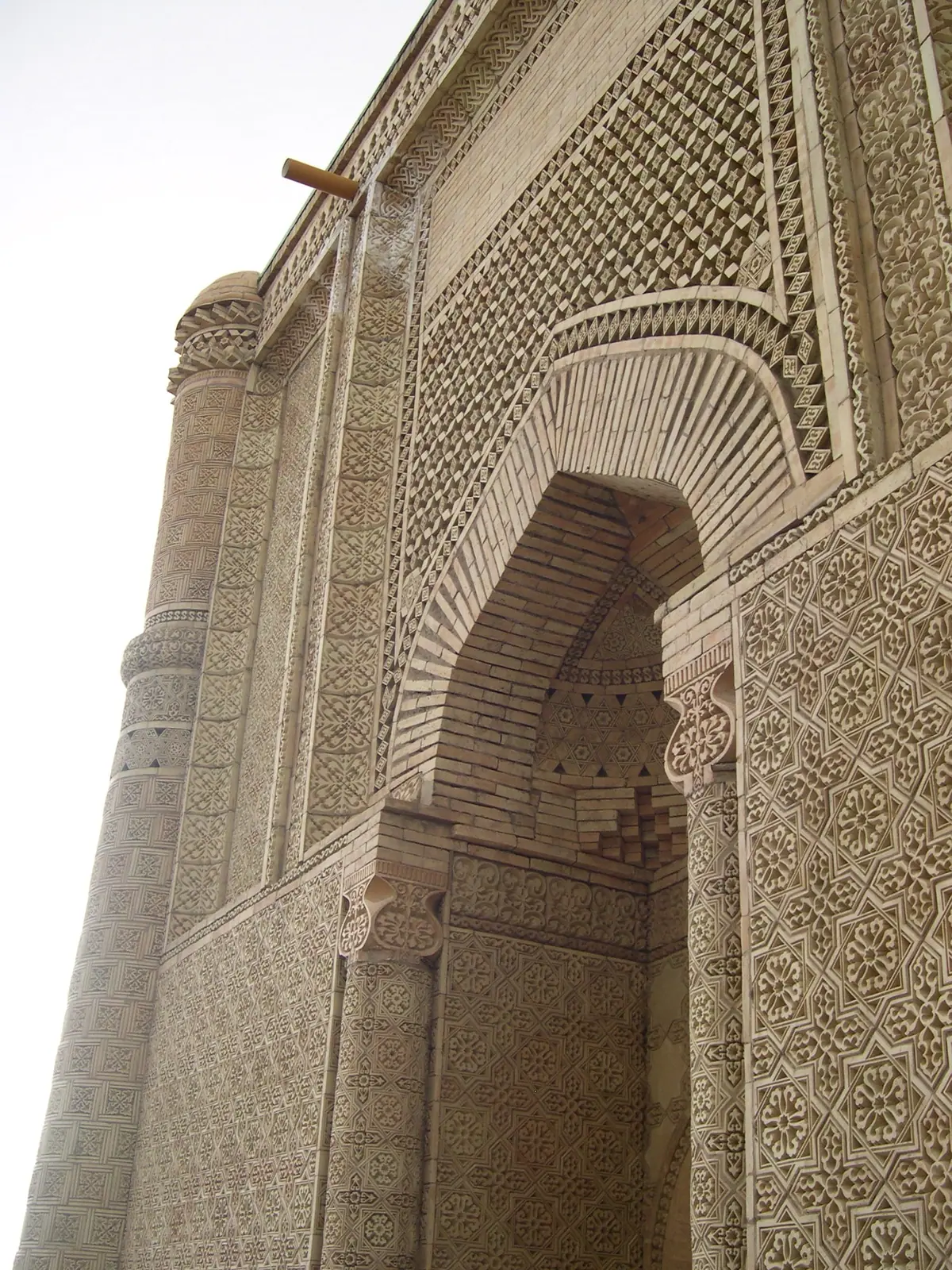
Aisha Bibi's terracotta walls
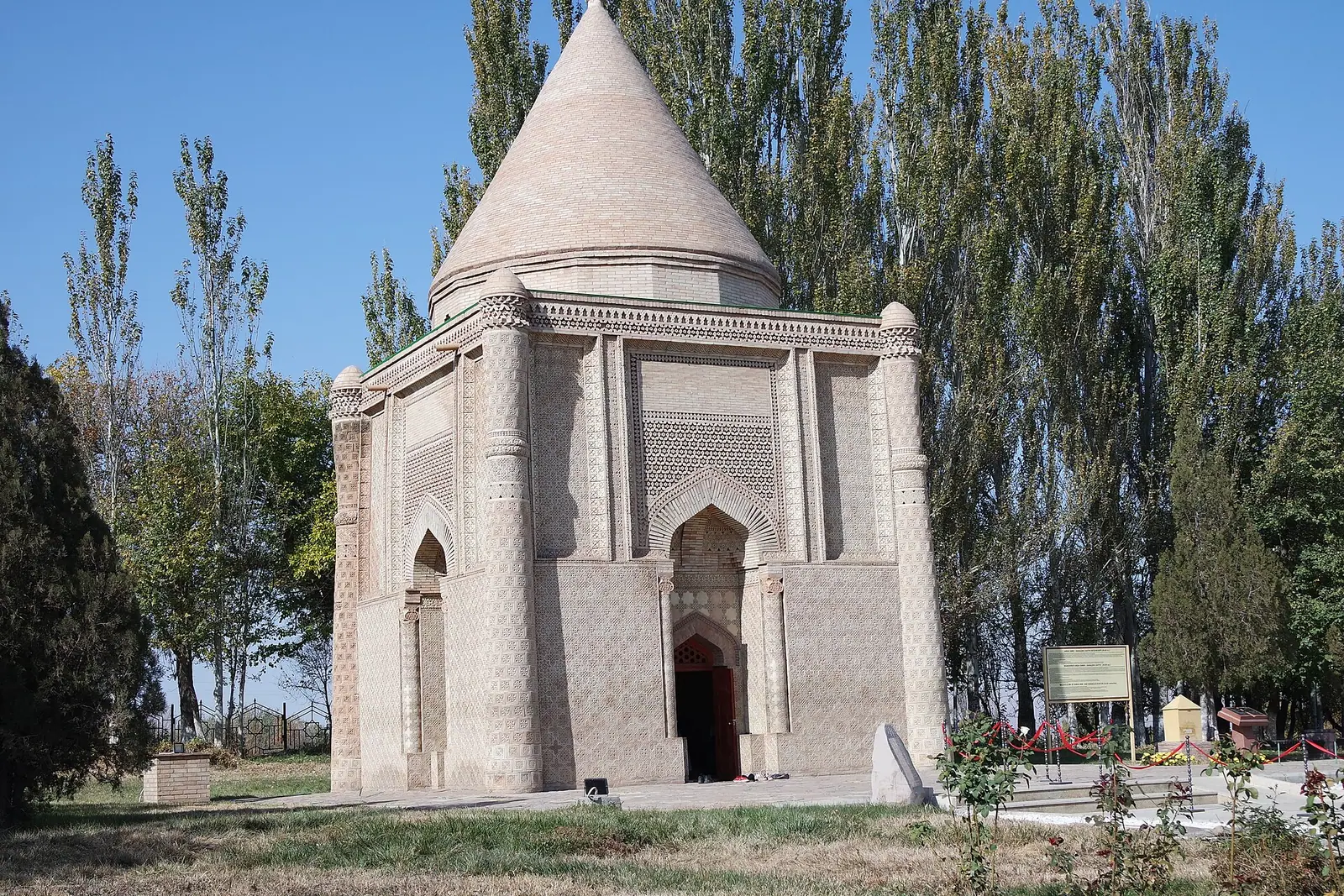
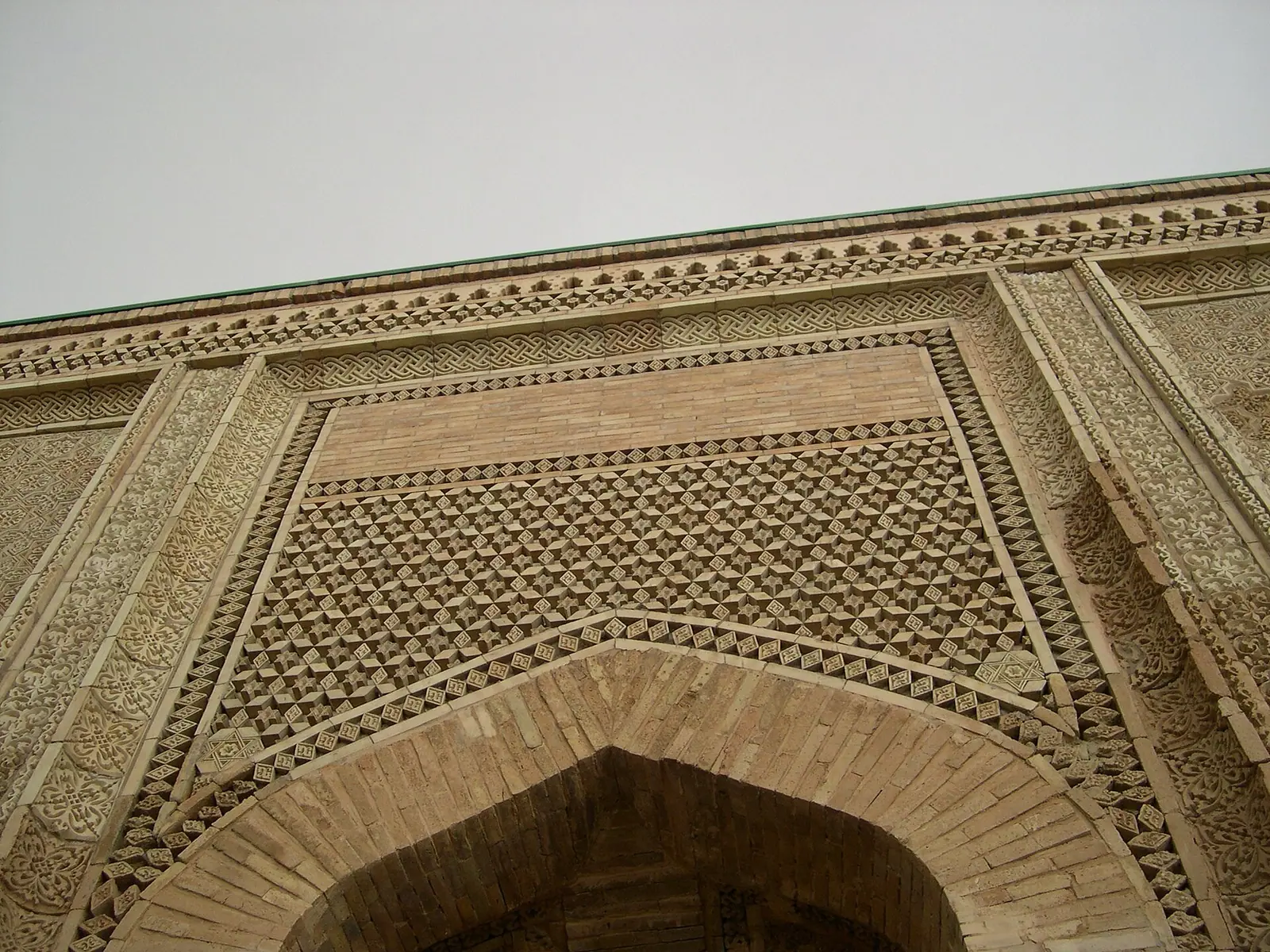
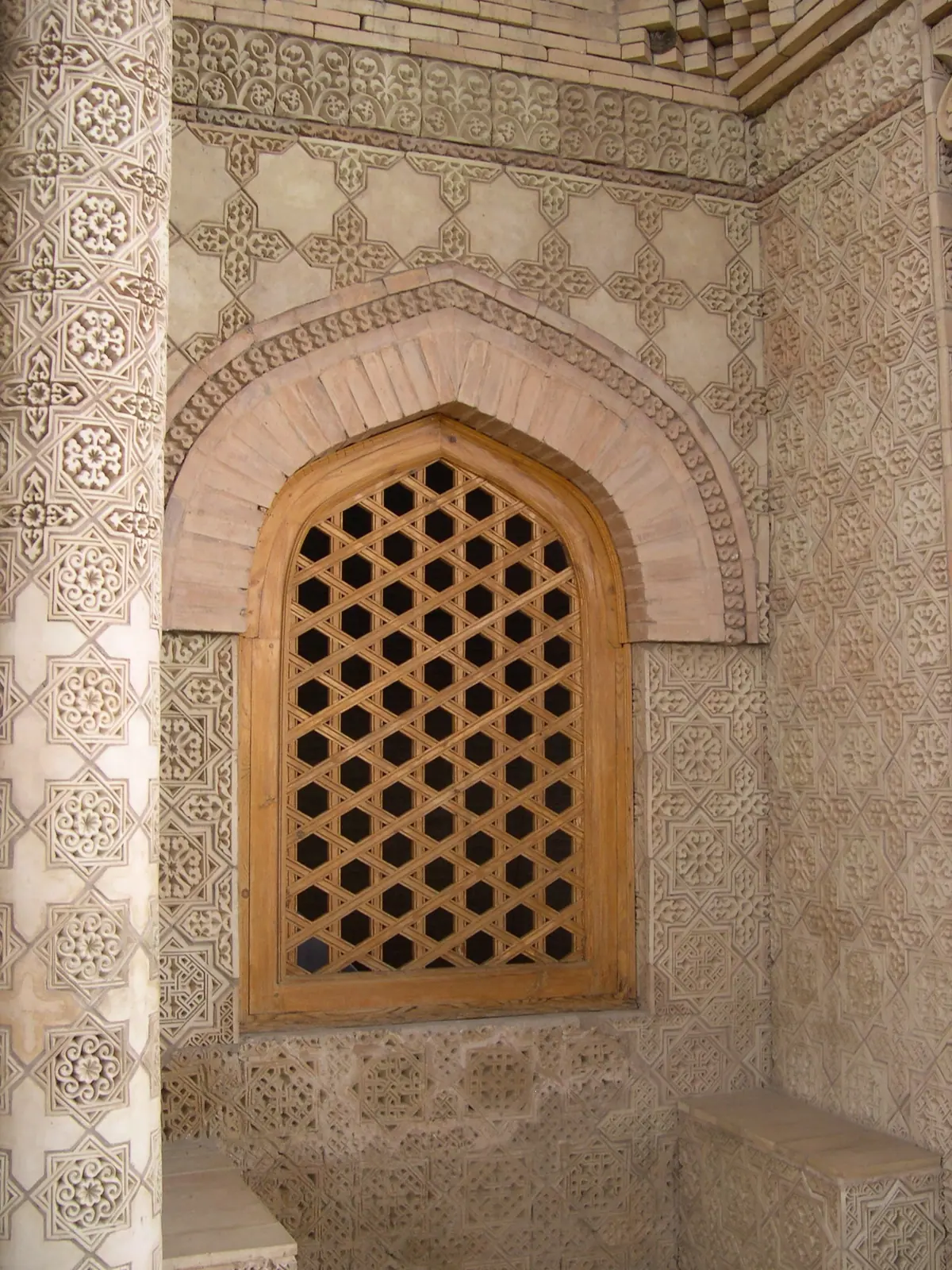
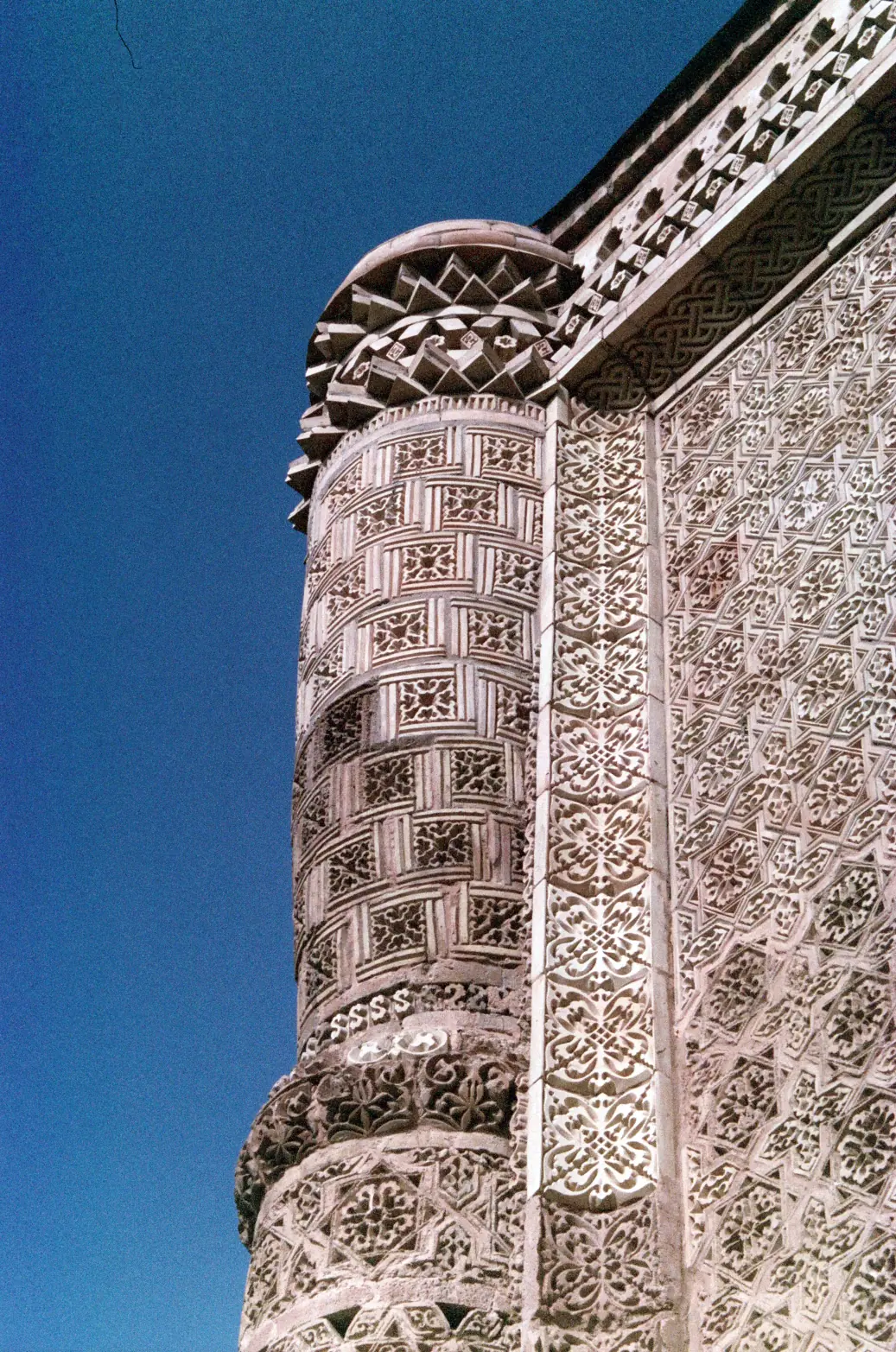
The whole exterior is faced with carved clay tiles in more than 60 patterns, including ram's horns and six-pointed stars. The decoration uses shadow rather than colour.
The original western façade
Only the west wall and a few fragments survived. The rest was rebuilt in 2002–2005, so the west side is where the medieval work stands.
From Karakhan to Aisha Bibi
Wedding parties from Taraz travel from the Karakhan Mausoleum in the city to this tomb, re-enacting the ruler's journey to his dying bride.
Mild May and September days
Highs are near 24 °C in May and September, against 32 °C in July. The ridge-top site has little shade, so these months suit an outdoor visit.
A poem on the Aisha Bibi columns
A Kufic inscription band runs 3.4 m up the western columns. Its surviving words read "Autumn... Clouds... The Earth is beautiful".
Visiting the Aisha Bibi Mausoleum, a carved terracotta tomb outside Taraz in photos
Real photos by travellers (Pexels, Unsplash, Wikimedia Commons); author and licence are given in each caption.
The Aisha Bibi Mausoleum is an 11th or 12th century tomb in the village of Aisha Bibi, 18 km from the city of Taraz in Zhambyl Region, southern Kazakhstan. It is small, about 7.6 metres square, but its walls are covered in carved terracotta tiles in more than 60 patterns. Most of what you see today is a 2002–2005 restoration, so it suits travellers interested in Silk Road architecture and living tradition rather than untouched ruins.
A Silk Road tomb on a ridge above the Taraz oasis
The mausoleum stands on a ridge overlooking the Taraz oasis from the west, in a village that shares its name. Russian, Kazakh and English Wikipedia all give 18 km from Taraz, and English Wikipedia places it west of the city; in a straight line it is about 15 km. It sits on the old Silk Road and dates to the Karakhanid period. Sources differ on the exact century: Russian Wikipedia says the 12th, English Wikipedia says the 11th or 12th.
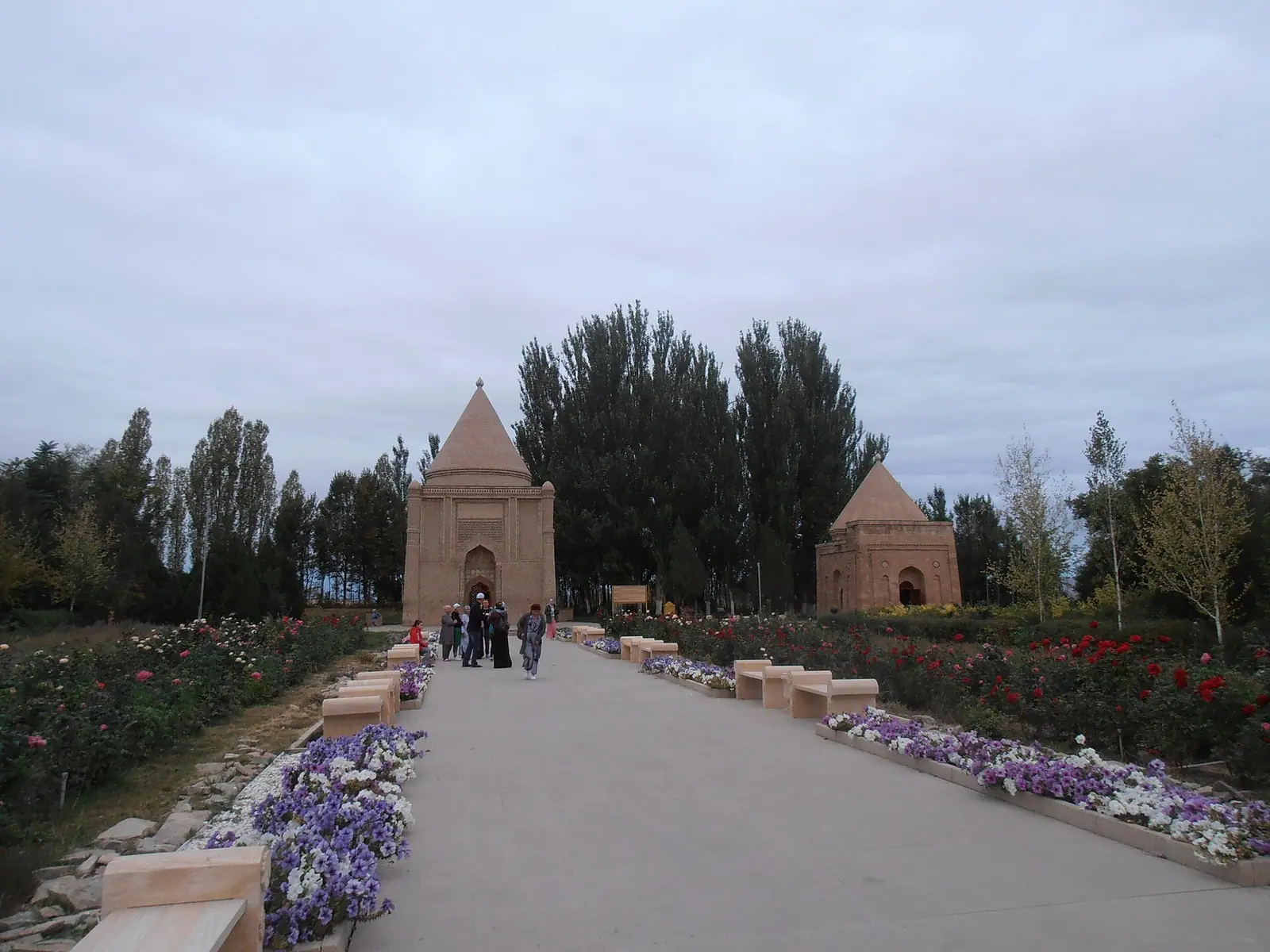
It is not a lone building. About ten metres away stands a second tomb, Babaji Khatun (Russian Wikipedia says twenty paces), and across the road is a sacred limestone cavern. With a garden and a parking area, they form one protected monument. The tomb has been listed as a monument of national significance since 1982.
The carved terracotta is the reason to come
What sets Aisha Bibi apart is its cladding: by Russian Wikipedia, it is the only architectural monument in Kazakhstan fully faced with carved terracotta tiles. The decoration works with light and shadow rather than colour, a pre-Mongol approach, and English Wikipedia calls it a direct stylistic descendant of the Samanid Mausoleum in Bukhara.
| Feature | Detail |
|---|---|
| Plan | Square, 7.6 × 7.6 m, entrance on the east |
| Walls | 80 cm thick: fired brick inside, carved tiles outside, clay and broken tiles in between |
| Reinforcement | Juniper wood beams laid inside the walls |
| Ornament | More than 60 patterns: geometric, plant forms, stylised ram’s horns, six-pointed stars |
| Inscription | Kufic band on the western columns at 3.4 m; surviving words read “Autumn… Clouds… The Earth is beautiful” |
| Tombstone | 3 × 1.4 m, in the centre |
With a site this small, these details are the visit. Look at the lower panels for the ram’s-horn motif radiating in four directions, and at the corner columns. They narrow towards the top, carry a band of plant ornament and end in a flared rim. The columns copy the wooden pillars of pre-Islamic Sogdian buildings.
Most of it is a restoration, and that is worth knowing beforehand
Only the western façade wall and small fragments of the other walls survived into modern times. The rest was rebuilt in 2002–2005 by the state restoration body Kazrestavratsiya, after the restorer Nishan Rameto was hired in 2002. The same project built the park around it.
If you expect a weathered medieval ruin, the crisp new walls may disappoint. If you want to see how the tomb was meant to look, the restoration helps. English Wikipedia notes that clay from Sauran was used for both the original and the restored bricks. Seek out the western side: that is the original medieval work.
The tomb has been studied for a long time. Chokan Valikhanov drew it in 1856. The archaeologist Vasily Bartold made the first study in 1893, and expeditions followed in 1897, 1938–1939 and 1953. Excavations in 1953 and 1962 showed that the tiles and bricks were made on site. Around 1960 a glass shell was built over the ruin to protect it.
The legend of Aisha Bibi exists in 28 versions
No reliable record of the tomb’s construction survives, but the love story behind it is told in 28 versions, according to Russian Wikipedia. In the best-known versions, a young woman sets out to marry the ruler of Taraz against her guardian’s wishes, and a snake hidden in her clothes or headdress bites her on the bank of the Assa River. The grieving ruler raises the tomb where she died.
| Point | Most common version (Russian Wikipedia) | English Wikipedia |
|---|---|---|
| Her father | Scholar and poet Suleiman Bakyrgani | Sufi poet Khakim-Ata |
| Her home | Raised by Sheikh Aikhoja after her father’s death | Otrar |
| Companion | Babaji Khatun, later keeper of the tomb | Her wet nurse |
| Her age | Not given | 16 |
In a second version, the ruler Karakhan arrives with healers and mullahs. When nothing can save her, he has a mullah marry them and calls out three times that Aisha has become “bibi”, a married woman. The historian Bayan Tuyakbayeva points to a possible real event: in 1034 the daughter of the ruler of Talas died on her way to a fiancé in Ghazna. If the legend’s Otrar link interests you, see the Otrar page.
A working shrine, not only a monument
The site has been venerated since the Middle Ages and is still in active use. Women from the Taraz oasis come to pray for children and a happy family. Newlyweds from Taraz have their marriage blessed here. The wedding party retraces Karakhan’s route, starting at the Karakhan Mausoleum in Taraz and ending at Aisha Bibi, where the couple honour the two lovers at each tomb.
You may share the site with a wedding group. Keep a respectful distance, as you would at any shrine. The Karakhan Mausoleum in Taraz pairs naturally with this visit, because the ritual links the two.
When to go: May and September are the comfortable months
The climate figures below are 2011–2020 normals from the ERA5 reanalysis for a grid point at 696 m near the site, not readings from a weather station.
Day high, °C / Night low, °C · Rain/snow, mm
A computed reanalysis normal for these coordinates, not weather station records.
Monthly figures
| Month | Day high, °C | Night low, °C | Rain/snow, mm |
|---|---|---|---|
| Jan | 2 | -6.4 | 47.5 |
| Feb | 3.4 | -5.7 | 55.6 |
| Mar | 11.5 | 1.1 | 93.5 |
| Apr | 18.6 | 6.7 | 107.2 |
| May | 24.8 | 11.1 | 55.7 |
| Jun | 29.3 | 15.3 | 29.7 |
| Jul | 31.8 | 17.4 | 8.3 |
| Aug | 30.1 | 15.8 | 14.8 |
| Sep | 24.5 | 10.8 | 18.8 |
| Oct | 16.7 | 4.5 | 49.5 |
| Nov | 7.1 | -2.6 | 66 |
| Dec | 2.6 | -6.1 | 51.7 |
The visit is mostly outdoors with little shade on the ridge, so heat matters. July averages 32 °C at midday and August 30 °C. In May and September daytime highs are about 24 °C, which makes them the easiest months. April and October, at about 17–19 °C, are also fine, though April is wet: March and April are the rainiest months, at roughly 80 mm each. From December to February highs stay around 3 °C and nights fall to about −7 °C, so a winter stop is possible but brief. Summer is very dry, with under 15 mm a month from July to September.
Getting there and fitting it into a trip
Taraz is the natural base: the tomb is about 15 km from the city in a straight line. The tomb itself is far from Almaty, about 464 km in a straight line. Shymkent is closer, at about 143 km, and Turkistan about 246 km. In practice, Aisha Bibi fits a southern Kazakhstan route rather than a day trip from Almaty.
We could not confirm any public transport to the village, a road distance, or opening hours. Plan on arranging a ride from Taraz and confirming the return before you set off. Further along a southern Kazakhstan route lie Turkistan, about 246 km away in a straight line, and the ruined city of Sauran, the source of the clay used in the restoration.
- Opening hours of the complex and whether entry is charged
- Public transport from Taraz to Aisha Bibi village and the road distance
- Whether there are rules on dress or photography inside the tomb
- Visitor facilities at the site beyond the garden and parking area
Visiting the Aisha Bibi Mausoleum, a carved terracotta tomb outside Taraz: tips before you go
- Walk round to the western wall first: it is the only original façade, while the other walls date from the 2002–2005 restoration.
- Combine the visit with the Karakhan Mausoleum in Taraz, the starting point of the newlyweds' ritual route to Aisha Bibi.
- Avoid July midday visits: average highs reach 32 °C and the ridge-top complex offers little shade.
- Look across the road for the sacred limestone cavern, which is part of the same protected complex.
More to see nearby


Frequently asked questions
How far is Aisha Bibi from Taraz?
How old is the Aisha Bibi Mausoleum?
What is the legend of Aisha Bibi in short?
Who is buried next to Aisha Bibi?
Why do newlyweds visit Aisha Bibi?
Sources
Read also
 Domalak Ana Mausoleum, a revered shrine on the southern slope of the Karatau
 Beket-Ata underground mosque at Oglandy
- Sacred places of Kazakhstan and how to choose which to visit
- Mosques in Kazakhstan: which to visit and how to behave inside
 Shopan-Ata: a rock-cut mosque and old necropolis in Mangystau
- The Mausoleum of Khoja Ahmed Yasawi and the other shrines and Silk Road cities of Kazakhstan